
xuán
Perhaps it’s wrong for a translator to have favorites… but xuán (玄) makes me swoon. Look at the Western Zhou Bronze Inscription above. Think about the idea that Lâozî probably wrote it just like that! It’s soooooooo evocative. Even six centuries later, the Small Seal Script detailed in the Shuowen Jiezi drew it pretty similarly:

We talked about this character a little in the post about the mysterious feminine essence—and indeed those two characters occur together again in Chapter 15. You can see how they definitely share an invisible cosmic nature. As you recall, the modern definitions of xuán are deep, profound, and mysterious. I would say translators of the Dào do most commonly use mysterious, mysteriously. or mystery, but they also famously and commonly translate xuán as darkness, primal, inner, hidden, supreme, and profound depending on the context. Ahem. Notice how I’m not giving a sermon about how much I dislike inconsistencies of this sort? I call that progress!
What doubly intrigued me about this character the first time I delved into its roots was the description of this glyph as “a string, dyed black.” And then of course I was taken with the string’s figure-eight shape. I immediately thought of the infinity symbol, and my first translation quite romantically included that image. To be fair, I didn’t think it was right to call it a figure-eight since Arabic numerals weren’t introduced to China until sometime between 1271 and 1368 AD—way after Lâozî’s time. But upon further research, I can’t find reliable evidence that the sideways eight was a symbol for infinity in ancient China either. So how can I describe the shape AND, for that matter, why did Lâozî use it?
I think the answer’s held within that first etymological description I read: a string dyed black. How could anyone ascertain those specific details from that image: string, dyed?
If you’re jumping up and down, waving your hand, and shouting “I know, I know!” then you’ve probably done some embroidery, knitting, spinning, or dying of fibers. You might say it looks like a skein. Or technically speaking, a “hank,” though the terms are often interchanged.
A pleasant side trip into the world of fibers:
A hank is a pretty long length of yarn or string arranged into one big open loop like this:

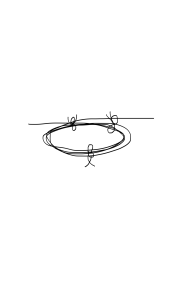
In order to handle a hank during the dying process, the loop needs to be stabilized. And you do that by securing it with figure-eight pieces of thread! Click here for a link to a charming 2-3/4-minute video that shows you how to do that with yarn. A hank with some figure-eights tied in place looks like this (well not really but you get the idea, especially if you watch the video):
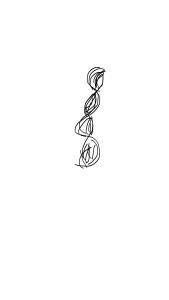
Once the fibers are dyed, it’s easier to handle, transport, and store a hank if you twist and fold it into a sturdy coil. Click here for a link showing a quick way to make a coil. The end result does look sort of like several figure-eights attached to each other end-to-end (I hope you’ll look at the video as my sketches aren’t great!):
Why am I getting into all this besides the fact that it’s always super interesting to voyage into a sub-world of skill and knowledge? Because I’m trying to understand the concept and pictogram of figure-eight of string dyed black. So far we haven’t seen anything exactly like the xuán character, though the figure-eight ties are obviously ringing a bell.
A few definitions:
- In theory, a coil is still a hank, and
- a “skein” is technically 1/16th of a hank. But many people nowadays call the coil arrangement a skein, especially for
- “string, twine, rope, cord, or yarn” which are defined as several strands or threads of fiber twisted together.
- A “strand or thread” is technically one individual piece of long, thin fiber.
- Except for “embroidery thread.” These individual strands are so fine that they’re commonly twisted together for ease of sale. We rather mistakenly but commonly call the result “thread,” though it’s technically string. Embroidery thread—be it wool, cotton, or silk, as was likely the case in Lâozî’s world—comes arranged in a very particular shape, also called a “skein.”
I hope you’ve seen these colorful little embroidery skeins and are getting excited thinking about it because… THEY DO kind of resemble figure-eights. And silk embroidery thread—which still almost always originates in China—exactly does because it has only one paper band squeezing in the center of a loop-shaped hank.
Now, here’s what I’m thinking. What if the technique for stabilizing hanks of fiber for dying is similar the world over and for generations past, including in ancient China? And what if they didn’t use paper bands to hold together embroidery thread skeins but rather… the same figure-eight tie they used during dying processes?
I decided to try that out. With black thread. Here’s my result:
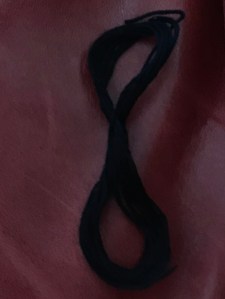
So cool, right?! But very hard to see… ohhhhhhhh. Have you ever worked with black thread? It IS hard to see. When you want stitching to be visible, you use light thread. I start to understand the translations like darkness and mystery.
Meanwhile, I re-arranged light, flashes, and background so you can see this little skein more clearly:

So cool. Still hard to see the center though (we hear you, Lâozî!). More light, bigger, closer…

It’s a figure-eight all right. And see the figure-eight string tie holding the figure-eight string into its characteristic shape?! What a lovely character and metaphor, thought Lâozî.
Back to translating
And even though Lâozî didn’t use the word “eight,” I’m going to modify my translation to insert this picture into a modern reader’s mind exactly as it’s shown in the pictogram:
mysterious figure-eight of string dyed black
We’re not going to wrap up Chapter 1 today since I got a little carried away with the thread experiment—yes, in order to be transparent I must report that some threads and part of my sanity were injured in the making of this blog….
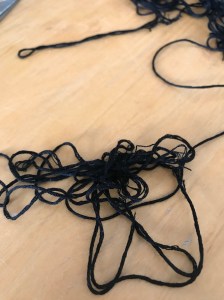
Plus it will be nice for us all to have a day or two to let this thread image knock around in your unconscious with what we have read so far. Tomorrow, we’ll clean up a few words in Chapter 1, and then on Wednesday… put it altogether. Or as you and I like to say:  .
.
Thank you so much for joining me today for what’s definitely the most exciting blogging day yet, for me anyway. I look forward to your comments!


2 replies on “mysterious figure-eight of string dyed black”
Ok… this is just brilliant. Who ever knew a pleasant side trip into the world of fiber would be so far reaching in its metaphoric implications. I’m so enjoying this exploration. Womanly mists and wild haired chieftains and now infinity ♾ in black string.
LikeLike
I’m so glad you like it! Thank you! And thank you for reading. Wait until we read all of Chapter 1 at once…. trip!
LikeLike