Categories
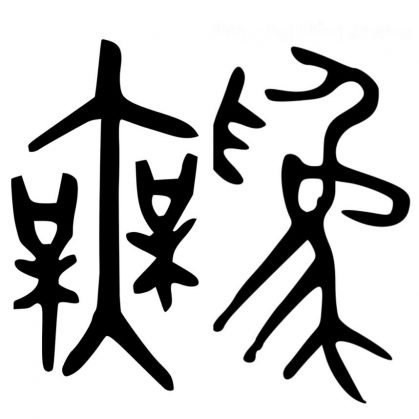
#2 Fū 夫 qù 去 shì 恃 Wéi 為

In which Lâozî tells us a bit about the status quo: how public opinion shapes things unborn, a sage’s life, and this particular man… Chapter 2 summary

After setting up a conflict, introducing the main characters, and leaving us with a mystery in Chapter 1, Lâozî gets down to business. Chapter 2 opens with a description of how things are in the established world (Heaven-below).

  • Here in Lâozî’s world we have public opinion being very sure of certain things. And this kind of “firing arrows from the mouth” has defining effects on what’s not yet even born:
    • First, the public is very opinionated about a particular kind of admired beauty.
      • Lâozî tells us that this has an “efforting” of beauty. It lops off or defines the opposite—a disdained ugliness—already… finishing it in the womb. This is the first of 51 times we see this efforting character (wéi).
    • Then public opinion is firing those certainty-arrows regarding a particular kind of traditional virtue.
      • Lâozî tells us this has an efforting of virtue. It lops off or defines the opposite—a husk but not really the true inner flower of virtue—already… finishing it in the womb.
  • There are consequences of this public opinion/efforting. It means other, opposite-sounding pairs are mutually occurring/doing things together:
    • Being and Not-Being are mutually birthing a bud sprouting from the ground;
    • solid and changeable: mutually completing that final nail in a weapon on a pole;
    • lengthy and short: mutually shaping within a hair’s breadth;
    • high level buildings in the suburbs and a lower level: mutually leaning toward one another, head askew, as if an arrow’s between them;
    • one tone from a moth and many sounds from hitting chimes: mutually harmonizing as a harmonica;
    • forward in the front lines of battle—where a foot gets cut off as punishment—and behind—what remains afterward when stepping slowly, only the left leg leading the way, leaving only the tiniest silk thread footprints as descendants: mutually accompanying one another, walking single file near soil mountains, stopping awhile along the road.
  • What a fascinating series of images, especially when read in sequence like that—it seems to paint its own story in some gauzy fashion. Then Lâozî tells us that the sun sees this list/story means some things about the grounded sage. (Throughout the 37 chapters of the Dào, whenever Lâozî says the sun’s seeing something, it sets up an objective big-picture “view from 30,000 feet.” Likewise, when Lâozî tells us about a grounded sage, it seems to be about an idealized wise person. In fact, these two phrases occur together eight of the eleven times that the sage is mentioned.) Specifically, we learn that the above list/story means six remarkable things about the sage:
    • RE dwelling, the sage’s personal role would be:
      • Not-Being efforting (as we discussed here). The pictograms for the word that means “dwelling” show someone staying at home at the tea table, chaste and unmarried, following something slowly from behind with tiger fur.
    • RE practicing/moving on a public road, the sage’s teaching would be:
      • just a husk of but not really speaking.
    • RE the Ten Thousand Things… getting up and going to work here:
      • “and yet now, bearded,” just a husk of but not really falling into some hollow-words style of governing that’s like a hand from above wielding that chisel used to mark slaves and criminals.
    • RE birthing:
      • “and yet now, bearded,” just a husk of but not really flesh-and-blood, meat-holding Being (as we discussed here);
    • RE efforting:
      • “and yet now, bearded,” just a husk of but not really expecting that will be holding one’s heart-core like one’s mother (shì).
    • RE real work completing that final nail in the weapon on a pole:
      • “and yet now, bearded,” not abiding (in fact, absent as sticks that were tied together to start a fire—pfft!).
  • And here Lâozî jumps in to interject extra detail. Lâozî repeats the last point to tell us something more about, that is to say, this particular grown man with a hairpin and public courtesy name () who’s absent as sticks that were tied together to start a fire, not abiding:
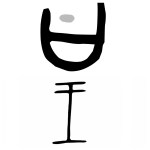
    • the sun sees this particular non-abiding man is not really leaving, not really withdrawing like someone with a mouth or cave between their legs ( 去). Here’s what that bronze inscription character looked like:

What a description of a life! That last big list began and ended with “efforting.” We learned that a sage’s personal role in dwelling is a Not-Being efforting. And by the end we learned that a sage might “effort” but isn’t really expecting anything personally of-the-heart to come from it (shì).This is important to remember since “efforting” comes up over and over again throughout the rest of the book.

The character shì (恃) combines the image of a heart with that of a temple or monastery. In Classical Chinese it meant mother, and now usually translates as rely on, presume upon, trust to. Dào translators call it take credit for, presumption, expect/expectations, lay claim to, claiming victory, claim as one’s own, claim possession, possessing, depend on, and return to. It’s like something has a hold on you, for better or worse. My translation, which I use in all three places where this character appears in the Dào, is:

expecting that will be holding one’s heart-core like one’s mother

~

I’m intrigued by what we’ve learned in Chapter 2 regarding: public opinion’s effect on what’s gestating, how that causes different pairs of “opposites” to mutually manifest, what Lâozî thinks that means for a sage’s life, and what happens in one particular man’s life who lives like that.

Actually, by “intrigued,” I mean that I have a lot of questions! Why does the sage “effort” at all? And why not expect a heart-level dependability from it? What can the sage—or we—trust will hold one’s heart’s claim? What’s the opposite of efforting? These are the answers I’m keeping my eyes open for as we move forward.

~

Does the final part of the chapter, describing the particular grown man’s experience, speak to these questions? Then the answer might be: do real work finishing things, but do it like a fire-starter… which means you won’t dwell there, and therefore you won’t ever really withdraw.

But, let’s face it, the old Lâozî-era image for that “withdrawing” character ( 去) is very odd. Did you think I was just going to glide over that picture?! When I see a drawing of a man over a mouth-like opening and the dictionary definition withdraw, I think of a man just finishing or maybe interrupting sex. I can’t figure out if this is obvious or just reveals that I have the sophistication of a junior-high boy. But then some etymologists have described the image as “a man with a hole in his crotch.” Now that, to me, sounds like a woman passing/identifying as a man. And it makes me wonder. It makes me look back at everything we’ve read so far with a completely different question: was Lâozî a woman? When it occurred to me, I decided to keep this question in my mind as I went forward with the translation, and at the same time not be attached to it. We will delve into this more—much more. Meanwhile, other linguists have thought it could be a representation of a man’s anus and therefore mean “getting rid of” like “waste” (AKA pooping). Or others believe it might be related to a different Chinese character that shows a mouth next to a person (rather than below) and means “open one’s mouth,” possibly referring to the custom of saying goodbye when you leave some place. I also looked at other definitions of this word to see if we could get more clues. One is to play a part or character, to act. Another is last or past. A recently coined meaning for the word is what the hell, damn, fuck. Honestly, I couldn’t agree more! It’s baffling. And it kind of changes everything.

Maybe as we leave Chapter 2 we’re about to find out more about what it looks like to be as absent as the twigs that started a fire… not dwelling. And therefore not really withdrawing/leaving/passing/play-acting/past.

Once again, I ask: why the obscurity? Is it just too hard to clearly describe because it has to do with that ease-y extraordinary way of being that can best be described as the absence of so many of our typical hard-and-fast things and behaviors—an absence of the grind and the surface matters? Or is all this code for something else? Maybe both?! I vote for both.

Thanks for joining me here again. Next up: Chapter 3, where we learn a little more about this world of Lâozî’s before stuff starts to change pretty quickly in Chapter 4! Meanwhile, thanks for your questions, ideas, and comments. Please keep them coming. You can use the contact form to reach me anytime. See you next week!
Categories
#2 Shèng 聖 Shēng 生 Wú 無 Yôu

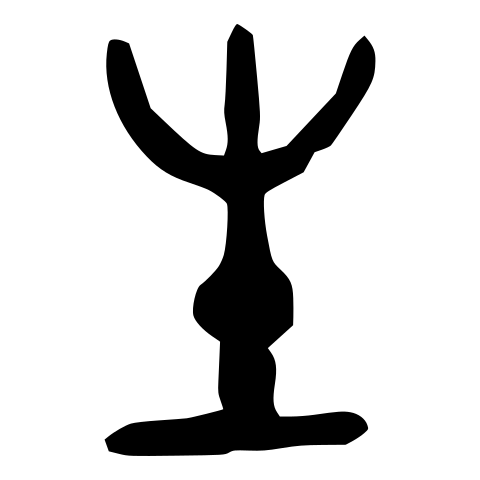
birthing—a bud sprouting from the ground

shēng

Birthing (生, shēng) sounds familiar to you because in the first half of Chapter 2 this word linked Being and Not-Being in a list of “opposites.” Lâozî told us that Being and Not-Being are mutually birthing.

~

In Western Zhou Bronze inscription script, familiar to and possibly most similar to the script used in Lâozî’s time, shēng looks like this:

This image is a compound of a sprouting new plant:

And the ground:

I especially like the added bulge. To me, it really augments the meaning of this character because the modern translations of shēng are to live, subsist, exist; grow, develop, bud; bear, give birth, bring up, rear; and be born, come into existence. It also can be a noun: offspring, descendant; disciple, student; Confucian scholar; or life, existence, being, living. And it can be an adjective/adverb like fresh, not stale; unripe; raw, uncooked; uncultured, uncivilized; strange, unfamiliar; vivid, strong; innate, and natural. In Buddhism, it can mean to go into society or be reincarnated.

Here are some of the different ways translators of the Dào, in particular, interpret shēng: arise, creating, give birth, rears, produces, and lives. And that’s just in this chapter. Elsewhere you find those same translations as well as be born, and foster. Most translators use more than one definition, many use more than one even within this chapter. You can see why—the possible meanings vary so significantly in nuance. Is the thing in question being birthed or giving birth or raising something up? Those are all very different, and it’s tempting to want to clarify.

Because this word is so often interpreted as birthing, I originally had a baby in my definition, but as I wrote this post, I realized that’s an addition on my part. The image only shows the plant, the ground, and that added bulge (which does put me in mind of a baby, but it could also be a meristem from which new leaves are going to grow). My translation is hereby corrected to:

birthing—a bud sprouting from the ground

I like it because it has that poetic multi-usefulness. It could refer to doing the birthing, being birthed, growing, or even being raised.

~

In the first part of Chapter 2, we learned that Being (yôu) and Not-Being (wú) are mutually birthing—a bud sprouting from the ground. Based on the lesson in the previous few lines of that chapter, this first seemed to me to mean that if you work hard to “effort” Being, then you’ll cut off and define Not-Being while it’s still developing on its own.

And vice versa? Possibly. Though it’s not definitely clarified for us, that word “mutually” could be seen to imply that. Maybe it even means that you can’t have Being without Not-Being and vice versa. That’s a very common interpretation of this lesson and goes with the pictogram for “mutually” (xiāng, 相) which shows a seen tree and the eye seeing it.

Maybe Being and Not-Being are two aspects of one phenomenon—maybe Not-Being is the life force that makes sprouts sprout, and Being is the actual physical sprout? Or maybe one is the ground and the other the sprout? Maybe their union creates life. I like that one.

One thing is for sure, we are definitely wandering once more in the uncertainty of the Being-Not-Being mystery. Again I wonder…

What exactly are these Not-Being and Being characters, anyway?!

  • As we’ve seen, they are often used as negative- and positive-particles.
  • But also as adjectives.
  • And in some places—like the previous paragraph—they’re standing on their own.

There are other negative particles in the Chinese languages—ways to negate a concept, i.e., to say “not__.” And other ways to say something positively IS happening. These two characters were decidedly not the common way to do either in Lâozî’s time.

Using these very human-tinged characters in so many different ways gives the characters their own sense of being actual characters. And always with a twist. Every time Lâozî uses them, it’s sort of a pun… a double entendre.

  • Are they actually separate people?
  • Are they two sides of every person, situation, and thing?

Thus far, it remains shockingly, beautifully unclear.

Further down in the chapter, we started to learn about the ideal grounded sage and were told that when it comes to “staying,” the sage’s personal role was Not-Being efforting. What does that mean?

  • Of course this could just mean the sage “remains not forceful.” That’s the most common interpretation, and a lovely and useful one at that.
  • But given the lesson in the lines immediately preceding these, I assume it also is telling us that when it comes to “staying,” the Not-Being aspect of the sage is efforting—trying hard.
    • And that when the sage’s Not-Being aspect tries to force something—to “effort”—the sage shifts from the shamanic, dancing Not-Being mode into a more concrete, outer-oriented Being. The sage has both aspects.
  • Or maybe the sage is that dancer—that Not-Being—and when it comes to “staying,” well… that is the sage making an effort.

Now even later in the same chapter, we’re told that when it comes to “birthing—a bud sprouting from the ground,” the sage is just the husk of but not really the true inner flower of Being, i.e., -Being. This other negative particle, , is a pictogram of a flower’s sepal or guard petals and in every way a completely different character than Not-Being’s image of a mysterious dancer. So this new information isn’t saying that when it comes to birthing, the sage is definitely in some sort of Not-Being role. It just says that when it comes to birthing, the sage isn’t really Being, even if it may look like it initially.

~

It sounds confusing, doesn’t it! It helps me to diagram it like a flow chart. To summarize what we’ve learned in Chapter 2 about birthing/sprouting and our favorite characters: Being, Not-Being, and the sage.

  • Being and Not-Being are the type of duo with a mutual relationship wherein defining one means you define the other by default. In their case, they are in fact mutually birthing/sprouting.
  • When it comes to staying, the sage‘s personal role is Not-Being efforting.
  • When it comes to birthing/sprouting, the sage is just the husk of but not really Being.

Every which way I re-arrange and re-phrase that to myself, it does seem the sage’s more identified with the Not-Being aspect.

It’s a lovely message in keeping with what most people make of the Dào: the wise person has a certain hard-to-describe, beautiful, mysterious, intuitive, flexible, unattached way commonly associated with mystics from the Buddha and Jesus to Rabia, Rumi, and Hafiz.

It’s interesting to consider what it might mean in our own lives to de-emphasize Being and feel our way into more Not-Being. It’s a hard thing to describe, but it feels spacious and restful and energizing. Experimenting with this sensation in the odd moment here and there—that’s my wish for you. And please, write to me with any feedback, questions, ideas that come from those moments. I love hearing people’s experiences with this concept.

~

Meanwhile… if this is one of the points of the text, why does Lâozî say it so obscurely? Is Lâozî making it intentionally hard so that by the time the reader finally figures it out, it’s fully integrated? Or maybe so it can mean many different things and therefore be useful to many different people in many different circumstances? Is it because this is the way to make words go together to fit a rhyme, alliteration, and meter scheme? I do think all of these are reasons the text has captivated people for millenia.

Or is it because the concept of Not-Being as the sage’s true creative essence was so hard to accept that it needed some disguising? We’ve seen that Lâozî does, after all, draw characters that are masked, hidden in caves, bearded, a husk and not the real thing, or a hard-to-see mystery within a hard-to-see mystery. Next time we’ll summarize Chapter 2 the way we did Chapter 1, and maybe more ideas—or questions—about this story will come into focus.

Thank you for joining me once again! As always, please use the Contact form to write to me until then—I really look forward to hearing from you.

Categories
#2 Dào Fú 夫 Fú 弗 Fū 夫

that is to say, this exact grown man with a hairpin and public courtesy name…

Chapter 2 introduces another character that shows up in pivotal times throughout the Dào: (夫). The Western Zhou Bronze Inscription starts with an image of a man…

… and adds a hairpin ():

I don’t know for sure if this image has to be male or if that’s just how it gets translated now. Women also wore hairpins, but maybe this image shows the pin men wore after their Guan Li naming ceremony when they officially became an adult man. Modern translations of this character when it’s pronounced are just that: male adult, man; husband; person; manual worker.

But there’s another pronunciation of this same character: . That’s how it’s usually been transcribed in the received versions of the Dào Dé Jīng. Its modern translations are as a generic personal pronoun—he, she, it, they—or a particular “demonstrative” pronoun like this, that, these, those. Translators of the Dào also interpret it variously as you, for, just, because, this very, the, ones, people, that is, and only. A lot of times it’s somehow combined with words like therefore, and, so or other introductory or transitional words or just dropped altogether and considered to be a meaningless particle. Perhaps, the translators think it’s been added for rhyme meter, and alliteration.

The thing is, its unique status as a particular character is lost when we do that. So, as you know, just in case it meant something to Lâozî, I give each character a unique translation that includes its pictogram image and can be used in every instance it occurs. For 夫, I have come up with:

that is to say, this particular grown man with a hairpin and public courtesy name…

Notice how it includes both of the key themes we saw in our summary of Chapter 1: hairstyles and naming types!

~

This particular grown man character is introduced to us in Chapter 2, just where we left off upon learning that when it comes to real work completing, the grounded sage, as one bearded, is absent as sticks that were tied together in a bundle to start a fire—’fff!’—not abiding or dwelling where birthed. Immediately after that line, Lâozî specifies:

That is to say, this particular grown man with a hairpin and public courtesy name…

essentially and only—like the heart of the ‘short-tailed bird’—

“absent as sticks that were tied together in a bundle to start a fire—’fff!’—not

abiding—dwelling where birthed…”

the sun—walking across the sundial a while, stopping a while—sees indeed

this means:

the husk of the initial protective bud casing—the sepal—but not really the true inner flower of

withdrawing like a person with a mouth or cave between their legs—leaving.

This is the particular format in which we most often see the 夫 character used: after a list describing various aspects of someone’s situation. After a list, Lâozî highlights one of the list’s conditions by repeating it and referring to this particular man to whom this applies. And then Lâozî reaches a conclusion about that particular man.

In this case, Lâozî says that the particular grown man who’s completely “not there” when it comes to abiding is “not really leaving.”

In other words, this guy who never stayed isn’t really going away. Makes sense. You could say this particular person already has left—like a bundle of twigs lit to start a fire, “Pfft!” It gets things going at the beginning, and then is gone. This character, rather poetically, is also pronounced but with a rising tone. Its pictogram shows two sticks tied together, which you can still see in the modern character: 弗. (An alternate explanation is that they are two bent arrows tied together to be straightened. Either way, its usage is dialectical and not commonly used now. It’s most often translated as “not,” but our friend is much more commonly used as that kind of negative particle.)

~

Have you ever felt like that bundle of twigs? You start the whole thing, and that’s your contribution. Maybe intentionally, that was your plan, or maybe the feeling of being “used up” came as a surprise to you. Maybe no one notices you’re not really there anymore. I can imagine this feeling bad—like “burnt out” or even taken for granted. But also I can see it being fine—like you’re a pivotal, essential “fire starter” and not part of the ongoing cooking or heating or whatever.

What’s the difference between these two versions? And more importantly: what do you do now? How we frame what happened—our mindset—is going to matter.

~

All this talk of leaving puts me in mind of the fact that, legendarily, the Dào Dé Jīng was imparted to a border guard as Lâozî departed from the country. Perhaps Lâozî is self-revealing something here. Perhaps Lâozî’s not really leaving—maybe because Lâozî wasn’t even still there to begin with.

As we go, let’s be on the lookout for more clues about Lâozî’s story and experience of it as well as maybe some insights on how we can frame our own experiences in not-really-leaving somewhere because we left long ago. Thank you for being here with me—please use the Contact form to send me your responses. See you next time!

Categories
#1 Ér Dào Fēi 非 Jiâo Míng Miào Tiān Wú 無 Yôu

By way of introduction… Chapter 1 summary

Here’s how I see it. Please consider it a light fanciful daydream if it offends your sense of the Dào Dé Jīng!

Setting the stage: conflict!

Yinxi the border guard recognizes Lâozî as he’s departing the country, allegedly fed up with politics in Zhou. He asks the renowned wiseman to leave behind some helpful words, presumably about his philosophy and the way to go about things. Lâozî says… well you might want to click here to read Chapter 1 and then pop right back. But basically Lâozî says…

The Way that I can describe to you as definitively The Way breaks the little wings off our traditional version of The Way.

Wow. What a great first sentence. It’s very overt and rather patronizingly graphic in setting up all sorts of conflict and questions… especially with those actual Western Zhou Bronze Inscription characters that Lâozî used! (Yes, I’m making lots of assumptions here, as do all translators. Mine are described here.)

What follows sets up some idiosyncratic themes for the whole book.

Hair

Somehow hairstyle figures prominently in this first sentence and the entire text! Here’s my full version of the first sentence:

The Way of the loose-haired chieftain—walking a while, stopping a while, listening, and speaking of it all—about which you can purse your lips like a piece of cane and puff: “Yup, that’s it, definitely The Way of the loose-haired chieftain—walking a while, stopping a while, listening, and speaking of it all—” is breaking the little wings off the ever-present square fabric which our grown men wrap around the ‘little bird’ top knots on their heads after receiving their public courtesy-names—or what we know as the timeless, whole-cloth ‘jin’ version of The Way of the loose-haired chieftain—walking a while, stopping a while, listening, and speaking of it all.

So we have a roaming prophet-like chieftain with loose hair. And then we have a sort of opposite: the current tradition in which men wrap their hair in a top knot on their head and cover it with a cloth as part of their puberty ritual. We’ll encounter some other hair and headdress images later in the book, but that theme’s established right here in the initial line.

What’s in a name

Different types of names also figure prominently throughout this whole first chapter. I count four different namings.

1.Above we learned about how when boys turned to men in ancient China, they received a new formal name.

2. The next sentence talks about the childhood name the boys gave up, a name you can still use with intimates after you’re a grownup:

Its personal, childhood name—what it says to identify itself urself by moonlight—about which you can purse your lips like a piece of cane and puff: “Yup, that’s it, definitely personal, childhood naming—what you say to identify yourself by moonlight” is breaking the little wings off our traditional its personal, childhood name—what it says to identify itself urself by moonlight.

[Yes, I shortened the ever-present square fabric which our grown men wrap around the ‘little bird’ top knots on their heads after receiving their public courtesy-names—or what we know as the timeless, whole-cloth ‘jin’ version of (chàng) into “our traditional.” Yes, it’s both a big assumption on my part AND a useful space saver! That character’s described in detail here.]

So here’s yet another harsh difference between tradition and what Lâozi could say. This time it’s over personal naming in particular. Now we feel like names might be key in the conflict that’s been staged for us.

Lâozi goes on to differentiate two kinds of personal names: Being, its personal name, and Not-Being, its personal name. In this simple step, Lâozi introduces two of our most central and most baffling characters and puts them squarely into this naming conflict… but more on them later. Let’s see what other kinds of naming are discussed in the first chapter.

3. There’s also how things are spoken of altogether with one another—like all earthly, mortal, commonplace plates. Lâozi uses THAT title when talking about Being and Not-Being when they’re a yoked pair, just before they’re stepping out “of a cave” and into their two different, masked personal namings.

4. To really describe them altogether like that, Lâozi adds in yet another kind of naming: what it’s called when speaking from the gut—words, like slaves or criminals branded by a chisel emerging from a mouth.

Later in the book, we’ll see some significant permutations of these naming types, and we’ll really notice them too, since the basics are pointedly noted in the first chapter.

Being, Not-Being, their altogetherness, their differently masked names once they step out of the cave and get bearded, plus the crux of the mystery:

Most importantly, in this introductory chapter we meet and learn a little something about two of the book’s fundamental characters. The facts we get, in order of appearance:

  • Not-Being is shown by a pictogram of a mysterious, shaman-like dancer and is often taken to mean “null” or “nothingness.” Lâozi tell us its personal naming is the conception of Heaven-Earth (merged to be something like… the whole universe or “heaven and earth”).
  • Being is shown by a pictogram of a hand holding a piece of meat. Lâozi says its personal naming is the rearing, raising, or “suckling” of all the gazillion of material things in that universe, literally 10,000 Things—all matter external or cut off from you.
  • In the traditional version, Not-Being is “wanting.” It’s missing something that’s been eroded, and that is a mysterious feminine essence called miào.
  • In the traditional tradition, Being is “wanting.” It’s missing something that’s been eroded, and that is delineated surface—like a patrolled frontier border lightly hit with a sword tip from left to right (jiâo).
  • Whoa, though! Really they’re a matched pair and can be spoken of in this state where they’re altogether—as common as daily dishes—stepping out of their cave…
  • But. Once they step out, lots of “buts” apply. The first, main, and most unusual and specific “but” is a character that’s a pictogram of a beard (èr). The instant they step out, Lâozi starts describing them with a qualifier: and yet now, bearded…. Every time this èr character’s used, I can’t help but harken back to its intro here as a description of Not-Being and Being as they step out of the cave.
  • So they’re altogether stepping out of a cave and yet now, bearded…. they have differently masked personal names (presumably this refers back to the “Being” and “Not-Being” personal names described before).
  • What they’re called from the gut when they’re altogether has this hard-to-see darkness—the figure-eight structure of a skein of string-dyed-black (xuán). Based on how the text’s written, I think the entire set-up described beforehand—what I summarized in the above bullet points—constitutes that xuán. But I guess it could be something as yet unspecified, something that we discover later.
  • And here’s the kicker… that hidden structure has its own hard-to-see dark figure-eight structure of string-dyed-black.
  • And THIS, my friends, is the mysterious feminine essence’s double-winged gateway. Ending the first chapter here leaves us with miào feeling somehow central to the whole story.

What’s this have to do with our original conflict between The Way and our tradition?

I guess that’s the question Lâozî’s setting up for the suspenseful tale about to unfold to Yinxi, me, and you.

What stands out to you?

I’m going to give you some time to ponder this introduction and my question and send me your answers before I prejudice you with mine—because they’re doozies! And with that cliff-hanger… I thank you for being here with me and for sending me your comments. It means the world to me.

Categories
Cí 慈 Dào Qīn 親 Xīn 心 Xīn 心

heart

xīn

In honor of Saint Valentines Day and love of every kind, here’s a special post featuring, yes: love. We see three kinds of love as we go through the first 37 chapters (the “Dào part”) of the Dào Dé Jīng.

~

First, we’ll meet ài (愛). Its modern translation is, quite simply, to love. Specifically it’s to treasure, or be fond of and also can be an honorific for someone else’s daughter or an adjective like affectionate or beloved. I love this bronze inscription image from the Warring States period (it’s the closest I can find to what Lâozî might have drawn):

In the later Qin dynasty, a foot (夊) was added to the bottom of this character—you can see it if you study the modern character, 愛. It’s thought this was done to show that this character had to do with people. But the original character’s meaning was carried by the picture of a heart. Originally in Oracle Bone inscriptions it looked much (thrillingly much!) like the Valentine heart I hope you draw somewhere today:

Aw! We’ll see this character, xīn (心), on its own and as a sub-component in many places throughout the Dào. By Western Zhou times, the bronze inscription had morphed to what, honestly, looks a lot less like a heart to me (?!):

The upper sub-component of ài is considered to be the phonetic part that just gives the word its sound. It’s pronounced , and its original Oracle Bone Script character looked like this:

It shows a kneeling figure… but with those extra lines from the top of the head to the neck. This character means: when food becomes stuck in the throat. Oh my gosh. When it comes to the heart, we all know that feeling. That’s why I’ve translated ài to mean:

loving—your heart-core in your throat—

Lâozî uses this character in three places:

  • First, in terms of a leader loving the civilians.
  • Second, in terms of oneself, when really making an effort, loving Heaven-Below (usually assumed to mean this earthly world).
  • Third, in terms a “virtuous” person loving the “materials” they work with (AKA “not-really virtuous people!”)

Lots of food for thought in this character and how it’s used. I love the idea that Lâozî’s main characters get choked up over the world at large, the masses, the “non-virtuous.” Those mystics tend to do that, don’t they.

~

The next kind of love is a person, an intimate: qīn (親). In modern times, this character can mean any kind of bosom beloved including a close friend, parent, brother, sister, or other blood relative. It also can mean marriage, kissing, or being close to someone. Look at this gorgeous old character:

The character on the right’s considered the part that gives the word its meaning: it’s someone looking and seeing, a big old eye for their head.

The left character’s considered to be the phonetic part. Like the heart above, it’s pronounced xīn. Interesting, huh. But what it shows breaks one’s heart: it’s a picture of a chisel used to mark slaves and criminals. Etymologically, its oldest Proto-Sino-Tibetan root meant liver, heart, bile, bitter.

Since I like to include all aspects of a character, I translate it for myself as:

intimate — a loved one you see closely even in suffering like from that chisel used to mark slaves and criminals

Qīn appears twice in the Dáo. Once it refers to the second-best kind of leader—this beloved one. The other time, it’s when talking about the unfortunate consequences that follow when “the six intimates are not really harmonizing.” Very mysterious. We will delve into those implications later when we deal more fully with Chapters 17 and 18.

Until then, this character has a big effect one me because seeing one another, to me, is truly love. Actually seeing one another, wounds and all, and holding everything in safety and love is profound for both the seer and the seen. (The New Testament describes Jesus loving a particular individual only one time. It was the rich guy who had as much chance of getting to heaven as would a camel in sliding through the eye of a needle. Here’s what the Bible says about that: “Jesus, seeing him. loved him.” Seeing seem to be a lot of what love’s about.)

~

Lastly, we have (慈). This character shows two skeins of silk string dyed black atop a heart:

Modern translations are the kind of love or affection shown from someone older to someone younger, benevolent, and, in the more classic sense, the honorific for a mother. Throughout the Dào, I call it:

benevolent as doubly-profound parental love, mysterious as two loops of string dyed black over the heart-core

It’s also become the character for the Buddhist concept of maitrī: loving-kindness, good will, friendliness. That’s about right isn’t it. The best part of Valentine’s Day.

In my house, we celebrate this day of love with ALL heart-shaped and red foods. Mashed potatoes! Cake! Meatloaf for the non-vegetarians! This tradition started with my qīn college roommate, Polly—who died way too young of a BRCA-associated breast cancer—and the other beloveds we lived with (Nancy, Gwen, and Ann). Every Valentine’s Day since, I’ve delighted in that tradition, whether it was alone, with friends, with my little kids, with my grown kids, or with my honey. As a result, I’ve never once had those Valentine Day blues that the modern “romantic” take on this day causes in so many people. I hope you treat yourself with just this kind of today and every single day. Thanks for reading along here with me. I love you.

Categories
#2 Êr 耳 Bù 不 Shèng 聖

the grounded sage—listening and speaking, standing connected to earth as well as the heavens

shèng

Last time, in the second half of Chapter 2, we met a new character: shèng, 聖.

This character’s sub-component 耳 (êr) is a pictogram of an ear and considered to be what gives the overall character its meaning. This character is also the second part of what’s widely believed to be Lâozî’s own personal childhood name, Lî Êr. Its bronze inscription glyph looks like this:

The other sub-component, 呈 (chéng), is considered to be the phonetic part that gives shèng its sound. Its glyph is in turn also a compound of two pictograms. The first is a mouth (口):

The second may be a carrying pole (壬) or, more likely, the symbol representing king (王, three lines that represent Heaven, Man, and Earth):

When you put those two together as the character chéng it looks like this:

In its modern form, chéng is translated as flat, submit, show, appear, petition, or memorial. Etymologists say this old glyph represents a man standing on the ground, speaking. It’s interesting to me that it’s like a king BUT ALSO listening and speaking. That’s an important distinction. You remember our main character, Dáo, The Way of the Loos-Haired Chieftain is ALSO listening and speaking BUT isn’t standing still. Rather that person is walking awhile and stopping awhile on a path. It feels to me as if the latter is more part of the world and regular life.

When you put all the components together for shèng, we get:

Modern meanings of this word are noble, holy, sacred, saint, sage, Confucius, master, professional, emperor, and king. Translators of the Dào most commonly use master or sage. My translation carries all that (with the exception of Confucius himself who is said to have been born the year Lâozî left the country and disappeared):

the grounded sage—listening and speaking, standing connected to earth as well as the heavens

Many people think this character refers to Lâozî as well as other wise people who follow the Dào, but there are other places where Lâozî actually says “I.” Shèng appears 11 times in the Dào part of the Dào Dé Jīng (i.e., the first 37 chapters). In eight of the appearances it’s preceded by a phrase that carries a lofty, objective perspective (“the sun sees that this means…“). This all combines to make me wonder if the grounded sage is an image of a theoretical, idealized wise person and not Lâozî per se. For these reasons, I treat it as its own character.

~

Lâozî introduces this ideal person in Chapter 2. Directly after giving us the list of paired opposites, Lâozî segues into a description of the sage during certain conditions:

  • As we saw last time, the first thing we learn about the grounded sage is that with respect to “staying,” the sage’s personal role has this Not-Being efforting. Here’s the rest of the list…
  • When it comes to being out in public moving, the grounded sage’s teaching has this: just the husk of, but not really, speaking.
  • When it comes to the Ten Thousand Things, the grounded sage’s getting up and going to work, and yet now, as one bearded, is just the husk of, but not really, falling into some empty-language style of governing.
  • When it comes to birthing, the grounded sage, as one bearded, is just the husk of, but not really, Being.
  • When it comes to real work completing—that final nail in the weapon on a pole—the grounded sage, as one bearded, is absent as sticks that were tied together in a bundle to start a fire—’fff!’—not abiding.

Very clear… and also puzzling of course. It feels straightforward that the sage teaches without too much speaking and that the sage works with all the many realities of the world without really falling into empty-worded governance. But then, when it gets to “birthing,” we float into that familiar uncertainty that comes with the characters Being and Not-Being. And THEN… then the sage is actually completely absent when it comes to work-completing. Perhaps the sage was “burnt up” in starting some metaphorical fire. What is going on here?

The sage, as well as Being and Not-Being, are prominent characters in the narrative arc of the Dào. For that reason, we’re going to pause here and devote the next post to the “birthing” that links these three characters. Hopefully more will be revealed to us.

~

Until then, what’s my takeaway?

I like to unravel the Dào for a couple reasons. One is to learn about Lâozî, and the other is to learn what ideas this book holds for my own life. Even without solving the whole mystery of the story or even deciding for sure on the meaning of any one character, I still get a lot out of any snippet… whether it be a word, line, or chapter. A big theme for me is allowing myself to rest in not being certain about things. That holds true in every post thus far as well as every aspect of my life. This character of the sage is already posing some useful and pleasant-feeling variations on that theme. Consider the pictures in that character: listening, as well as speaking, feet on the ground even as connected to the loftiness above us. Getting a visual image of that sensation makes me so grateful to Lâozî.

Thank you for being here! If you have any comments for me before next time, please use the contact form (click on the Contact tab). I love getting your notes.

Tinkered with on 2/16/20

Categories
#2 Chù 處 Wéi 為 Wú 無 Yôu

Not-Being efforting

wú wéi

“Not-Being efforting.” This phrase is in some ways the most obscure phrase in the Dào Dé Jīng. I posit it’s also the clearest.

We first encounter this phrase in the second half of Chapter 2 where, just a paragraph beforehand, Lâozî painstakingly lays out two examples illustrating the essential nature of “efforting.” As we saw in our last post:

When public opinion defines something with great certainty, that constitutes a forceful “efforting” of that thing. Such “efforting” results in cutting off and defining the very opposite of that original something before it’s actually developed in its own right.

Lâozî then lists a series of opposite conditions linked to one another in mutual interaction (like a seen tree and the eye seeing it… both are required for the interaction to happen):

The first such pair of opposites listed is Not-Being vs Being. Lâozî says they are mutually birthing.

Because of Lâozî’s careful set-up, I think it’s safe and indeed important to assume that this linking of opposites happens because of someone “efforting” one of the pair. I think we can conclude that the mutual birthing of Not-Being and Being has its roots in these two options:

  • Not-Being is efforting and therefore peremptorily defining Being, and/or
  • Being is efforting and therefore peremptorily defining Not-Being.

Let’s look at this in the context in which it’s first used. If you read the second half of Chapter 2, you see a list of things that a grounded sage person does in certain circumstances. Here’s the first such situation:

The sun—walking across the sundial a while, stopping a while—sees indeed

this means:

the grounded sage—speaking and listening with both feet on the ground,

this person…

staying-remaining at home at the tea table, chaste and unmarried, following something slowly from behind with tiger fur-

nothing—no one dancing with long tails flowing from their wrists—nope, never, no way, nowhere, nohow Not-Being

efforting—like holding up an elephant…

has this

personal, manual role—what one does with a weapon, a flag, or a pen;

So first we are going to learn about what the grounded sage does when they are chù (處) or staying. It’s usually translated as remains, but the Western Zhou Bronze Inscription character is, as usual, a lot more evocative and complex than that:

The top component (虍) shows tiger fur:

which is usually considered the phonetic sub-component (). Below that there are two semantic components considered to give the word its meaning. First is:

which shows two legs followed by something from behind and in modern times (夂) is translated to mean exactly that. Also shown is:

which shows a stool, and again the modern translation (几) matches the old pictogram.

The modern translation of the overall character chù, however, includes not just stay, remain, reside, live, and dwell, but also “staying at home, not assuming a government position or not married.” It also includes virginity and chastity as well as manage, deal with, punish, discipline, and get along with. This reads to me like a laundry list of what it meant to be an unmarried woman in most parts of the world in “the old days!” At any rate, as you can see above, I included all these elements in as neutral a way as possible.

And what does a grounded sage do when staying—remaining at home at the tea table, chaste and unmarried, following something slowly from behind with tiger fur? Well, then their personal role is Not-Being efforting.

And that, we suspect, means it lops off and defines Being (yôu 有).

Fascinating. We’ll delve more into the grounded sage next time, as we continue to feel our way into what it means that their role when “staying” is cleverly lopping off a basket of and therefore defining Being.

Thank you for joining me here again. I hope you’ll re-read Chapter 2 again and enjoy letting all these ideas percolate in your unconscious as well as conscious mind. Meanwhile please use the contact form to send me your comments, ideas. and questions. Until next time!

Categories
#2 Gōng 功 Lì 力 Qín 勤 Wéi 為 Xuán Yòng

efforting—like lifting an elephant—

wéi

I love the modern character, 為, and the old compound character of wéi is equally descriptive:

When you pull it apart you see it shows a hand (albeit upside down as if doing biceps crunches)…

…lifting up an elephant:

Wéi‘s modern meaning is to do or to make. It can also mean govern, construct, transform or turn something into, act as, be, and more. Dào translators call it so many different things: act/action, act upon, improve, try to change, do what you want with, tamper with, grab after, contrive, do work, make, achieve things, accomplish tasks, perform deeds, strive for, interfere, guided by, play the role of, merge, join together, fuse, capable of doing, can be, set, become, the nouns form, model, or action, and quite often simply, has, is, be or do. I would say they’re all trying to capture this sense of a human applying a hardcore sort of force to something big, heavy, or significant in nature in order to get something done. My translation is:

efforting—like lifting an elephant

~

Wéi figures prominently into a couple of my favorite chapters where Lâozî explains the way of the world by comparing it to what it’s not. For example, in Chapter 11, Lâozî specifies that wéi is what we do to clay or wood when we are efforting those physical things into the shape of a pot or a living space. And then Lâozî contrasts this efforting with Not-Being’s yòng (用):

doing truly useful work—like a water bucket—by means of carrying capacity

I found a Spring and Autumn Bronze Inscription image for this character which always makes me happy since that’s the script I believe to be the closest to Lâozî’s own hand (as described in the tab Dates, dynasties, their scripts, and my preferences). It’s a pictogram of a water bucket:

What a perfect illustration of how negative, receptive space is useful. Modern translations of the character are use, employ, operate; utility, usefulness, use [nouns]; to eat or to drink [in an honorific way]; expenses, outlay; with, by, using. Dáo translators most commonly call it useful, usefulness, and use. You can see this is a classic example of how one word can be noun, verb, or adjective in Chinese thus setting up the potential translation inconsistencies I like to avoid by using gerunds (“___ing”). In a few places, translators also call it potential, put into practice, draw upon, plus other non-related things that infer actions based on the nouns in the sentence.

In Chapter 6, yòng is part of a paradox describing our old friend, xuán, the hard-to-see darkness of a figure-eight of string dyed black. That short chapter concludes its description of xuán by saying:

Doing of truly useful work—like a water bucket—by means of carrying capacity (yòng)

has this…

the husk of the initial protective bud casing, but not really the true inner flower, of

exerting with force—with the strength of an arm, a bladed tool, or a plough on the soil (qín).

So here yòng‘s contrasted with yet another type of “doing,” qín (勤). In fact, with Lâozî’s use of , we get the specific sense that yòng may look like this other kind of work and be related to it in some way, especially at the beginning, but it’s not really that at all. Qín translates in modern times to industrious, diligent, and attentive, but traditionally it specifically meant laboring. This compound character’s right-hand component, (), is considered to be the semantic part that imparts meaning. In Bronze Inscription script it looked like this:

This is considered to be either an image of an arm bending out from the body (those bicep crunches again) or a plough. It means physical strength. In physics, it’s the technical term for Force where it has the particular meaning of a quantity calculated by multiplying mass times acceleration. This sub-component shows up in a lot of words and also occurs on its own as a character once in the Dào in Chapter 33 where I translate it as:

forcefulstrong like an arm, a bladed tool, or a plough

The left sub-component of qín is considered to be the phonetic part that tells us how to pronounce the word. It is indeed pronounced qín, and on its own now means clay. The etymology of this word thus far eludes me… I will keep after it. However, until then, you can see I incorporated its meaning into my translation of qín as is my want:

exerting with force—with the strength of an arm, a bladed tool, or a plough on the soil

This character looks very much like one we will see in our next post about the latter half of Chapter 2, gōng (功). Just looking at gōng‘s modern character, you recognize the strong-arm/plough sub-component on the right meaning force. The left sub-component, its phonetic element gông (), is a bladed tool:

On its own, gông has the modern meaning of labour or work, laborer or worker, industry. When combined with the strong-arm/plough character, it’s taken on the meaning of achievement. And it’s used in physics as the technical term for Work, calculated as Force times distance. In other words, work is done when a force accelerates a mass through a distance. A force on its own isn’t “going anywhere.” Only when it exerts that effort to move something somewhere is it officially Work. I translate this character as:

really working—laboring with the force from a bladed tool, one’s arm, or a plough—

~

As you can tell, I’m gathering a list of the various and subtly different ways Lâozî talks about “doing stuff.” Partly I’m super interested in this because my original career was an engineer (!), and so not only am I used to being precise about these words but also I love considering the physics of the Dào Dé Jīng. In fact, that was one of the original three motivators for this whole Dào project. So here’s what we have so far under the category of “ways to do things”:

  • wéi, 為: efforting like lifting an elephant (occurs 51 times in the first 37 chapters of the Dào)
  • yòng, 用: doing truly useful work—like a water bucket—by means of carrying capacity (occurs 11 times, 4 of those are in Chapter 11)
  • qín, 勤: exerting with force—with the strength of an arm, a bladed tool, or a plough on the soil (occurs only once, in Chapter 6)
  • gōng, 功: real work—laboring with the force from a bladed tool, one’s arm, or a plough— (occurs in 6 spots in 6 different chapters)
  • , 力: forceful—strong like an arm, a bladed tool, or a plough (1 occurence)

Sometimes, I’m pretty sure a particular one of these characters is used for a poetic reason like rhyme and alliteration. But also, in general, you’ll see as we work our way through the book that yòng, the negative-space “bucket” way of doing things, mostly is associated with Non-Being, The Way of the loose-haired chieftain (Dào), and the grounded sage that Lâozî so often describes for us. The other four more effortful ways of doing things mostly are associated with Being, The Ten Thousand Things, a grown man, civilians, “one’s pregnant self” (traditionally translated as oneself), traditional virtue, and other such concrete players. That said, there will be exceptions to this rule, and it is there that we may gain the most insight into what’s really going on in Lâozî’s schema.

But I say we trust Lâozî to lead us into and through all this in the natural layout of the book, so for now we are firmly in Chapter 2. As we saw in the last post, that’s where Lâozî told us that public opinion firing arrows of certainty about a particular admired “beauty” or traditional “virtue” is really an “efforting” of those traits. It’s like lifting an elephant… i.e., not easy. And not only can we viscerally feel that’s hard and hard to sustain, but also this approach lops off and defines the opposites of those traits before they’re even fully born. With this introduction to “wéi,” it’s safe to say that whenever we see that word from here on out, we’ll remember these consequences that Lâozî’s laid out for us. And furthermore we’ll be noticing and remembering that there is more than one way to go about doing things in the world. We can be feeling which ways seem more appealing and effective. We can be thinking about how we want to feel when we do stuff.

Thank you for joining me here today. Next time, we’ll see what the rest of Chapter 2 has to hold for us. Until then, please keep sending me your comments—they’re super helpful to me.

most recently tinkered with on 2/16/20: modified gōng definition

Categories
#2 Bù 不 Mêi Shàn Wú 無 Yôu

thus cleverly lopping off a basket of and thereby defining something already… finishing it in the womb

sī yî

Lâozi starts Chapter 2 talking to us about how people here on earth talk about beauty:

“Heaven-down below (lower level) public opinion—that clear, plain back and forth between people: firing arrows from the mouth sure of admired beauty—picture someone wearing a ram’s horn headdress…”

Mêi (美), “beauty,” is a picture of just what I’ve described: someone wearing a ram’s horn headdress. Then Lâozi describes this approach to beauty with a particular character, saying it results in:

efforting—like lifting up an elephant—beauty

Oh, Wéi (為). I love this word, it’s pivotal in the rest of the Dào (occurring in 51 crucial spots, in these first 37 chapters), AND it took me awhile to land on this translation of “efforting.” It will have its own blog post very soon!

Meanwhile… Lâozî tells us that effortfully defining beauty in this strong-arming way has a side effect. It is:

thus cleverly lopping off a basket of, and thereby defining, a disdained ‘ugliness’—an inferior-hearted evil right outside, touching the house—already… finishing it in the womb.”

Lâozî seems to be saying that when we work hard to forcefully set some very certain kind of beauty, we are insinuating that everything else is ‘not beauty.’ Or is Lâozî saying that approaching beauty in that way is itself ugly? Probably it’s both and either, as is so often the case in good poetry.

~

(斯) shows a basket on the left and an axe on the right:

Writing this for you, I realized that I didn’t have the basket in my old translation in the first post, so I’ve revised it as you see here:

thus cleverly lopping off a basket of and thereby defining

This symbol was used to depict a traditional unit of weight (about 1/2 kg or a “catty” which is a little more than one pound), but also means axe, and keen or shrewd. This chapter is the only place this word’s used in the Dào.

~

(已) now means stop, finish, already, or have done [something]. In the Dâo, translators call it as arisen, become, stopping in time, be done, get it, succeed, attained success, and achieve results. Often it’s hard to tell for sure how they translate this word because it gets buried as some simple word like is. In fact, this word seems to occur in especially convoluted obscure sentences, and as you’ve seen, that’s saying something when it comes to this document!

The first etymological reference I read said comes from the symbol for fetus or snake (pronounced and now meaning snake and written as 巳):

So my translation combined that with the abstract meanings:

already… finishing it in the womb

But since then I’ve seen others say this version of absolutely should not be confused with that symbol. Nor, they added, should it be confused with this other old symbol that looked similar and is pronounced (己). This image is considered to be a silk cord used to bind things; it now means see, oneself, personal, or private. Those words combined with the suggestive images of a fetus put me in mind of an umbilical cord:

I’m not sure why our yî (已) should never be associated with these other two similar sounding and looking images nor why there’s no alternative interpretation for our image’s origins. It’s confusing. My first thought was that I could see why a person wouldn’t want to think a fetus is the original symbol for “stop, finish, already, or have done something” as it could put us in mind of sad and oft-hidden events like miscarriage or abortion. But then again it doesn’t necessarily have to mean those things either. It could also represent the later evolutions of this word: achieved, results etc. It does show something that developed inside, privately. All these layers filter together in that evocative uncertain way we are getting used to Lâozî creating in us, so I will leave it at that.

~

So to review: Lâozi used today’s two words and together in a particular construction to say that when public opinion’s firing arrows sure of a particular beauty, it by default “lops off” and thus defines the opposite “already, finishing it in the womb.” Next, Lâozi uses this same construction to tell us what happens when public opinion’s firing arrows sure of traditional virtue (shàn, 善). The old bronze inscription version of this character shows a sacrificial offering of a goat together with a mouth emanating words that are branded by a chisel, in the same way that slaves or criminals were marked. This image gives me the feeling that Lâozi didn’t admire this kind of virtue. I wonder if the beautiful person wearing the ram’s horn headdress carries that same tone of hypocrisy for Lâozi. Anyway, being sure of this kind of virtue has the same hard-core effect of efforting, in this second case it’s efforting traditional virtue

“…thus cleverly lopping off a basket of, and thereby defining, the husk of the initial protective bud casing—the sepal—but not really the true inner flower of traditional virtue already… finishing it in the womb.”

Being certain of that particular kind of virtue means everything else is automatically, privately, successfully defined as “not really virtuous.”

~

Here Lâozî uses one very specific way of saying “not____.” (不) shows us what biologists call a sepal—that little husk around the outside of a flower. The Bronze Inscription character shows those dried up little petals hanging off below a bloom:

The sepal starts out looking like a bud’s outermost petals, but ends up peeling back and drying up once the true blossom is open. This husk is made up off former “guard petals”—it played a crucial role!—but it’s not really the true flower of the thing we’re talking about.

We talked about different negative particles in this post. As with this sepal husk, most of the negative particles’ images show something where outer appearance doesn’t match reality. Èr uses the beard image for but now or and yet. uses a masked person for the word different:

Other images in Chapter 1 also showed us hidden or obscured versions reality. The pictogram for mìng (personal naming) shows a mouth speaking under the cover of night by moonlight. Chàng (the ever-present, constant, timeless version of something) shows the jìn head-cloth covering the hair of an adult man. Xuàn—the very structure of the miáo stuff that is the conception of Heaven-and-Earth—is a hard-to-see darkness… a figure-eight of string dyed black. And of course gives us a Not-Being—a mysterious dancer swinging tails from each wrist—as a symbol of something so different than normal reality that we don’t even know what to call it other than just “not.” Lâozî is a true poet, weaving an entire spell for us using even the smallest words as part of the overall tone.

~

So what does Lâozî do in Chapter 2 after setting up this construction for us in which public opinion’s sure-fire efforting a set definition of anything cuts off and defines its opposite? The next long and quite famous part of Chapter 2 begins by saying:

“anciently, for ten generations, this therefore lightly hits and leaves a mark of reason…”

What follows is a list of opposites that define each other, presumably, based on Lâozî’s set-up, because of public opinion’s strong-arming, effortful certainty of one of the pair of traits:

  • Not-Being vs Being
  • solidly hard vs changeable
  • lengthy vs short
  • high above vs down below
  • one tone vs many sounds
  • forward vs behind

Ahem: did you notice that Not-Being and Being are set out on their own here and not used as positive or negative particles simply modifying other words?! It’s as we suspected. They are almost beyond adjective, adverb, or status. As one reader put it: “ohhhh… the characters ARE characters!” And being effortfully certain about one gives birth to the other.

What does this mean? We’ll see in the second half of Chapter 2. Meanwhile, you can read the full text of that chapter here and ponder it. Please use the comment icon at the top of this post or the comment form to send me your thoughts, feelings, experiences, and questions—I love receiving them and they impact me and this project.

Thank you for joining me here today! I apologize for the little lapse that just happened in my posting. I really got off track trying to make a video summarizing all of Chapter 1 for you! Every one of the many many attempts I’ve made has been too clunky, long, simplistic, awkward, or otherwise difficult. My conclusion is that it’s not yet time for that to happen. I so wanted a tidy package for you, but it’s too early. I will continue coming up with a nice verbal way to deliver this information to you, but, meanwhile, I’m going to carry on with flowing the written translation process to you in as organic a way as possible. It means you will be floating in uncertainty longer… and I think Lâozî and other sages would approve. As I’m typing this, my daughter texted me a quote from Dolly Parton:

“There are just some things in life you don’t explaint it, you just live it, and know it, and be it.”

Categories
Dào

Your Chapter 1 Worksheet

Now it’s time. It’s time to step back and read this chapter as a whole… with all of the previous two weeks’ images in our conscious and unconscious minds and hearts.

The way I do this is to have a “shorthand” in my mind, and then read the chapter aloud to myself with the appropriate pauses for line breaks. This works best if you make up your OWN shorthand. To that end, I made this worksheet for you:

You can print it out, or you can pull out a piece of paper and just write down your answers on it. Then read it aloud to yourself.

And then we’ll meet here tomorrow to talk about what occurs to us when we do that.

Thank you for checking back in today. I’m asking the most of you on this, the blog’s two-week anniversary. I really love thinking about you out there. See you tomorrow.