Categories
#1 Xuán

mysterious figure-eight of string dyed black

xuán

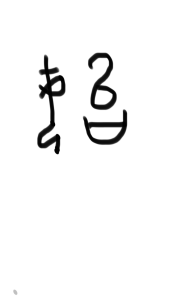
Perhaps it’s wrong for a translator to have favorites… but xuán (玄) makes me swoon. Look at the Western Zhou Bronze Inscription above. Think about the idea that Lâozî probably wrote it just like that! It’s soooooooo evocative. Even six centuries later, the Small Seal Script detailed in the Shuowen Jiezi drew it pretty similarly:

We talked about this character a little in the post about the mysterious feminine essence—and indeed those two characters occur together again in Chapter 15. You can see how they definitely share an invisible cosmic nature. As you recall, the modern definitions of xuán are deep, profound, and mysterious. I would say translators of the Dào do most commonly use mysterious, mysteriously. or mystery, but they also famously and commonly translate xuán as darkness, primal, inner, hidden, supreme, and profound depending on the context. Ahem. Notice how I’m not giving a sermon about how much I dislike inconsistencies of this sort? I call that progress!

What doubly intrigued me about this character the first time I delved into its roots was the description of this glyph as “a string, dyed black.” And then of course I was taken with the string’s figure-eight shape. I immediately thought of the infinity symbol, and my first translation quite romantically included that image. To be fair, I didn’t think it was right to call it a figure-eight since Arabic numerals weren’t introduced to China until sometime between 1271 and 1368 AD—way after Lâozî’s time. But upon further research, I can’t find reliable evidence that the sideways eight was a symbol for infinity in ancient China either. So how can I describe the shape AND, for that matter, why did Lâozî use it?

I think the answer’s held within that first etymological description I read: a string dyed black. How could anyone ascertain those specific details from that image: string, dyed?

If you’re jumping up and down, waving your hand, and shouting “I know, I know!” then you’ve probably done some embroidery, knitting, spinning, or dying of fibers. You might say it looks like a skein. Or technically speaking, a “hank,” though the terms are often interchanged.

A pleasant side trip into the world of fibers:

A hank is a pretty long length of yarn or string arranged into one big open loop like this:

In order to handle a hank during the dying process, the loop needs to be stabilized. And you do that by securing it with figure-eight pieces of thread! Click here for a link to a charming 2-3/4-minute video that shows you how to do that with yarn. A hank with some figure-eights tied in place looks like this (well not really but you get the idea, especially if you watch the video):
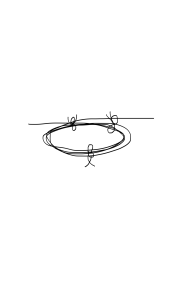
Once the fibers are dyed, it’s easier to handle, transport, and store a hank if you twist and fold it into a sturdy coil. Click here for a link showing a quick way to make a coil. The end result does look sort of like several figure-eights attached to each other end-to-end (I hope you’ll look at the video as my sketches aren’t great!):
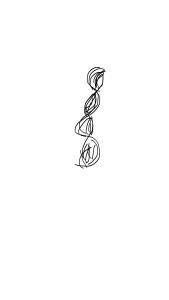
Why am I getting into all this besides the fact that it’s always super interesting to voyage into a sub-world of skill and knowledge? Because I’m trying to understand the concept and pictogram of figure-eight of string dyed black. So far we haven’t seen anything exactly like the xuán character, though the figure-eight ties are obviously ringing a bell.

A few definitions:

  • In theory, a coil is still a hank, and
  • a “skein” is technically 1/16th of a hank. But many people nowadays call the coil arrangement a skein, especially for
  • “string, twine, rope, cord, or yarn” which are defined as several strands or threads of fiber twisted together.
  • A “strand or thread” is technically one individual piece of long, thin fiber.
  • Except for “embroidery thread.” These individual strands are so fine that they’re commonly twisted together for ease of sale. We rather mistakenly but commonly call the result “thread,” though it’s technically string. Embroidery thread—be it wool, cotton, or silk, as was likely the case in Lâozî’s world—comes arranged in a very particular shape, also called a “skein.”

I hope you’ve seen these colorful little embroidery skeins and are getting excited thinking about it because… THEY DO kind of resemble figure-eights. And silk embroidery thread—which still almost always originates in China—exactly does because it has only one paper band squeezing in the center of a loop-shaped hank.

Now, here’s what I’m thinking. What if the technique for stabilizing hanks of fiber for dying is similar the world over and for generations past, including in ancient China? And what if they didn’t use paper bands to hold together embroidery thread skeins but rather… the same figure-eight tie they used during dying processes?

I decided to try that out. With black thread. Here’s my result:
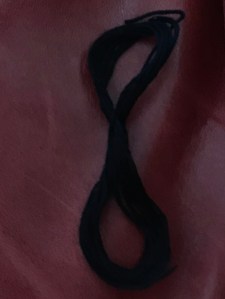
So cool, right?! But very hard to see… ohhhhhhhh. Have you ever worked with black thread? It IS hard to see. When you want stitching to be visible, you use light thread. I start to understand the translations like darkness and mystery.

Meanwhile, I re-arranged light, flashes, and background so you can see this little skein more clearly:

So cool. Still hard to see the center though (we hear you, Lâozî!). More light, bigger, closer…

It’s a figure-eight all right. And see the figure-eight string tie holding the figure-eight string into its characteristic shape?! What a lovely character and metaphor, thought Lâozî.

Back to translating

And even though Lâozî didn’t use the word “eight,” I’m going to modify my translation to insert this picture into a modern reader’s mind exactly as it’s shown in the pictogram:

mysterious figure-eight of string dyed black

We’re not going to wrap up Chapter 1 today since I got a little carried away with the thread experiment—yes, in order to be transparent I must report that some threads and part of my sanity were injured in the making of this blog….
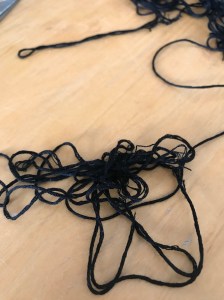
Plus it will be nice for us all to have a day or two to let this thread image knock around in your unconscious with what we have read so far. Tomorrow, we’ll clean up a few words in Chapter 1, and then on Wednesday… put it altogether. Or as you and I like to say: .

Thank you so much for joining me today for what’s definitely the most exciting blogging day yet, for me anyway. I look forward to your comments!
Categories
#1 Shî Xuán

beginning in and by a woman

shî

Remember how, during my post about , I changed my own translation to include more of the actual picture shown in the script from Lâozî’s own time? I just did it again with today’s character, shî. Writing out my rationale to you is having a big effect on this project and shaping my perspective on translations I’d settled on over a year ago! So thank you for reading along and for your ideas and support. It’s results in a powerful alchemy.

So, back to today’s character. The modern version might look familiar to you:

The left hand component is the same kneeling woman (person with breasts) we saw in xuán, the mysterious feminine essence:

The right-hand component (台) is considered the phonetic part of the character, giving us a pronunciation cue—it’s pronounced which rhymes with the overall word’s sound. You can see it is itself a compound character. I find two different ways of looking at the top sub-subcharacter. On one hand, 厶 comes from an old pictogram that looks like this:

This character is from the Warring States (WS) era bronze inscription, so more than likely this came from just after Lâozî, but it’s the closest I can get for now. It’s considered to be a picture of revolving around oneself or self-circling and meant private.

Even though I would have tended to think that was the origin of this sub-sub-component, more sources say it’s the character 㠯, and that this is the phonetic clue for . Not much else besides the pronunciation seems very certain. The pictogram and meaning are mysterious. The Western Zhou Bronze Inscription character from Lâozî’s time looked like this:

Some say that’s a plough; others say its a turned version of the pictogram for a snake or a fetus. In modern times, its use is mainly in a different word also pronounced , 以, where it’s morphed into being written in the form of the left-hand component you see there. It’s meaning is by, according to, or by means of.

The lower sub-sub-component (口) is another one that’s familiar to you. It’s a mouth, which sometimes means mouth, sometimes indicates someone is “saying” the thing in whatever other picture it’s drawn next to, and sometimes refers to a hole in something (entrance, exit, mouth of a cave, etc.) :

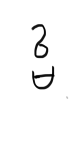
Together, these two added up to a compound character 台 that was the original character meaning happy. In the 4th-3rd centuries BC it came to mean I or me. I can’t find an old image of this word, so I drew how it might have looked when Lâozî drew them together:

And when we put that with the kneeling woman in the left sub-component, it would look like this:

That’s the complete old glyph style drawing of today’s word, shî, usually translated as begin, start, beginning, starting, or initial. But… after I saw the etymology described as “beginning in and by a woman,” I decided to re-think those ordinary translations.

In fact, fittingly, this is the very first, the beginning etymological reference I noticed on Hilmar Alquiros’ website. It’s what started this project of mine. I was quite taken with its beauty and amount and quality of interesting information. To keep the original feel, I decided conception was a better translation, and you saw me use that in my initial translation of Chapter 1 in my very first post.

The thing is, typing all this to you, I remember that when I decided on that word, I was still trying very hard to come up with simple, preferably one-word translations to make it easier to read and in keeping with the one-word nature of each character in the Tao Te Ching. Heck they are all one syllable!! But in the last year and a half, I’ve evolved more and more to believing it’s valuable to include as much information as I can to give the reader—be it me or you—regarding the experience of the old glyph as LâoZî may have drawn it.

For that reason, I’m now going with the translation I first saw:

beginning in and by a woman

One thing immediately reinforced my belief that this way of interpreting the characters is valuable: the recurrence throughout Chapter 1 of this kneeling person with breasts.

~

Remember the context of this character in Chapter 1: it’s when Lâozî’s telling us that “Not-Being, its name is Sky-Earth’s beginning in and by a woman.” I’m going to get into how in the world we can interpret this phrasing, probably the day after tomorrow. But meanwhile, just note that in the very next pair of lines, we learn that “Being, its name is The TenThousand Things’ suckling.” Of course suckling was the term I decided to use back in my one-word translation days. Let’s look at it again.

The actual word, (母), looked like this:

Yup, the kneeling person’s breasts now have distinct nipples a lá a nursing woman, female, older woman relative, or mother. Most translators use that last word. I want to keep the word “woman” so we can “see” it shares a sub-component with shî, so I’m modifying my original translation to this:

suckling from a woman

And then a few lines later, and in the very last line also, we see our kneeling woman in the form of xuán, the mysterious feminine essence—a few drops of that womanly essence:

All these female-specific words do notably contrast with that male-specific image in the word cháng, the ever-present square fabric which our grown men wrap around the ‘little bird’ top knots on their heads after receiving their public courtesy-names—or what we know as the timeless, whole-cloth ‘ji’ version of… things and, for that matter, in the word ér, and yet—now bearded. It remains to be seen what we can make of these gender-specific terms. Other characters (the dancer in , the loose-haired chieftain in dào, the person being named in míng) have no specific gender, nor do most terms and pronouns in Chinese.

I had considered wrapping up Chapter 1 today, but I felt negligent not talking to you about these other concepts and so instead dove into these words, and thank goodness since it led me to some worthwhile tinkering. I best not move on without delving into a few more. Tomorrow I think we’ll get into Heaven… or at least the sky and its heavenly implications. I’ll see you then. Thanks for visiting here again and following this translation’s evolution. I look forward to your comments!
Tinkered with 3/10/20

Categories
#1 Jiâo Miào Xuán

mysterious feminine essence—a few drops of that womanly mist

miào

Welcome back! I’m grateful you’re here. Let me get straight to the point: you probably returned because of the confounding puzzle in yesterday’s post… namely the Dáo Dé Jīng’s first chapter! And more specifically, I bet (or hope!) you were particularly struck by the character that I translated as: mysterious feminine essence–a few drops of that womanly mist.

The name of that character is miào:

Yup — I couldn’t make this stuff up!

This intriguing term appears TWICE in Chapter 1. And it does so in sort of a baffling Russian doll fashion. When you try to follow the logical layout of Chapter 1 (which we’ll do together in a minute), you find it’s as if miào is a small interior doll BUT ALSO somehow comprised of or entered via the complete make-up of a Russian nesting doll itself. It’s like the over-arching structure of how things work is the entryway into this substance that makes up one tiny part of it? Hmmm… sort of like a fractal but not exactly. Let’s see if the pictogram version of this word illuminates things for us.

~

As is always the case when I can’t find a Western Zhou Bronze (WZB) Inscription character for a modern character that’s made up of multiple images, I looked into each of the two components of this word. The left sub-component is a drawing of a woman. The old WZB glyph shows a kneeling person with breasts (that sort of curly-queue around her torso):

The even older Oracle Bone Script glyph—the most ancient version of every Chinese character—is almost identical:

That similarity’s important to me because when I started looking into the right-hand sub-component, I couldn’t find a WZB inscription version. But I did find an Oracle Bone Script glyph of this character, and I figure Lâozî, an accomplished court scribe, and his peers were familiar with it too. This pictogram of four dots means few or little in number:

This sub-component is considered to be the phonetic part of the word—in other words it carries the sound of the word. This character on its own is pronounced shǎo, so presumably when combined with the first sub-component, we see that the new word, in this case, ends with that “ao” sound.

Together, the two components might look like this:

You can see how the modern Chinese character, , incorporates the updated symbol for woman on the left and re-arranges the four dots in the right-hand component.

When the two components were combined into one, that compound character miào came to mean mysterious, subtle; fine, glorious; ingenious; exquisite. What a gorgeous word. And when it comes to interpreting Lâozî’s use of it, things get even more interesting. Stephen Mitchell translates it variously as mystery and all understanding in Chapter 1 ,wisdom in Chapter 15, and the great secret in Chapter 27. Gia-fu Feng and Jane English stuck with mystery both times the character appears in Chapters 1 and 27, but in Chapter 15 they called it unfathomable. Yi Wu used myriad subtleties or essential subtlety. Thomas Cleary follows his lead in some places, but in this first chapter calls it marvels.

So now you can see how I came up with my translation by combining the abstract meanings as well as the actual images. Even though the four little drops are supposedly “only” the phonetic part of this word, that sense of a little bit of something seems crucial to the word’s meaning, so I included them in the one phrase I decided to use everywhere this character appears:

mysterious feminine essence–a few drops of that womanly mist

It’s quite a word. And somehow a keystone in The Way that Lâozî’s describing. As you remember from yesterday, Chapter 1 lays it out like this:

  • Lâozî first describes for us this yoked, matching pair of core concepts (Not-Being and Being) then
  • outlines how each of those core concepts lies at the beginning of an important part of our universe (Not-Being is Sky-Earth’s conception, and Being is the suckling of all the material stuff or what is known in Chinese as “The 10,000 Things”), and then
  • tells us what each of those “holds a basket of” (miào and jiâo, respectively). Miào is associated with Not-Being, and that’s what we’re exploring here today. As for Being’s jiâo (徼), its WZB character shows four sub-components: left, white/acorn/or skull, sword tip, and right.While its modern translations is frontier, border, patrol, or inspect, other Dào translators have called it manifestations, outward, or the surface. I translate it as delineated surface because the sword is said to be drawing a line from left to right.
  • We then find out that these two core concepts actually started out altogether but that when they stepped out into the world, they became known by different titles. When they’re together though… what they’re REALLY called? Well that possesses something that may be my favorite word of all: xuán (玄). It deserves its own post on here for sure! Suffice for now to say that while others translate it as darkness or mystery, I absolutely want you to know that its glyph is a picture of a mysterious infinity-loop of string dyed black: Seriously. It is. I imagine you can see where my physics-happy mind goes!
  • Furthermore it turns out that this mysterious infinity-loop of string dyed black ITSELF also possesses, has, or is somehow made of… yes: mysterious infinity-loop of string dyed black.
  • Mind=boggled.
  • But here’s the grand finale, the last line of Chapter 1 and what seems at this point to be the outermost Russian nesting doll:

The sun shining down like an eye on the people sees all this, sees mysterious feminine essence—a few drops of that womanly mist—has this double-winged gateway.

~

So there you have it. We now know that today’s featured heroine, the mysterious feminine essence—a few drops of that womanly mist—known as miào, is what’s held by Not-Being and that it may be entered via a double-winged gateway that seems to be the entire Not-Being/Being situation outlined above in which Not-Being/Being are really the same thing and, though differently masked/named once they step out into the world where one of them is the origin of heaven-and-earth and the other is the origin of all of its material inhabitants, in fact what they’re really called when they’re together has this mysterious infinity-loop of string dyed black. And this is the mysterious-infinity-loop-of-string dyed black’s own mysterious infinity loop of string dyed black.

I couldn’t love it more.

~

Thank you so much for sticking with me on this big trip. I hope you’re feeling a little disoriented. I am, and I think that’s key. We’re just at the beginning, after all. Tomorrow let’s double-back and look at pictures of Not-Being and Being. I bet that’s not an invitation you get everyday! I can’t wait.

*Updated 1/5/20 to include the specifics of the jiâo and xuán translations.*