Categories
#10 dé 德 Miào Xuán

the Dé—an Ethics system that’s the straight-heart-core of the way

dé (德)

Right in the first chapter, we became aware of a hard-to-see dark structure—like a figure-eight skein of string-dyed-black (xuán). It underlies the true name of the matched pair of Being and Not-Being when they’re together… before stepping out of the cave and acquiring different personal childhood names. And then that hard-to-see dark structure of a figure-eight string dyed black, in turn, has a hard-to-see dark structure of a figure-eight string dyed black. And that—the whole arrangement?—is mysterious feminine essence’s (miào) double-winged gateway.

Now in Chapter 10, we learn more about this mysterious dark structure. And we learn about it in the context of our hero receiving an assignment to complete a task. The previous chapters have led up to this task nicely. Here’s what we learned before:

  • Chapter 7: Heaven-Earth is now long-lasting and “capable of lengthy birthing” and that means
    • the sage’s pregnant self, now bearded, is surviving and
    • the wings are broken off of Not-Being’s disastrous personal concerns, and therefore Not-Being’s capable of completing personal concerns [non-disastrous ones, I presume].
  • Chapter 8: Regarding higher-level ruling traditional virtue:
    • “Someone” says that now bearded, you’re not really competing. [I assume that’s continuing the explanation of how the sage is avoiding disastrous personal concerns.] And we learn that this is very close to The Way.
    • There’s a list of what I assume are the non-disastrous things that are of concern to you: abiding, heart core, speaking, being straight upright, one’s personal role, and laboring. And there’s a corresponding description of what each of these looks like to traditional virtue. In the end, our narrator re-emphasizes that this particular man who’s essentially and only not-competing is therefore, by logic, Not-Being in particular. And possibly this Not-Being has been made lame by resentment and blame. Resentment and blame on the part of themselves or of someone else, like traditional virtue? It’s delightfully ambiguous as usual.
  • Chapter 9:
    • If you, now bearded, are over-doing things, then it’s not really going to be helpful:
      • You’re not going to be finishing what’s in the womb, not long safeguarding a child, not capable of defending your place… you will leave behind you only calamity.
    • Alternately, if one’s pregnant self withdraws after real labor’s completed, then that’s Heaven’s Way of the loose-haired chieftain, walking awhile, stopping awhile, listening, and speaking of it all. That’s exactly The Way.

And now here, in Chapter 10 someone lists what I assume are the very real specific, almost paradoxical details of exactly following The Way. And then they challenge, “pah, can you?!

  • Can you carry the physical soul and spiritual soul bundled up into one… with being separated from Not-Being?
  • Can you control chi or breath of life and cause softening… with an infant son?
  • Can you do the washing and arranging for moving me to a new mountain posting and have the hard-to-see dark structure that’s like a figure-eight skein of string-dyed-black reflecting like a vessel looking down—all eyes—overseeing… with Not-Being ill on a stretcher?
  • Can you love the civilians and regulate this nation by harnessing the river Happy and regulating yourself… with Not-Being very sure every day?
  • Can you unlatch Heaven’s double gateway and shut it—like a person with a mouth between their legs withdrawing and covering an empty chalice from within the double-winged gateway… with efforting femaleness?
  • Can you be as bright as dawn rising on a crescent moon—enlightened—and have hundreds arriving in all four directions like little lambs… with Not-Being very sure every day?

You can see the verbatim text here, and go here to read others’ traditional translations that leave out all the imagery from the old script. But you have to admit, it’s crazy how much that imagery has to do with having a baby, yes? And how it would fit exactly with my theory that our hero is a pregnant Not-Being—a shamanic woman—posing as a man? She’s trying to do all the impossible things involved in being a pregnant woman while also being a government official. It’s a lot.

The narrator concludes by saying there IS one example of doing all this stuff at once. It comes from nature:

Birthing—a bud sprouting from the ground

has this;

rearing animals—giving them feed from a bag tied with a rope

has this.

But for our hero to do it all? The narrator sums up that situation:

Birthing—a bud sprouting from the ground—

and yet now, bearded, you…

the husk of the initial protective bud casing but not really the true inner flower of

Flesh-and-blood, meat-holding Being;

efforting—like lifting up an elephant—

and yet now, bearded, you…

the husk of the initial protective bud casing but not really the true inner flower of

expecting that will be holding one’s heart-core like a mother;

lengthening like long hair, 

and yet now, bearded, you…

the husk of the initial protective bud casing but not really the true inner flower of

dominating—like the house of that chisel used to mark slaves and criminals.

Our narrator gives our hero, or maybe us, a hint as to how to simultaneously rule and birth while not really a Being:

The sun—walking across the sundial a while, stopping a while—sees indeed

what it’s called when speaking from the gut…

the hard-to-see dark structure—like a figure-eight skein of string-dyed-black…

the Dé—an Ethics system that’s the straight-heart-core of the way.

The Dé is the famous subject of the second half of the Dào Dé Jīng (Chapter 38 through 81). It’s considered to be a set of principles for application of the Dao, for living according to The Way. And it makes its first appearance here, where our hero is tasked with an almost impossible challenge.

~

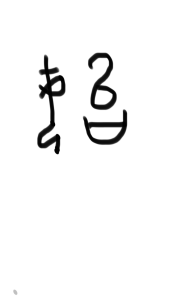
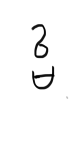
The old Western Zhou era script shows a compound character. The left side is the symbol for a path, the same as that shown in the Dao. The right hand side show a heart on the bottom. And on the top is a drawing that means “in the center.”

I translate it as:

the Dé—an Ethics system that’s the straight-heart-core of the way

~

Here, in its first appearance, we learn that the Dé is tied to the mysterious structure that underlies the deep union [and yet surface separation] of Being and Not-Being. And based on its appearance in this chapter, it’s all tied to our hero’s challenge. How?

How does the Dé help our hero combine all the complex tasks necessary for this dual role? In the next chapter, we get more details on how this matched pair and its figure-eight structure loop together. Until then, please use the contact form to send me your comments. I look forward to each one. And thank you for being here.

Categories
#6 cún 存 Cháng Dào dì 帝 Fú 夫 lâo 老 mián 綿 ruò 若 Tiān Xuán xī 希

someone compliantly combing their loose hair seems to be saying: ‘this is as if…’

ruò (若)

Within that valley mouth between two mountains,

a lightning god…

the husk of the initial protective bud casing—the sepal—but not really the true inner flower of

being mortal—going from a standing person to a pile of bones;

the sun—walking across the sundial a while, stopping a while—sees indeed

what it’s called when speaking from the gut—words, like slaves or criminals branded by a chisel emerging from a mouth,

the hard-to-see dark structure—like a figure-eight skein of string-dyed-black:

a mother’s lap—a cow with an arrow… a vagina.

“Hard-to-see dark structure—like a figure-eight skein of string-dyed-black,

a mother’s lap—a cow with an arrow… a vagina,

has this

double-winged gateway… “[from Chapter 1]

the sun—walking across the sundial a while, stopping a while—sees indeed

what it’s called when speaking from the gut—words, like slaves or criminals branded by a chisel emerging from a mouth:

Heaven (that sky level above the human head)-Earth (this soil vagina)…

root of the family tree—penis…

barely perceptible—like the fine, white silk threads making up that ever-present, timeless, whole head-cloth ‘ji’ our grown men wrap around the ‘little bird’ top knots on their heads once they’ve received their adult, public courtesy-names.

Barely perceptible—like the fine, white silk threads making up that ever-present, timeless, whole head-cloth ‘ji’ our grown men wrap around the ‘little bird’ top knots on their heads once they’ve received their adult, public courtesy-names…

someone compliantly combing their loose hair seems to be saying: ‘this is as if…’ (ruò, 若)

surviving—on the plane of a baby with health issues, maybe a large head, but still sprouting… (cún,存)

doing truly useful work like a water bucket—by means of carrying-capacity

has this…

the husk of the initial protective bud casing, but not really the true inner flower, of

exerting with force—working hard with the strength of an arm, a bladed tool, or a plough on the soil.

That’s all of Chapter 6 in its entirety. It’s a pivotal chapter because here we meet a new character, ruò, 若. Its bronze inscription character is a pictogram of a person combing their hair:

Its modern translations are to be obedient or compliant, to trim vegetables, to choose, you/yours, he/his, like, as if, and supposing. Dào translators usually interpret it as is like, seems, or as. Or they just ignore it altogether or use “is” in its place. In two key places in Chapter 37, the final chapter of the Dào part of the Dào Dé Jīng, they almost universally translate it as “if.” As is my custom, I incorporate the modern meanings, the pictogram, and the traditional translations into one consistent translation every where it occurs:

someone compliantly combing their loose hair seems to be saying: ‘this is as if…’

Since there are other, more specific, ways to say each of the traditional meanings (if, like), I think this character has some particular use for Lâozî.

~

It’s interesting that ruò so prominently features hair since that’s a recurring motif… beginning with The Way itself. In the character for Dào, the head very obviously has a head of big loose hair.

And in Chapter 1, right away we’re struck by how that seems to very obviously differ from the conventional hairstyle of a grown man with a top knot (, 夫) and especially from a grown man whose top knot’s covered by a traditional head cloth. This head cloth image occurs not only in that word for the timeless, never-changing traditional version of things (cháng, 常) but also in the characters showing God in Heaven or emperor (, 帝, as we saw in Chapter 4), barely perceptible (mián, 綿, as we see in this chapter), and sparse (, 希).

Hair style appears in many other characters including, not least of all, lâo, 老: an old man with long hair and a cane. This word is the first part of Lâo Zî’s honorific name.

~

It’s fascinating to me that this character ruò first appears in this particular place in our story. In Joseph Campbell’s classic Hero’s Journey story arc, this is the place where the hero would get outside help, usually from a supernatural, larger-than-life, or unexpected source.

In the last chapter, there was the doubtful sentiment of “pah, can you?!” The call to the daunting adventure of living according to The Way of the Loose-Haired Chieftain seemed rather undoable. But now we have someone compliantly combing their loose hair who seems to be saying: ‘this is as if’ surviving—on the plane of a baby with health issues, maybe a large head, but still sprouting.

Chapter 4 introduced the possibility of surviving. But here, our magic someone not only rather drolly says that’s what’s happening but elaborates what this means: the doing of truly useful work (like a water bucket) has this: non-exertion.

OHHHHH. Doing useful work like a water bucket without overflowing (while pouring water our from the center hollow drum!) was the calling for The Way at the beginning of Chapter 4.

So what does Chapter 6 tell us?

  • Here’s the situation: The lightning god within that valley mouth between two mountains isn’t really turning into a pile of bones. Phew.
  • The sun sees indeed what it’s truly called, that hard-to-see dark structure—like a figure-eight skein of string dyed black:a mother’s lap/vagina…
  • and the “hard-to-see dark structure, a mother’s lap/vagina’s double-winged gateway” (remember that phrase dramatically ending Chapter 1?) is truly called… Heaven-Earth… root-of-the-family-tree or penis…
  • barely perceptible. Mián, 綿, or “barely perceptible” is drawn by showing the fine, white silk threads making up that ever-present, timeless, whole head-cloth ‘ji’ that grown men wrap around the ‘little bird’ top knots on their heads once they’ve received their adult, public courtesy-names. The modern translation of this word is soft, downy, or sometimes cotton. Dào translators variously call it continuously, always present, like a veil, lingering like gossamer, or invisible.

As usual, the lack of punctuation and various potential syntaxes make those first five lines interpretable in many ways. Also as usual, I interpret it based on how the drawings and double-meanings make something occur to me. What with all the pregnancy and baby images, I’m starting to think that Heaven (tiān, that sky level above the human head)-Earth (dì, this soil vagina) refers to a spirit from above when it is down here, manifest, in the womb. In other words a fetus.

In the Western Zhou bronze inscription age just preceding Lâozî’s era, tiān was drawn as a person with a large head:

In the even older Shang oracle bone script, it was drawn with a line above a person’s head, supposedly indicating a higher level:

It is thought that the oldest meaning was sky. It’s also been used to mean heavens, celestial, heaven as a place for deities or departed souls, heaven as a deity, overhead, top, climate, a 24-hour day, daytime, season, nature, natural, innate.

So is my interpretation far-reaching? Maybe. But when I re-read everywhere this phrase occurs, it totally can fit this secondary-level interpretation at the same time that it fits into a meta- or symbolic story about “Heaven on Earth” or “Heaven and Earth.” In this use of it, I see someone literally trying to figure out what’s going on inside a laboring uterus and barely being able to discern the fetus. Maybe they can tell it’s a boy? Or maybe they know that after the fact. Or maybe the vagina’s product is called the family root, attributed to the work of a penis. Okay back to what we see for sure…

  • Even though it’s barely perceptible, our magically helpful someone, compliantly combing their loose hair, seems to be saying: ‘this is as if’ it’s surviving —on the plane of a baby with health issues, maybe a large head, but still sprouting. Now you can see how, based on my imagination and the previous and following chapters, I like to think of our someone as a midwife helping with premature labor.
  • And given this situation, she says that surviving means doing truly useful work like a water bucket, by means of carrying capacity, has this “not really exerting with force.” I see that as “the most useful work now is just to carry that baby. Don’t labor. Especially don’t push.”

There you go… I’ve fully bared my most wild, favorite theory. And you can understand my admiration for Lâozî, given that this story is buried within characters that ALSO can be translated as a cosmic, existential, life handbook. Here’s how Yi Wu translates this chapter:

The spirit of the valley never dies;
It is called the mysterious female.
The gate of the mysterious female is called the root of Heaven and Earth.
Continuously it seems to exist.
There is no labour in its use.

And here’s how Feng and English translated it:

The valley spirit never dies;
It is the woman, primal mother.
Her gateway is the root of heaven and Earth.
It is like a veil barely seen.
Use it; it will never fail.

Thomas Cleary translates it as:

The valley spirit not dying is called the mysterious female.
The opening of the mysterious female is called the root of heaven and earth.
Continuous, on the brink of existence, to put in into practice, don’t try to force it.

Is this non-forcing possible? Sometimes—whether because you’re in actual labor or you’ve found yourself in the habit of over-efforting in life and not relying on the “female” type of creativity—it doesn’t seem like it. Can our magical someone help in ways more tangible than just saying “don’t labor; don’t force it?”

We’ll find out next time. And now, until then, please use the contact form to send me your responses to my theory! I hope you’ll go back and re-read all the chapters we’ve looked at thus far and see how my ideas do or don’t make sense to you. Thanks for being here.

Categories
#2 Gōng 功 Lì 力 Qín 勤 Wéi 為 Xuán Yòng

efforting—like lifting an elephant—

wéi

I love the modern character, 為, and the old compound character of wéi is equally descriptive:

When you pull it apart you see it shows a hand (albeit upside down as if doing biceps crunches)…

…lifting up an elephant:

Wéi‘s modern meaning is to do or to make. It can also mean govern, construct, transform or turn something into, act as, be, and more. Dào translators call it so many different things: act/action, act upon, improve, try to change, do what you want with, tamper with, grab after, contrive, do work, make, achieve things, accomplish tasks, perform deeds, strive for, interfere, guided by, play the role of, merge, join together, fuse, capable of doing, can be, set, become, the nouns form, model, or action, and quite often simply, has, is, be or do. I would say they’re all trying to capture this sense of a human applying a hardcore sort of force to something big, heavy, or significant in nature in order to get something done. My translation is:

efforting—like lifting an elephant

~

Wéi figures prominently into a couple of my favorite chapters where Lâozî explains the way of the world by comparing it to what it’s not. For example, in Chapter 11, Lâozî specifies that wéi is what we do to clay or wood when we are efforting those physical things into the shape of a pot or a living space. And then Lâozî contrasts this efforting with Not-Being’s yòng (用):

doing truly useful work—like a water bucket—by means of carrying capacity

I found a Spring and Autumn Bronze Inscription image for this character which always makes me happy since that’s the script I believe to be the closest to Lâozî’s own hand (as described in the tab Dates, dynasties, their scripts, and my preferences). It’s a pictogram of a water bucket:

What a perfect illustration of how negative, receptive space is useful. Modern translations of the character are use, employ, operate; utility, usefulness, use [nouns]; to eat or to drink [in an honorific way]; expenses, outlay; with, by, using. Dáo translators most commonly call it useful, usefulness, and use. You can see this is a classic example of how one word can be noun, verb, or adjective in Chinese thus setting up the potential translation inconsistencies I like to avoid by using gerunds (“___ing”). In a few places, translators also call it potential, put into practice, draw upon, plus other non-related things that infer actions based on the nouns in the sentence.

In Chapter 6, yòng is part of a paradox describing our old friend, xuán, the hard-to-see darkness of a figure-eight of string dyed black. That short chapter concludes its description of xuán by saying:

Doing of truly useful work—like a water bucket—by means of carrying capacity (yòng)

has this…

the husk of the initial protective bud casing, but not really the true inner flower, of

exerting with force—with the strength of an arm, a bladed tool, or a plough on the soil (qín).

So here yòng‘s contrasted with yet another type of “doing,” qín (勤). In fact, with Lâozî’s use of , we get the specific sense that yòng may look like this other kind of work and be related to it in some way, especially at the beginning, but it’s not really that at all. Qín translates in modern times to industrious, diligent, and attentive, but traditionally it specifically meant laboring. This compound character’s right-hand component, (), is considered to be the semantic part that imparts meaning. In Bronze Inscription script it looked like this:

This is considered to be either an image of an arm bending out from the body (those bicep crunches again) or a plough. It means physical strength. In physics, it’s the technical term for Force where it has the particular meaning of a quantity calculated by multiplying mass times acceleration. This sub-component shows up in a lot of words and also occurs on its own as a character once in the Dào in Chapter 33 where I translate it as:

forcefulstrong like an arm, a bladed tool, or a plough

The left sub-component of qín is considered to be the phonetic part that tells us how to pronounce the word. It is indeed pronounced qín, and on its own now means clay. The etymology of this word thus far eludes me… I will keep after it. However, until then, you can see I incorporated its meaning into my translation of qín as is my want:

exerting with force—with the strength of an arm, a bladed tool, or a plough on the soil

This character looks very much like one we will see in our next post about the latter half of Chapter 2, gōng (功). Just looking at gōng‘s modern character, you recognize the strong-arm/plough sub-component on the right meaning force. The left sub-component, its phonetic element gông (), is a bladed tool:

On its own, gông has the modern meaning of labour or work, laborer or worker, industry. When combined with the strong-arm/plough character, it’s taken on the meaning of achievement. And it’s used in physics as the technical term for Work, calculated as Force times distance. In other words, work is done when a force accelerates a mass through a distance. A force on its own isn’t “going anywhere.” Only when it exerts that effort to move something somewhere is it officially Work. I translate this character as:

really working—laboring with the force from a bladed tool, one’s arm, or a plough—

~

As you can tell, I’m gathering a list of the various and subtly different ways Lâozî talks about “doing stuff.” Partly I’m super interested in this because my original career was an engineer (!), and so not only am I used to being precise about these words but also I love considering the physics of the Dào Dé Jīng. In fact, that was one of the original three motivators for this whole Dào project. So here’s what we have so far under the category of “ways to do things”:

  • wéi, 為: efforting like lifting an elephant (occurs 51 times in the first 37 chapters of the Dào)
  • yòng, 用: doing truly useful work—like a water bucket—by means of carrying capacity (occurs 11 times, 4 of those are in Chapter 11)
  • qín, 勤: exerting with force—with the strength of an arm, a bladed tool, or a plough on the soil (occurs only once, in Chapter 6)
  • gōng, 功: real work—laboring with the force from a bladed tool, one’s arm, or a plough— (occurs in 6 spots in 6 different chapters)
  • , 力: forceful—strong like an arm, a bladed tool, or a plough (1 occurence)

Sometimes, I’m pretty sure a particular one of these characters is used for a poetic reason like rhyme and alliteration. But also, in general, you’ll see as we work our way through the book that yòng, the negative-space “bucket” way of doing things, mostly is associated with Non-Being, The Way of the loose-haired chieftain (Dào), and the grounded sage that Lâozî so often describes for us. The other four more effortful ways of doing things mostly are associated with Being, The Ten Thousand Things, a grown man, civilians, “one’s pregnant self” (traditionally translated as oneself), traditional virtue, and other such concrete players. That said, there will be exceptions to this rule, and it is there that we may gain the most insight into what’s really going on in Lâozî’s schema.

But I say we trust Lâozî to lead us into and through all this in the natural layout of the book, so for now we are firmly in Chapter 2. As we saw in the last post, that’s where Lâozî told us that public opinion firing arrows of certainty about a particular admired “beauty” or traditional “virtue” is really an “efforting” of those traits. It’s like lifting an elephant… i.e., not easy. And not only can we viscerally feel that’s hard and hard to sustain, but also this approach lops off and defines the opposites of those traits before they’re even fully born. With this introduction to “wéi,” it’s safe to say that whenever we see that word from here on out, we’ll remember these consequences that Lâozî’s laid out for us. And furthermore we’ll be noticing and remembering that there is more than one way to go about doing things in the world. We can be feeling which ways seem more appealing and effective. We can be thinking about how we want to feel when we do stuff.

Thank you for joining me here today. Next time, we’ll see what the rest of Chapter 2 has to hold for us. Until then, please keep sending me your comments—they’re super helpful to me.

most recently tinkered with on 2/16/20: modified gōng definition

Categories
#1 Xuán

mysterious figure-eight of string dyed black

xuán

Perhaps it’s wrong for a translator to have favorites… but xuán (玄) makes me swoon. Look at the Western Zhou Bronze Inscription above. Think about the idea that Lâozî probably wrote it just like that! It’s soooooooo evocative. Even six centuries later, the Small Seal Script detailed in the Shuowen Jiezi drew it pretty similarly:

We talked about this character a little in the post about the mysterious feminine essence—and indeed those two characters occur together again in Chapter 15. You can see how they definitely share an invisible cosmic nature. As you recall, the modern definitions of xuán are deep, profound, and mysterious. I would say translators of the Dào do most commonly use mysterious, mysteriously. or mystery, but they also famously and commonly translate xuán as darkness, primal, inner, hidden, supreme, and profound depending on the context. Ahem. Notice how I’m not giving a sermon about how much I dislike inconsistencies of this sort? I call that progress!

What doubly intrigued me about this character the first time I delved into its roots was the description of this glyph as “a string, dyed black.” And then of course I was taken with the string’s figure-eight shape. I immediately thought of the infinity symbol, and my first translation quite romantically included that image. To be fair, I didn’t think it was right to call it a figure-eight since Arabic numerals weren’t introduced to China until sometime between 1271 and 1368 AD—way after Lâozî’s time. But upon further research, I can’t find reliable evidence that the sideways eight was a symbol for infinity in ancient China either. So how can I describe the shape AND, for that matter, why did Lâozî use it?

I think the answer’s held within that first etymological description I read: a string dyed black. How could anyone ascertain those specific details from that image: string, dyed?

If you’re jumping up and down, waving your hand, and shouting “I know, I know!” then you’ve probably done some embroidery, knitting, spinning, or dying of fibers. You might say it looks like a skein. Or technically speaking, a “hank,” though the terms are often interchanged.

A pleasant side trip into the world of fibers:

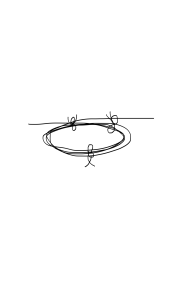
A hank is a pretty long length of yarn or string arranged into one big open loop like this:

In order to handle a hank during the dying process, the loop needs to be stabilized. And you do that by securing it with figure-eight pieces of thread! Click here for a link to a charming 2-3/4-minute video that shows you how to do that with yarn. A hank with some figure-eights tied in place looks like this (well not really but you get the idea, especially if you watch the video):

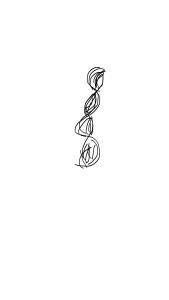
Once the fibers are dyed, it’s easier to handle, transport, and store a hank if you twist and fold it into a sturdy coil. Click here for a link showing a quick way to make a coil. The end result does look sort of like several figure-eights attached to each other end-to-end (I hope you’ll look at the video as my sketches aren’t great!):

Why am I getting into all this besides the fact that it’s always super interesting to voyage into a sub-world of skill and knowledge? Because I’m trying to understand the concept and pictogram of figure-eight of string dyed black. So far we haven’t seen anything exactly like the xuán character, though the figure-eight ties are obviously ringing a bell.

A few definitions:

  • In theory, a coil is still a hank, and
  • a “skein” is technically 1/16th of a hank. But many people nowadays call the coil arrangement a skein, especially for
  • “string, twine, rope, cord, or yarn” which are defined as several strands or threads of fiber twisted together.
  • A “strand or thread” is technically one individual piece of long, thin fiber.
  • Except for “embroidery thread.” These individual strands are so fine that they’re commonly twisted together for ease of sale. We rather mistakenly but commonly call the result “thread,” though it’s technically string. Embroidery thread—be it wool, cotton, or silk, as was likely the case in Lâozî’s world—comes arranged in a very particular shape, also called a “skein.”

I hope you’ve seen these colorful little embroidery skeins and are getting excited thinking about it because… THEY DO kind of resemble figure-eights. And silk embroidery thread—which still almost always originates in China—exactly does because it has only one paper band squeezing in the center of a loop-shaped hank.

Now, here’s what I’m thinking. What if the technique for stabilizing hanks of fiber for dying is similar the world over and for generations past, including in ancient China? And what if they didn’t use paper bands to hold together embroidery thread skeins but rather… the same figure-eight tie they used during dying processes?

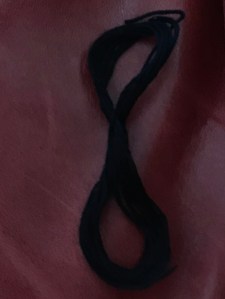
I decided to try that out. With black thread. Here’s my result:

So cool, right?! But very hard to see… ohhhhhhhh. Have you ever worked with black thread? It IS hard to see. When you want stitching to be visible, you use light thread. I start to understand the translations like darkness and mystery.

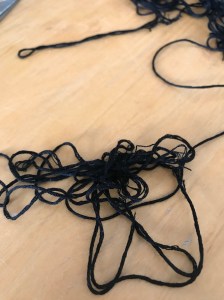
Meanwhile, I re-arranged light, flashes, and background so you can see this little skein more clearly:

So cool. Still hard to see the center though (we hear you, Lâozî!). More light, bigger, closer…

It’s a figure-eight all right. And see the figure-eight string tie holding the figure-eight string into its characteristic shape?! What a lovely character and metaphor, thought Lâozî.

Back to translating

And even though Lâozî didn’t use the word “eight,” I’m going to modify my translation to insert this picture into a modern reader’s mind exactly as it’s shown in the pictogram:

mysterious figure-eight of string dyed black

We’re not going to wrap up Chapter 1 today since I got a little carried away with the thread experiment—yes, in order to be transparent I must report that some threads and part of my sanity were injured in the making of this blog….

Plus it will be nice for us all to have a day or two to let this thread image knock around in your unconscious with what we have read so far. Tomorrow, we’ll clean up a few words in Chapter 1, and then on Wednesday… put it altogether. Or as you and I like to say: .

Thank you so much for joining me today for what’s definitely the most exciting blogging day yet, for me anyway. I look forward to your comments!

Categories
#1 Shî Xuán

beginning in and by a woman

shî

Remember how, during my post about , I changed my own translation to include more of the actual picture shown in the script from Lâozî’s own time? I just did it again with today’s character, shî. Writing out my rationale to you is having a big effect on this project and shaping my perspective on translations I’d settled on over a year ago! So thank you for reading along and for your ideas and support. It’s results in a powerful alchemy.

So, back to today’s character. The modern version might look familiar to you:

The left hand component is the same kneeling woman (person with breasts) we saw in xuán, the mysterious feminine essence:

The right-hand component (台) is considered the phonetic part of the character, giving us a pronunciation cue—it’s pronounced which rhymes with the overall word’s sound. You can see it is itself a compound character. I find two different ways of looking at the top sub-subcharacter. On one hand, 厶 comes from an old pictogram that looks like this:

This character is from the Warring States (WS) era bronze inscription, so more than likely this came from just after Lâozî, but it’s the closest I can get for now. It’s considered to be a picture of revolving around oneself or self-circling and meant private.

Even though I would have tended to think that was the origin of this sub-sub-component, more sources say it’s the character 㠯, and that this is the phonetic clue for . Not much else besides the pronunciation seems very certain. The pictogram and meaning are mysterious. The Western Zhou Bronze Inscription character from Lâozî’s time looked like this:

Some say that’s a plough; others say its a turned version of the pictogram for a snake or a fetus. In modern times, its use is mainly in a different word also pronounced , 以, where it’s morphed into being written in the form of the left-hand component you see there. It’s meaning is by, according to, or by means of.

The lower sub-sub-component (口) is another one that’s familiar to you. It’s a mouth, which sometimes means mouth, sometimes indicates someone is “saying” the thing in whatever other picture it’s drawn next to, and sometimes refers to a hole in something (entrance, exit, mouth of a cave, etc.) :

Together, these two added up to a compound character 台 that was the original character meaning happy. In the 4th-3rd centuries BC it came to mean I or me. I can’t find an old image of this word, so I drew how it might have looked when Lâozî drew them together:

And when we put that with the kneeling woman in the left sub-component, it would look like this:

That’s the complete old glyph style drawing of today’s word, shî, usually translated as begin, start, beginning, starting, or initial. But… after I saw the etymology described as “beginning in and by a woman,” I decided to re-think those ordinary translations.

In fact, fittingly, this is the very first, the beginning etymological reference I noticed on Hilmar Alquiros’ website. It’s what started this project of mine. I was quite taken with its beauty and amount and quality of interesting information. To keep the original feel, I decided conception was a better translation, and you saw me use that in my initial translation of Chapter 1 in my very first post.

The thing is, typing all this to you, I remember that when I decided on that word, I was still trying very hard to come up with simple, preferably one-word translations to make it easier to read and in keeping with the one-word nature of each character in the Tao Te Ching. Heck they are all one syllable!! But in the last year and a half, I’ve evolved more and more to believing it’s valuable to include as much information as I can to give the reader—be it me or you—regarding the experience of the old glyph as LâoZî may have drawn it.

For that reason, I’m now going with the translation I first saw:

beginning in and by a woman

One thing immediately reinforced my belief that this way of interpreting the characters is valuable: the recurrence throughout Chapter 1 of this kneeling person with breasts.

~

Remember the context of this character in Chapter 1: it’s when Lâozî’s telling us that “Not-Being, its name is Sky-Earth’s beginning in and by a woman.” I’m going to get into how in the world we can interpret this phrasing, probably the day after tomorrow. But meanwhile, just note that in the very next pair of lines, we learn that “Being, its name is The TenThousand Things’ suckling.” Of course suckling was the term I decided to use back in my one-word translation days. Let’s look at it again.

The actual word, (母), looked like this:

Yup, the kneeling person’s breasts now have distinct nipples a lá a nursing woman, female, older woman relative, or mother. Most translators use that last word. I want to keep the word “woman” so we can “see” it shares a sub-component with shî, so I’m modifying my original translation to this:

suckling from a woman

And then a few lines later, and in the very last line also, we see our kneeling woman in the form of xuán, the mysterious feminine essence—a few drops of that womanly essence:

All these female-specific words do notably contrast with that male-specific image in the word cháng, the ever-present square fabric which our grown men wrap around the ‘little bird’ top knots on their heads after receiving their public courtesy-names—or what we know as the timeless, whole-cloth ‘ji’ version of… things and, for that matter, in the word ér, and yet—now bearded. It remains to be seen what we can make of these gender-specific terms. Other characters (the dancer in , the loose-haired chieftain in dào, the person being named in míng) have no specific gender, nor do most terms and pronouns in Chinese.

I had considered wrapping up Chapter 1 today, but I felt negligent not talking to you about these other concepts and so instead dove into these words, and thank goodness since it led me to some worthwhile tinkering. I best not move on without delving into a few more. Tomorrow I think we’ll get into Heaven… or at least the sky and its heavenly implications. I’ll see you then. Thanks for visiting here again and following this translation’s evolution. I look forward to your comments!

Tinkered with 3/10/20

Categories
#1 Jiâo Miào Xuán

mysterious feminine essence—a few drops of that womanly mist

miào

Welcome back! I’m grateful you’re here. Let me get straight to the point: you probably returned because of the confounding puzzle in yesterday’s post… namely the Dáo Dé Jīng’s first chapter! And more specifically, I bet (or hope!) you were particularly struck by the character that I translated as: mysterious feminine essence–a few drops of that womanly mist.

The name of that character is miào:

Yup — I couldn’t make this stuff up!

This intriguing term appears TWICE in Chapter 1. And it does so in sort of a baffling Russian doll fashion. When you try to follow the logical layout of Chapter 1 (which we’ll do together in a minute), you find it’s as if miào is a small interior doll BUT ALSO somehow comprised of or entered via the complete make-up of a Russian nesting doll itself. It’s like the over-arching structure of how things work is the entryway into this substance that makes up one tiny part of it? Hmmm… sort of like a fractal but not exactly. Let’s see if the pictogram version of this word illuminates things for us.

~

As is always the case when I can’t find a Western Zhou Bronze (WZB) Inscription character for a modern character that’s made up of multiple images, I looked into each of the two components of this word. The left sub-component is a drawing of a woman. The old WZB glyph shows a kneeling person with breasts (that sort of curly-queue around her torso):

The even older Oracle Bone Script glyph—the most ancient version of every Chinese character—is almost identical:

That similarity’s important to me because when I started looking into the right-hand sub-component, I couldn’t find a WZB inscription version. But I did find an Oracle Bone Script glyph of this character, and I figure Lâozî, an accomplished court scribe, and his peers were familiar with it too. This pictogram of four dots means few or little in number:

This sub-component is considered to be the phonetic part of the word—in other words it carries the sound of the word. This character on its own is pronounced shǎo, so presumably when combined with the first sub-component, we see that the new word, in this case, ends with that “ao” sound.

Together, the two components might look like this:

You can see how the modern Chinese character, , incorporates the updated symbol for woman on the left and re-arranges the four dots in the right-hand component.

When the two components were combined into one, that compound character miào came to mean mysterious, subtle; fine, glorious; ingenious; exquisite. What a gorgeous word. And when it comes to interpreting Lâozî’s use of it, things get even more interesting. Stephen Mitchell translates it variously as mystery and all understanding in Chapter 1 ,wisdom in Chapter 15, and the great secret in Chapter 27. Gia-fu Feng and Jane English stuck with mystery both times the character appears in Chapters 1 and 27, but in Chapter 15 they called it unfathomable. Yi Wu used myriad subtleties or essential subtlety. Thomas Cleary follows his lead in some places, but in this first chapter calls it marvels.

So now you can see how I came up with my translation by combining the abstract meanings as well as the actual images. Even though the four little drops are supposedly “only” the phonetic part of this word, that sense of a little bit of something seems crucial to the word’s meaning, so I included them in the one phrase I decided to use everywhere this character appears:

mysterious feminine essence–a few drops of that womanly mist

It’s quite a word. And somehow a keystone in The Way that Lâozî’s describing. As you remember from yesterday, Chapter 1 lays it out like this:

  • Lâozî first describes for us this yoked, matching pair of core concepts (Not-Being and Being) then
  • outlines how each of those core concepts lies at the beginning of an important part of our universe (Not-Being is Sky-Earth’s conception, and Being is the suckling of all the material stuff or what is known in Chinese as “The 10,000 Things”), and then
  • tells us what each of those “holds a basket of” (miào and jiâo, respectively). Miào is associated with Not-Being, and that’s what we’re exploring here today. As for Being’s jiâo (徼), its WZB character shows four sub-components: left, white/acorn/or skull, sword tip, and right.While its modern translations is frontier, border, patrol, or inspect, other Dào translators have called it manifestations, outward, or the surface. I translate it as delineated surface because the sword is said to be drawing a line from left to right.
  • We then find out that these two core concepts actually started out altogether but that when they stepped out into the world, they became known by different titles. When they’re together though… what they’re REALLY called? Well that possesses something that may be my favorite word of all: xuán (玄). It deserves its own post on here for sure! Suffice for now to say that while others translate it as darkness or mystery, I absolutely want you to know that its glyph is a picture of a mysterious infinity-loop of string dyed black: Seriously. It is. I imagine you can see where my physics-happy mind goes!
  • Furthermore it turns out that this mysterious infinity-loop of string dyed black ITSELF also possesses, has, or is somehow made of… yes: mysterious infinity-loop of string dyed black.
  • Mind=boggled.
  • But here’s the grand finale, the last line of Chapter 1 and what seems at this point to be the outermost Russian nesting doll:

The sun shining down like an eye on the people sees all this, sees mysterious feminine essence—a few drops of that womanly mist—has this double-winged gateway.

~

So there you have it. We now know that today’s featured heroine, the mysterious feminine essence—a few drops of that womanly mist—known as miào, is what’s held by Not-Being and that it may be entered via a double-winged gateway that seems to be the entire Not-Being/Being situation outlined above in which Not-Being/Being are really the same thing and, though differently masked/named once they step out into the world where one of them is the origin of heaven-and-earth and the other is the origin of all of its material inhabitants, in fact what they’re really called when they’re together has this mysterious infinity-loop of string dyed black. And this is the mysterious-infinity-loop-of-string dyed black’s own mysterious infinity loop of string dyed black.

I couldn’t love it more.

~

Thank you so much for sticking with me on this big trip. I hope you’re feeling a little disoriented. I am, and I think that’s key. We’re just at the beginning, after all. Tomorrow let’s double-back and look at pictures of Not-Being and Being. I bet that’s not an invitation you get everyday! I can’t wait.

*Updated 1/5/20 to include the specifics of the jiâo and xuán translations.*