Categories
#7 Ér jiû 久 Tiān Wú 無

enduring through time—like someone receiving moxibustion treatments with mugwort used for cramps, turning a breech baby, or other health issues—

jiû (久)

Heaven (that sky level above the human head)…

lengthy as hair that has to be tied with a brooch;

Earth (this soil vagina)…

enduring for years—like someone receiving moxibustion treatments with mugwort used for cramps, turning a breech baby, or other health issues;

Thus begins Chapter 6.

Lâozî’s referred to Heaven-Earth several times by now:

  • In Chapter 1, we learned that Not-Being personal naming is Heaven-Earth’s beginning—like conception in a woman.
  • In Chapter 5, we learned that Heaven-Earth is not really personable, and it has an interstice that is like a bellows.
  • Last time, in Chapter 6, Lâozî said the double-winged gateway of the hard-to-see structure of a mother’s lap (vagina) is called Heaven-Earth root of the family tree (penis)… and is barely perceptible. Also: surviving.

Here, though, Lâozî’s pulled Heaven and Earth apart and is telling us something about each one, on its own. Heaven is long. Earth is enduring. Dào Dé Jīng translators variously say heaven is eternal or long-lasting and earth abides or is everlasting; or they lump them together and say they are enduring, or infinite and eternal.

In our last discussion of Heaven-Earth, I went into the images a little more, the history of each word, their association with all these pregnancy pictures… and confessed that I think Lâozî’s using a sort of double code where Heaven represents not only an abstract idea of a place/state but also a literal celestial spirit. Like: a person’s soul. And Earth represents not just this earthly plane but also an actual womb like the one pictured in the original glyph. That would mean that in the first line of Chapter 6, Lâozî’s just told us that a fetus is alive and also the womb is intact. Next we learn how that affects the combo of the two, when considered as a “place” or unit:

Heaven (that sky level above the human head)-Earth (this soil vagina) 

‘place’— somewhere intentionally created, like a door chopped with an axe…

this means

capable—powerful as that legendary bear with deer legs—of

“lengthy as hair that has to be tied with a brooch…”

abiding for a long time—the erect penis of a male ancestor—

“enduring for years—like someone receiving moxibustion treatments with mugwort used for cramps, turning a breech baby, or other health issues—”

—now this is cooking!

Yes, now we’re cooking! The celestial spirit in the earthen womb can be long-lasting for a long time and endure like someone receiving moxibustion treatments with mugwort used for cramps, turning a breech baby, or other health issues. Moxibustion really was, and still is, used in Chinese medicine for the exact OB/GYN uses described here. The pictogram of that process evolved to the modern character 久 (jiǔ) meaning a long time, presumably because it promotes health and longevity. This is the first place this character occurs in the Dào Dé Jīng. And what does it mean for our story? The next lines say:

This means

what it holds a basket of…

the husk of the initial protective bud casing—the sepal—but not really the true inner flower of

of course—one’s self personally, right on one’s nose…

birthing—a bud sprouting from the ground;

anciently, for ten generations, this therefore lightly hits and leaves a mark of reason…

“capable—powerful as that legendary bear with deer legs—of

lengthy as hair that has to be tied with a brooch…”

birthing—a bud sprouting from the ground.

So: not really oneself birthing, therefore capable of long-lasting birthing.

Okay, even if you don’t agree, you must admit that you can see how I might imagine that our midwife someone from the last chapter has just prevented premature labor and thereby allowed our hero to be birthing later?!

And how in the world do other translators make sense of this line, you ask? Referring to Heaven and Earth, they say:

  • Yi Wu: Is because they do not live for themselves. So, they can live long.
  • Feng and English: They are unborn, so ever living.
  • John C H Wu: Is it not because they do not live for themselves 
    That they can live so long?
  • Chao-Hsiu ChHen: because they have no ego; therefore they can live for ever.

It’s not that I disagree with these interpretations. It’s just that I wish we didn’t have to lose that other level of the earthy, intimate, domestic, human parts of life that Lâozî use to convey those lofty ideas.

And there’s more. As a result of all of the above, the sage’s life is a certain way:

The sun—walking across the sundial a while, stopping a while—sees indeed

this means…

the grounded sage—listening and speaking, standing connected to earth as well as the heavens,

that person:

being behind—what remains afterward when stepping slowly, only one’s left leg leading the way, leaving the tiniest of silk thread footprints—one’s descendants…

what it holds a basket of…

one’s pregnant self, 

The sage’s pregnant self is behind… or it’s what’s left behind. It’s the sage’s descendants, you could say.

and yet now, bearded, you: (ér, 而)

one’s pregnant self…

being long before—like one’s dead ancestor;

So, at the same time, that “bearded” pregnant self is ahead… it’s the sage’s ancestor, you could say.

It’s a paradox that most translators describe as: the sage puts himself behind and therefore is ahead. The description of the sage continues:

‘outside’ or foreign—like the relatives of your mother, sister, and daughter who divine by the moon…

what it holds a basket of…

one’s pregnant self,

and yet now, bearded, you:

one’s pregnant self…

surviving—on the plane of a baby with health issues, maybe a large head, but still sprouting;

Once more, phew: surviving despite being foreign or an outsider (with suspiciously witchy female relatives, at that!). And here’s what happens as a result:

breaking the little wings off…

this means…

what it holds a basket of…

Nothing—no one dancing with long tails flowing from their wrists—nope never, no way, nowhere, nohow Not-Being (, 無)

personal concerns—like about one’s private grain field—

of a disastrous nature—like that disease-causing environment around Tusk Town—

This reads like a double or triple negative! I see it as: this stops the sage’s Not-Being from potentially disastrous personal concern. (Also it makes me wonder about Tusk Town! Some think it was the old name of Langya. What calamity happened there—was it swampy and malarial? Was there some kind of unwholesome behavior thereabouts? In Classical Chinese medicine the term referred to pathogenetic factors… were there a large number of children born with issues? I can find reference to sulfur springs in the area, so maybe it was just the smell?) Anyway, as a result of this…

therefore—anciently, for ten generations, this lightly hits and leaves this mark of reason…

capable—powerful as that legendary bear with deer legs—of

completing—that final nail in the weapon on a pole—

what it holds a basket of…

personal concerns—like about one’s private grain field

Now the sage can complete his personal concern.

Without my habit of seeing the character Not-Being as a persona, it gets even more complicated: “stopping not being unhealthily personally-concerned means the sage can complete his personal-concern?”

Here’s how others translate this passage:

  • Yi Wu says: Is it not because he has no self that his self is realized?
  • Feng and English: Through selfless action, he attains fulfillment.
  • John C H Wu: Is it not because he is selfless that his self is realized?
  • Chao-Hsiu ChHen: Only through unselfishness can he achieve fulfillment.

Much easier to read! And I’m not saying they’re wrong, of course. But I like seeing where Not-Being shows up, especially after all that pregnancy and moxibustion. And I like seeing where the “bearded, you” appears.

To me, in the sub-text story, the day has been saved—that labor from the last chapter has been averted by moxibustion performed by our midwife-someone. And that means that our pregnant sage adopts a beard and sallies forth into this new double life.

Ok, well we CAN agree that the sage gives up a certain kind of personal concern in order to complete another kind of personal concern. That seems to be true no matter whether you agree with my imagination or not! And now here we go… into Act 2 and a whole new world with this new kind of selfless self in action.
Categories
#3 Fú 夫 Wéi 為 Wú 無 zhì 治

governing—regulating by harnessing the river named Happy or speaking of turning yourself—

zhì

Last time we were looking at what the traditional version of breeding does to our old friend, , this particular grown man:

breeding—like a gentleman holding a fountain pen making something happen—

that is to say, this particular grown man with a hairpin and public courtesy name…

“firing arrows from the mouth—sure” as the sun, daily…

—now this is cooking!—

the husk of the initial protective bud casing—the sepal—but not really the true inner flower of

daring—lightly hitting ears on both sides of the head—

efforting—like lifting up an elephant…

—yes, that too, vagina!

efforting—like lifting up an elephant…

nothing—no one dancing with long tails flowing from their wrists—nope, never, no way, nowhere, nohow Not-Being

efforting—like lifting up an elephant;

We left off with that evocative “efforting… Not-Being efforting.” Here’s what comes next:

after following this sacrificial blade-and-cauldron-like ritual example, standard, or regulation…

nothing—no one dancing with long tails flowing from their wrists—nope, never, no way, nowhere, nohow Not-Being…

the husk of the initial protective bud casing—the sepal but not really the true inner flower of

“governing—regulating by harnessing the river named Happy or speaking of turning yourself.”

What we learn here is that in following that example of the grown man who doesn’t really dare efforting… efforting Not-Being efforting, then Not Being… not really governing.

Lâozî used this same “governing” character zhì (治) earlier in the chapter when telling us about how the sage governs. There we learned that because breeding civilians a certain way had a certain effect, “the sage has this governing” which Lâozî described in some detail for us.

~

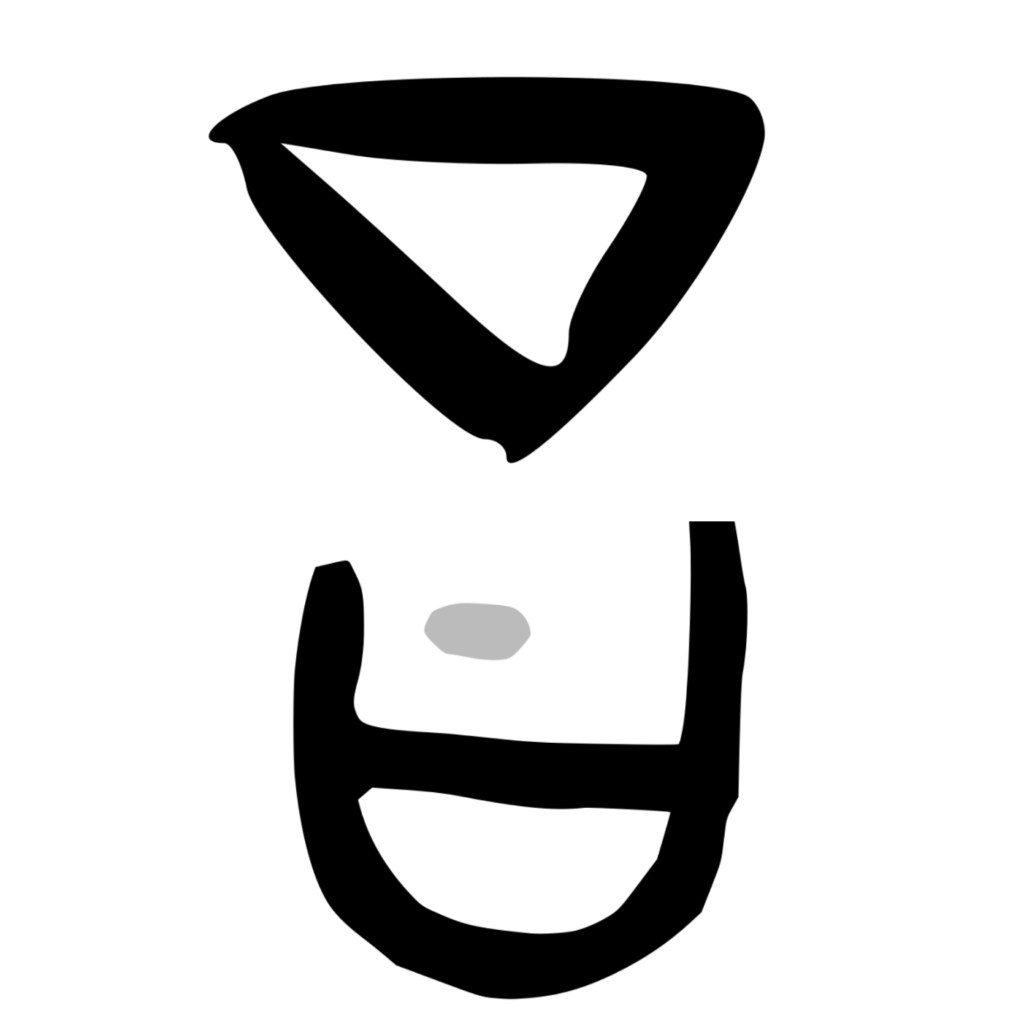
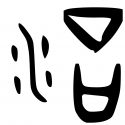
Remember, the zhì (治) character shows water or a river in its left sub-component. The right sub-component is a pictogram incorporating a mouth below a very mysterious element, 厶. I mentioned before that this element variously been identified as a plow turning, a fetus finishing in the womb, or an abstract symbol for being selfish, but I decided to look into it a little more today. Its bronze inscription glyph looked like this:

It’s such a classic and evocative symbol in all of the oldest cultures. What does it “mean?”

The oldest etymology of Chinese characters was compiled in the Shuowen Jiezi during the Han dynasty. From what I can tell, a lot of etymology still references this work, though more recent discoveries about the oldest oracle bone scripts seem to have really cast doubt on its conclusions. The Shuowen Jiezi’s description of this mysterious triangle said that “in olden times, when Cangjie invented the system of writing, a self-encircling element was designated as the character for ‘private.'” They compared it to the symbol for ‘public’ which was 公, and it is possible to see the connection when looking at the modern characters.

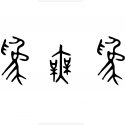
But this is a good example of how the Shuowen Jiezi’s descriptions were flawed since its author(s) didn’t have access to the oldest scripts. It turns out that the bronze inscription for the “public” character looked like this:

And the even older oracle bone script like this:

You can see there’s no triangle. But by the time of Shuowen Jiezi, the 厶 character had evolved to look like this:

Now you can see how the Shuowen Jiezi authors thought it was related to the character (以) which we investigated in a previous post. I translated it as already… finishing it in the womb based on its typical translations and the original pictogram which is said to be either a snake or a fetus as it came from this bronze inscription:

And this original oracle bone script:

But neither of those resemble the triangle that was the original symbol for the 厶 we see in our character zhì (治). We still don’t know what the triangle symbol originally meant, though I think we are safe in saying it’s not necessarily the opposite of “public.”

We might learn more about the triangle by looking at how it was combined with the pictogram of grain to make the character (私), which some people believe meant a person’s private grain field. It now means self, private, personal. In Classical Chinese it meant I, me. In later times it morphed into not only self but even selfish as well as illegal, secret, stealthy. Most recently it’s the word that means to Private Message or Direct Message someone on the internet!

I’m going into this detail not only because I find it interesting but so you and I can remember how tricky it is to go with the modern or even sort-of-old meanings for the old glyphs of Lâozî’s time. If you’ve been following along, you’ll note that my previous posts and definitions of terms were more influenced by newer meanings that they are now. The more time I spend with the glyphs, the more I don’t trust the modern definitions or even the Shuowen Jiezi. So I will now be going back and changing any translations where I used the “selfish” or “private” connotations for these characters discussed here.

MEANWHILE what does the triangle mean?!

Let’s look at the whole right sub-component of zhì (治). Here the triangle character (厶) sits atop a mouth. Here’s what those original glyphs might have looked like together:

This was the original character for the word happy but then evolved into talking about oneself or I/me. (When that happened, the character for happy became . You can see that they just put a picture of a person in front of the original character. This is such an interesting and typical kind of evolution in the language.)

Combined with its left hand component which was the picture of a river, a glyph version of zhì (治) would have looked like this:

I think it’s still difficult to say what the triangle alone meant, but putting the pieces altogether, here’s my translation of zhì:

governing—regulating by harnessing the river named Happy or speaking of turning yourself—

*I love this image as a representation of governing. It revolves around one’s self in the best way: Harness the River Happy! Turn yourself somehow and speak of that! No wonder Lâozî used this character to describe a sage’s governing. My favorite leaders have in fact acted in just this way. How can I implement this in my life? How can you?*

~

Back to the end of Chapter 3 where we saw Not-Being… not really truly governing like the sage.

If Not-Being were the negative particle “not,” then we’d have a double negative here: not not-really governing. That would mean that after following the example described in the previous post, there is this kind of governing happening. That feels so dang convoluted. But maybe Lâozî does indeed use all the “nots” to emphasize that all this is such a receptive and non-grinding way of going about things.

On the other hand… what if Not-Being is actually a person with non-person status—a non-being? Then the text would mean: after following this example, the Not-Being isn’t really governing.

What’s the correct interpretation? Well there’s no way to know of course. Each translator and each tradition has its own idea. It’s tempting to simplify things so I can land on an answer, but I try to withhold making conclusions until I’ve read the whole Dào. And… we have quite a long way to go! I know it’s frustrating, but for me that’s balanced by the thought experiments, take-aways, curious puzzles, and tiny hints we find in each character, line, section, and chapter. I hope you’re finding some satisfaction too, as well as some of that disorientation that must be part of Lâozî’s plan.

Next time, I’ll prepare a summary of Chapter 3 that hopefully will clarify things without getting rigid. Until then, please use the contact form to let me know your feedback. I love the comments I get, and if you haven’t sent one yet, now is a good time to start. Thank you for that and for being here.

Categories
#3 Fú 夫 Wéi 為 Wú 無

Efforting… Not-Being efforting

wéi wú wéi

Before I got side-tracked by interjections—oh my!— we were finishing up Chapter 3. We had been looking at: 1. what it means to “breed civilians” in certain ways, 2. how the sage governs, 3. the implications of the traditional version of breeding civilians for Not-Being, and, 4. lastly, we were just at the part where we were learning what that traditional version of breeding does to our old friend, , this particular grown man:

breeding—like a gentleman holding a fountain pen making something happen—

that is to say, this particular grown man with a hairpin and public courtesy name…

“firing arrows from the mouth—sure” as the sun, daily…

—now this is cooking!—

the husk of the initial protective bud casing—the sepal—but not really the true inner flower of

daring—lightly hitting ears on both sides of the head—

efforting—like lifting up an elephant…

—yes, that too, vagina!

efforting—like lifting up an elephant…

nothing—no one dancing with long tails flowing from their wrists—nope, never, no way, nowhere, nohow Not-Being

efforting—like lifting up an elephant;

after following this sacrificial blade-and-cauldron-like ritual example, standard, or regulation…

nothing—no one dancing with long tails flowing from their wrists—nope, never, no way, nowhere, nohow Not-Being…

the husk of the initial protective bud casing—the sepal but not really the true inner flower of

“governing—regulating by harnessing the river named Happy or speaking of turning yourself.”

Let’s parse this out.

  • We see that the traditional version of breeding civilians is breeding this particular man one way: very sure.
  • And this very sure grown man is not really daring “efforting.” He isn’t really being brave enough to get himself to do that grinding approach to things. Is this foreshadowing that our hero isn’t rising to the occasion?

Lâozî has talked to us about this efforting (wéi) approach before. We first examined this character here, at the beginning of Chapter 2. We saw that an “efforting” of any particular kind of quality resulted in “lopping off and defining” a rather opposite quality in something before that thing was even born.

And later in Chapter 2 we looked at it again here because Lâozî used the phrase “Not-Being efforting.” It could simply mean “not efforting.” I also did wonder if “Not-Being efforting” resulted in a lopping off and defining of Being before it was even fully developed and born. Now, considering the weird things we keep seeing about Not-Being and Being, I wonder if this phrase was talking about a person who has an outsider status. Maybe it’s describing someone who was considered a “non-being” and was doing some efforting! Well, bear with me and let’s see what happens here in Chapter 3 when Lâozî brings that Not-Being character back into a discussion of efforting.

  • Efforting… Not-Being efforting.” That is one whole line. Just those three words, all by themselves. Wow—okay I’m taking a breath! What’s this mean?
    • Maybe it’s a short list of two opposites, like we saw in the list in Chapter 2. It could be saying: “ok, so we have efforting and we have not-being efforting… now let’s talk about them both.”
    • Or maybe this line’s talking about when “hard work isn’t hard work.” Maybe it’s talking about when getting stuff done is somehow magically easy. “Doing not-doing.” That’s the usual interpretation, and it is a beautiful one that I love. But. If this is the correct interpretation, then our shamanic dancing character (Not-Being) is simply the negative particle “not.” That’s how most translators in fact translate this word—except in some cases when they don’t!
      • Sometimes the word’s just sitting by itself, and so they let it have a life of its own. That throws me and makes me wonder if is truly just a particle in other cases like this one. Furthermore, why use (“just the husk and not really”) as a negative particle sometimes and (the dancing Not-Being) other times? You remember I did delve into that question here. In short, ptype particles like  originally seemed to modify actions beyond the control of living people, and the mtypes like seemed to attach to actions over which people thought they had control. In the part of Chapter 3 I translated at the top of this post, would you say “daring” is something over which we have NO control, and “efforting” is something over which we DO have control? That’s hard for me to believe. That’s why I’m going to consider what it would mean if Not-Being were more than just “not.” What if Not-Being has full status as a character of its own..
    • Maybe the proper interpretation of this line is: “efforting… to be a Not-Being who is efforting:”
    • Or maybe: “an efforting that is… a Not-Being who is efforting:”

In any of these interpretations, the next line is super important because it’s going to modify this one and tell us something important about it. We’ll explore that next time.

Meanwhile… I hope you’ll play a little mind experiment and explore what it would feel like to you to be:

really muscularly trying… nothing—no one dancing with long tails flowing from their wrists—nope never, no way, nowhere, nohow Not-Being really muscularly trying

Please use the contact form to let me know your feedback. I love the comments I get, and if you haven’t sent one yet, now is a good time to start. Thank you for that and for being here.

Categories
#3 Cháng Mín 民 Qí 其 Wú 無 Yôu zhì 治

civilians—like the Mín people enslaved by blinding with a dagger—

Mín

An eye pierced by a dagger. That’s the pictogram for today’s word, 民, which is modernly translated as people, citizens, folk, popular, and civilian.

Wow. This is why the images within the characters matter to me. The above picture of an eye and dagger is what Lâozî most likely would have drawn while writing down the 37 chapters we now call The Dào. Eye-piercing was an historic method for enslaving people. I’ve read that this practice was associated with enslaving the Mín people, hence this word and their name. Words from the Mín dialect make their way into the Dào in several places that I’ll note as we go along. We saw our first one in the last post, and—possibly not coincidentally?— that word (shî) occurs directly before today’s word (Mín) the first four times we see either one used.

As you recall, Chapter 3 opens with a list of three attitudes to avoid. If you avoid these, then you have a populace that doesn’t do three corresponding bad things. –>Not really elevating the elite rich means people don’t really compete (like with two hands clawing over a plow). –>Not really treasuring hard-earned transformation of riches means people don’t really “effort” thievery. –>And not really seeing something as definitely wanting or missing means peoples’ hearts aren’t really in a confused anxiety where their tongues are like twisted threads with one remnant string hanging out.

But, to be specific, each of those three prohibitions is spelled out according to this formula:

Not really doing [fill in the blank]

is breeding (like a gentleman holding a fountain pen)

civilians (like the Mín people enslaved by blinding with a dagger)

who don’t really do [fill in the blank].

I found this to be a nice time to re-read our last post and really reflect on that image of a government official holding in his hand a “fountain pen” that resembles “a flagpole sticking out of a drum.” Remember too: this image possibly shows that tool superimposed over a mouth. And of course there was the charming information that its meaning—to make someone do something—means to f*@# in the Mín dialect. So is it just me or does it sound like “breeding civilians” is another way of saying f*@#-ing the lowly masses who were enslaved by blinding their eyes with a dagger.

Does my heart suddenly seem rather dark to you?! Okay before I get all carried away seeing something horrible where it doesn’t exist, let’s find out what happens in the rest of the chapter and how these two words (shî mín) are used there. After all, this chapter is actually the only place that this shî character’s used at all.

~

What immediately follows is another instance of Lâozî telling us the suns sees indeed that this means something about the grounded sage. In this case, that description of what breeds civilians to be a certain way means the grounded sage has a particular style for governing (zhì, ).

If you look at this modern character for zhì, you see it has two sub-components. The left side evolved from the pictogram from water:

The right-hand sub-character (台), when it’s by itself, is pronounced in Mandarin and was the original form of the word for happy or pleased. It depicts a mouth (the square) below another character. Most often that arrangement of a mouth means speaking about though sometimes it actually does seem to carry the meaning of a mouth, a cave, or a similar type opening.

In this case the mouth is drawn below a character that’s sometimes thought to be a plow or a symbol for turned or revolving. More often, and more specifically, it’s thought to be a variation of (以) which we investigated in a previous post. There I translated it as already… finishing it in the womb based on its typical translations and the original pictogram which is said to be either a snake or a fetus. Nowadays, when this character’s combined with the mouth character to make , it seems to refer to some aspect of talking about oneself. The result’s translated as I or me or sometimes as what. It no longer carries the original meaning of happy/pleased, harmony, or joy unless it’s combined with a character showing a heart to the left of it: 怡.

When that same happy character was combined with the pictogram of water to form , the resulting meaning was often an ancient river name (pronounced either and chí). In modern usage, though, it’s pronounced zhî and translated as to govern, regulate, or administer. Historically it was used to describe a seat of local government. Dáo translators generally prefer the terms govern, governing, and government, but sometimes you’ll also see them translate it as rules or leads. Here’s how I translate it to include all the imagery:

governing—regulating by harnessing the river named Happy or speaking of turning yourself

I know it gets kind of wild when I translate this way, but I do so love the results. I love how it associates harnessing the River Happy with regulating or turning yourself around…. and with governing.

UPDATE: I look into this character a little more in a later post here.

~

So, to continue on, Lâozî says that in light of that list of what kinds of attitudes do or don’t breed what kinds of civilians, a sage’s governing looks like this:

The sun—walking across the sundial a while, stopping a while—sees indeed

this means…

the grounded sage—listening and speaking, standing connected to earth as well as the heavens,

that person

has this

governing—regulating by harnessing the river named Happy or speaking of turning yourself:

~ emptying—like lifted land…

what it holds a basket of…

heart-core

~ really filling—like a building with strings of solid cowry-like riches…

what it holds a basket of…

inside—the gut, the meat belly;

~ being as fragile as a matching pair of decorative bows or little wings…

what it holds a basket of…

having heart-core determination and aspiration

~ strengthening like an insect—turning yourself as a venomous snake-like bow…

what it holds a basket of…

that bony will that comes from a skeleton framework.

What “it” is referred to in the phrase “what it holds a basket of?” This character, (其) puzzles me. We first looked at this little connecting word back in one of our earliest posts. But when translating Chapter 3, I decided to go back and review all 61 times it occurs in the first 37 chapters of the Dào Dé Jīng and compare how it’s handled by different translators (especially Chinese translators). I ultimately decided it’s safe to say that this phrase doesn’t necessarily refer back to the word right in front of it. Rather it points the reader back to the most recent “subject.”

In other words, Lâozî probably isn’t saying that “emptying has heart-core.” More likely this phrase says that the sage’s governing empties the sage’s heart-core, fills the sage’s inside/gut, is fragile in the sage’s heart-core determination, and strengthens the sage’s bony will. However only Chia-Hsu Chen translates it this way.

Most translators say the sage’s govern empties the people’s hearts, fills their bellies, weakens their ambition, and strengthens their will. They think “it” refers back to Lâozî’s previous “paragraph.” Other translators leave out the whole question of whose basket is in question! They say the sage’s governing empties the heart, fills the belly, weakens ambition, strengthens will.

What bothers me is that these approaches aren’t consistent in how they decide what the connecting word is pointing to. And when you read the different options I pose here, this subtlety really makes a difference, doesn’t it? Maybe this is another example of Lâozî the poet being intentionally ambiguous. Maybe “it” could be any of those things. “It” could be the sage, the governing itself, the people, or it could even be the word right in front of “it.” Maybe it COULD mean “emptying has heart.” (I like that last version a lot. I translated it that way myself until I more thoroughly analyzed .)

So why do I belabor this?

Because it makes a difference on a very important point: does the sage’s way of governing have anything to do with making the civilians be a certain way? It’s easy to assume so. After all we usually do think of governing as controlling others. And in the first part of this chapter, we just saw some gentleman a fountain pen was making them do stuff. But it seems to me that the point of this next section here is that the sage doesn’t do that. Maybe the sage is just over here minding the sage’s own heart, gut, ambition, and will. The very particular way that Lâozî drew the “governing” character could support that—governing could be about turning yourself, harnessing your own Happy river.

Let’s see where else Lâozî goes with these topics in this chapter. It’s pretty interesting.

~

As you remember, in the very first sentence of Chapter 1, Lâozî set up a conflict between the definitive “” version of things and the cháng version—the ever-present traditional, timeless, constant version of things as symbolized by the head cloth that men donned upon becoming official adults. Now we learn more about the cháng (常) version. We’re going to learn about what happens with that traditional version of breeding civilians:

The ever-present square fabric which our grown men wrap around the ‘little bird’ top knots on their heads after receiving their public courtesy-names—what we know as the timeless, whole head-cloth ‘ji’ version of

breeding—like a gentleman holding a fountain pen making something happen—

civilians—like the Mín people enslaved by blinding with a dagger:

~ nothing—no one dancing with long tails flowing from their wrists—nope, never, no way, nowhere, nohow Not-Being…

firing arrows from the mouth—sure;

~ nothing—no one dancing with long tails flowing from their wrists—nope, never, no way, nowhere, nohow Not-Being…

wanting what’s been eroded from this ravine

We know two things about the traditional version of breeding civilians:

  • Not-Being… sure
  • Not-Being… wanting what’s missing

Does this mean the traditional version of breeding civilians breeds civilians that aren’t sure and aren’t wanting or missing anything? OR that in the traditional version of breeding civilians, someone who is a Not-Being is sure and is wanting something that’s missing? It’s our old familiar debate about the nature of the shamanic dancer Not-Being character, , and the meat-holding character we call Being, yôu. Are they people or are they negative and affirmative parties? Does it depend on context? Let’s keep reading with an open mind.

When we do so, we see in the very next sentence Lâozî tells us a third thing about the traditional version of breeding, and this is for sure about this particular man with a hairpin and public courtesy name (). We met this character in Chapter 2. There we learned he was absent and therefore not really leaving. Here we learn that he’s a person who, in the traditional version of breeding, is sure:

breeding—like a gentleman holding a fountain pen making something happen—

that is to say, this particular grown man with a hairpin and public courtesy name…

“firing arrows from the mouth—sure” as the sun, daily

—now this is cooking!—

the husk of the initial protective bud casing—the sepal—but not really the true inner flower of

daring—lightly hitting ears on both sides of the head—

efforting—like lifting up an elephant,

—yes, that too, vagina!

~

All right, all right. Before I continue, I want to address the elephant in the room—and no, I don’t mean the actual elephant we once again see inside the image for “efforting!” I mean that last exclamation and its reference to female genitalia. Is this gratuitous sensationalism on my part? You tell me. I will give you the facts… in our next post. Because this one’s getting soooo long, and I want to tell you about all of Lâozî’s colorful interjections at one time.

Until next time, be sure to use the contact form to send me your questions and comments. Thank you for being here!

Categories
#2 Shèng 聖 Shēng 生 Wú 無 Yôu

birthing—a bud sprouting from the ground

shēng

Birthing (生, shēng) sounds familiar to you because in the first half of Chapter 2 this word linked Being and Not-Being in a list of “opposites.” Lâozî told us that Being and Not-Being are mutually birthing.

~

In Western Zhou Bronze inscription script, familiar to and possibly most similar to the script used in Lâozî’s time, shēng looks like this:

This image is a compound of a sprouting new plant:

And the ground:

I especially like the added bulge. To me, it really augments the meaning of this character because the modern translations of shēng are to live, subsist, exist; grow, develop, bud; bear, give birth, bring up, rear; and be born, come into existence. It also can be a noun: offspring, descendant; disciple, student; Confucian scholar; or life, existence, being, living. And it can be an adjective/adverb like fresh, not stale; unripe; raw, uncooked; uncultured, uncivilized; strange, unfamiliar; vivid, strong; innate, and natural. In Buddhism, it can mean to go into society or be reincarnated.

Here are some of the different ways translators of the Dào, in particular, interpret shēng: arise, creating, give birth, rears, produces, and lives. And that’s just in this chapter. Elsewhere you find those same translations as well as be born, and foster. Most translators use more than one definition, many use more than one even within this chapter. You can see why—the possible meanings vary so significantly in nuance. Is the thing in question being birthed or giving birth or raising something up? Those are all very different, and it’s tempting to want to clarify.

Because this word is so often interpreted as birthing, I originally had a baby in my definition, but as I wrote this post, I realized that’s an addition on my part. The image only shows the plant, the ground, and that added bulge (which does put me in mind of a baby, but it could also be a meristem from which new leaves are going to grow). My translation is hereby corrected to:

birthing—a bud sprouting from the ground

I like it because it has that poetic multi-usefulness. It could refer to doing the birthing, being birthed, growing, or even being raised.

~

In the first part of Chapter 2, we learned that Being (yôu) and Not-Being (wú) are mutually birthing—a bud sprouting from the ground. Based on the lesson in the previous few lines of that chapter, this first seemed to me to mean that if you work hard to “effort” Being, then you’ll cut off and define Not-Being while it’s still developing on its own.

And vice versa? Possibly. Though it’s not definitely clarified for us, that word “mutually” could be seen to imply that. Maybe it even means that you can’t have Being without Not-Being and vice versa. That’s a very common interpretation of this lesson and goes with the pictogram for “mutually” (xiāng, 相) which shows a seen tree and the eye seeing it.

Maybe Being and Not-Being are two aspects of one phenomenon—maybe Not-Being is the life force that makes sprouts sprout, and Being is the actual physical sprout? Or maybe one is the ground and the other the sprout? Maybe their union creates life. I like that one.

One thing is for sure, we are definitely wandering once more in the uncertainty of the Being-Not-Being mystery. Again I wonder…

What exactly are these Not-Being and Being characters, anyway?!

  • As we’ve seen, they are often used as negative- and positive-particles.
  • But also as adjectives.
  • And in some places—like the previous paragraph—they’re standing on their own.

There are other negative particles in the Chinese languages—ways to negate a concept, i.e., to say “not__.” And other ways to say something positively IS happening. These two characters were decidedly not the common way to do either in Lâozî’s time.

Using these very human-tinged characters in so many different ways gives the characters their own sense of being actual characters. And always with a twist. Every time Lâozî uses them, it’s sort of a pun… a double entendre.

  • Are they actually separate people?
  • Are they two sides of every person, situation, and thing?

Thus far, it remains shockingly, beautifully unclear.

Further down in the chapter, we started to learn about the ideal grounded sage and were told that when it comes to “staying,” the sage’s personal role was Not-Being efforting. What does that mean?

  • Of course this could just mean the sage “remains not forceful.” That’s the most common interpretation, and a lovely and useful one at that.
  • But given the lesson in the lines immediately preceding these, I assume it also is telling us that when it comes to “staying,” the Not-Being aspect of the sage is efforting—trying hard.
    • And that when the sage’s Not-Being aspect tries to force something—to “effort”—the sage shifts from the shamanic, dancing Not-Being mode into a more concrete, outer-oriented Being. The sage has both aspects.
  • Or maybe the sage is that dancer—that Not-Being—and when it comes to “staying,” well… that is the sage making an effort.

Now even later in the same chapter, we’re told that when it comes to “birthing—a bud sprouting from the ground,” the sage is just the husk of but not really the true inner flower of Being, i.e., -Being. This other negative particle, , is a pictogram of a flower’s sepal or guard petals and in every way a completely different character than Not-Being’s image of a mysterious dancer. So this new information isn’t saying that when it comes to birthing, the sage is definitely in some sort of Not-Being role. It just says that when it comes to birthing, the sage isn’t really Being, even if it may look like it initially.

~

It sounds confusing, doesn’t it! It helps me to diagram it like a flow chart. To summarize what we’ve learned in Chapter 2 about birthing/sprouting and our favorite characters: Being, Not-Being, and the sage.

  • Being and Not-Being are the type of duo with a mutual relationship wherein defining one means you define the other by default. In their case, they are in fact mutually birthing/sprouting.
  • When it comes to staying, the sage‘s personal role is Not-Being efforting.
  • When it comes to birthing/sprouting, the sage is just the husk of but not really Being.

Every which way I re-arrange and re-phrase that to myself, it does seem the sage’s more identified with the Not-Being aspect.

It’s a lovely message in keeping with what most people make of the Dào: the wise person has a certain hard-to-describe, beautiful, mysterious, intuitive, flexible, unattached way commonly associated with mystics from the Buddha and Jesus to Rabia, Rumi, and Hafiz.

It’s interesting to consider what it might mean in our own lives to de-emphasize Being and feel our way into more Not-Being. It’s a hard thing to describe, but it feels spacious and restful and energizing. Experimenting with this sensation in the odd moment here and there—that’s my wish for you. And please, write to me with any feedback, questions, ideas that come from those moments. I love hearing people’s experiences with this concept.

~

Meanwhile… if this is one of the points of the text, why does Lâozî say it so obscurely? Is Lâozî making it intentionally hard so that by the time the reader finally figures it out, it’s fully integrated? Or maybe so it can mean many different things and therefore be useful to many different people in many different circumstances? Is it because this is the way to make words go together to fit a rhyme, alliteration, and meter scheme? I do think all of these are reasons the text has captivated people for millenia.

Or is it because the concept of Not-Being as the sage’s true creative essence was so hard to accept that it needed some disguising? We’ve seen that Lâozî does, after all, draw characters that are masked, hidden in caves, bearded, a husk and not the real thing, or a hard-to-see mystery within a hard-to-see mystery. Next time we’ll summarize Chapter 2 the way we did Chapter 1, and maybe more ideas—or questions—about this story will come into focus.

Thank you for joining me once again! As always, please use the Contact form to write to me until then—I really look forward to hearing from you.

Categories
#1 Ér Dào Fēi 非 Jiâo Míng Miào Tiān Wú 無 Yôu

By way of introduction… Chapter 1 summary

Here’s how I see it. Please consider it a light fanciful daydream if it offends your sense of the Dào Dé Jīng!

Setting the stage: conflict!

Yinxi the border guard recognizes Lâozî as he’s departing the country, allegedly fed up with politics in Zhou. He asks the renowned wiseman to leave behind some helpful words, presumably about his philosophy and the way to go about things. Lâozî says… well you might want to click here to read Chapter 1 and then pop right back. But basically Lâozî says…

The Way that I can describe to you as definitively The Way breaks the little wings off our traditional version of The Way.

Wow. What a great first sentence. It’s very overt and rather patronizingly graphic in setting up all sorts of conflict and questions… especially with those actual Western Zhou Bronze Inscription characters that Lâozî used! (Yes, I’m making lots of assumptions here, as do all translators. Mine are described here.)

What follows sets up some idiosyncratic themes for the whole book.

Hair

Somehow hairstyle figures prominently in this first sentence and the entire text! Here’s my full version of the first sentence:

The Way of the loose-haired chieftain—walking a while, stopping a while, listening, and speaking of it all—about which you can purse your lips like a piece of cane and puff: “Yup, that’s it, definitely The Way of the loose-haired chieftain—walking a while, stopping a while, listening, and speaking of it all—” is breaking the little wings off the ever-present square fabric which our grown men wrap around the ‘little bird’ top knots on their heads after receiving their public courtesy-names—or what we know as the timeless, whole-cloth ‘jin’ version of The Way of the loose-haired chieftain—walking a while, stopping a while, listening, and speaking of it all.

So we have a roaming prophet-like chieftain with loose hair. And then we have a sort of opposite: the current tradition in which men wrap their hair in a top knot on their head and cover it with a cloth as part of their puberty ritual. We’ll encounter some other hair and headdress images later in the book, but that theme’s established right here in the initial line.

What’s in a name

Different types of names also figure prominently throughout this whole first chapter. I count four different namings.

1.Above we learned about how when boys turned to men in ancient China, they received a new formal name.

2. The next sentence talks about the childhood name the boys gave up, a name you can still use with intimates after you’re a grownup:

Its personal, childhood name—what it says to identify itself urself by moonlight—about which you can purse your lips like a piece of cane and puff: “Yup, that’s it, definitely personal, childhood naming—what you say to identify yourself by moonlight” is breaking the little wings off our traditional its personal, childhood name—what it says to identify itself urself by moonlight.

[Yes, I shortened the ever-present square fabric which our grown men wrap around the ‘little bird’ top knots on their heads after receiving their public courtesy-names—or what we know as the timeless, whole-cloth ‘jin’ version of (chàng) into “our traditional.” Yes, it’s both a big assumption on my part AND a useful space saver! That character’s described in detail here.]

So here’s yet another harsh difference between tradition and what Lâozi could say. This time it’s over personal naming in particular. Now we feel like names might be key in the conflict that’s been staged for us.

Lâozi goes on to differentiate two kinds of personal names: Being, its personal name, and Not-Being, its personal name. In this simple step, Lâozi introduces two of our most central and most baffling characters and puts them squarely into this naming conflict… but more on them later. Let’s see what other kinds of naming are discussed in the first chapter.

3. There’s also how things are spoken of altogether with one another—like all earthly, mortal, commonplace plates. Lâozi uses THAT title when talking about Being and Not-Being when they’re a yoked pair, just before they’re stepping out “of a cave” and into their two different, masked personal namings.

4. To really describe them altogether like that, Lâozi adds in yet another kind of naming: what it’s called when speaking from the gut—words, like slaves or criminals branded by a chisel emerging from a mouth.

Later in the book, we’ll see some significant permutations of these naming types, and we’ll really notice them too, since the basics are pointedly noted in the first chapter.

Being, Not-Being, their altogetherness, their differently masked names once they step out of the cave and get bearded, plus the crux of the mystery:

Most importantly, in this introductory chapter we meet and learn a little something about two of the book’s fundamental characters. The facts we get, in order of appearance:

  • Not-Being is shown by a pictogram of a mysterious, shaman-like dancer and is often taken to mean “null” or “nothingness.” Lâozi tell us its personal naming is the conception of Heaven-Earth (merged to be something like… the whole universe or “heaven and earth”).
  • Being is shown by a pictogram of a hand holding a piece of meat. Lâozi says its personal naming is the rearing, raising, or “suckling” of all the gazillion of material things in that universe, literally 10,000 Things—all matter external or cut off from you.
  • In the traditional version, Not-Being is “wanting.” It’s missing something that’s been eroded, and that is a mysterious feminine essence called miào.
  • In the traditional tradition, Being is “wanting.” It’s missing something that’s been eroded, and that is delineated surface—like a patrolled frontier border lightly hit with a sword tip from left to right (jiâo).
  • Whoa, though! Really they’re a matched pair and can be spoken of in this state where they’re altogether—as common as daily dishes—stepping out of their cave…
  • But. Once they step out, lots of “buts” apply. The first, main, and most unusual and specific “but” is a character that’s a pictogram of a beard (èr). The instant they step out, Lâozi starts describing them with a qualifier: and yet now, bearded…. Every time this èr character’s used, I can’t help but harken back to its intro here as a description of Not-Being and Being as they step out of the cave.
  • So they’re altogether stepping out of a cave and yet now, bearded…. they have differently masked personal names (presumably this refers back to the “Being” and “Not-Being” personal names described before).
  • What they’re called from the gut when they’re altogether has this hard-to-see darkness—the figure-eight structure of a skein of string-dyed-black (xuán). Based on how the text’s written, I think the entire set-up described beforehand—what I summarized in the above bullet points—constitutes that xuán. But I guess it could be something as yet unspecified, something that we discover later.
  • And here’s the kicker… that hidden structure has its own hard-to-see dark figure-eight structure of string-dyed-black.
  • And THIS, my friends, is the mysterious feminine essence’s double-winged gateway. Ending the first chapter here leaves us with miào feeling somehow central to the whole story.

What’s this have to do with our original conflict between The Way and our tradition?

I guess that’s the question Lâozî’s setting up for the suspenseful tale about to unfold to Yinxi, me, and you.

What stands out to you?

I’m going to give you some time to ponder this introduction and my question and send me your answers before I prejudice you with mine—because they’re doozies! And with that cliff-hanger… I thank you for being here with me and for sending me your comments. It means the world to me.

Categories
#2 Chù 處 Wéi 為 Wú 無 Yôu

Not-Being efforting

wú wéi

“Not-Being efforting.” This phrase is in some ways the most obscure phrase in the Dào Dé Jīng. I posit it’s also the clearest.

We first encounter this phrase in the second half of Chapter 2 where, just a paragraph beforehand, Lâozî painstakingly lays out two examples illustrating the essential nature of “efforting.” As we saw in our last post:

When public opinion defines something with great certainty, that constitutes a forceful “efforting” of that thing. Such “efforting” results in cutting off and defining the very opposite of that original something before it’s actually developed in its own right.

Lâozî then lists a series of opposite conditions linked to one another in mutual interaction (like a seen tree and the eye seeing it… both are required for the interaction to happen):

The first such pair of opposites listed is Not-Being vs Being. Lâozî says they are mutually birthing.

Because of Lâozî’s careful set-up, I think it’s safe and indeed important to assume that this linking of opposites happens because of someone “efforting” one of the pair. I think we can conclude that the mutual birthing of Not-Being and Being has its roots in these two options:

  • Not-Being is efforting and therefore peremptorily defining Being, and/or
  • Being is efforting and therefore peremptorily defining Not-Being.

Let’s look at this in the context in which it’s first used. If you read the second half of Chapter 2, you see a list of things that a grounded sage person does in certain circumstances. Here’s the first such situation:

The sun—walking across the sundial a while, stopping a while—sees indeed

this means:

the grounded sage—speaking and listening with both feet on the ground,

this person…

staying-remaining at home at the tea table, chaste and unmarried, following something slowly from behind with tiger fur-

nothing—no one dancing with long tails flowing from their wrists—nope, never, no way, nowhere, nohow Not-Being

efforting—like holding up an elephant…

has this

personal, manual role—what one does with a weapon, a flag, or a pen;

So first we are going to learn about what the grounded sage does when they are chù (處) or staying. It’s usually translated as remains, but the Western Zhou Bronze Inscription character is, as usual, a lot more evocative and complex than that:

The top component (虍) shows tiger fur:

which is usually considered the phonetic sub-component (). Below that there are two semantic components considered to give the word its meaning. First is:

which shows two legs followed by something from behind and in modern times (夂) is translated to mean exactly that. Also shown is:

which shows a stool, and again the modern translation (几) matches the old pictogram.

The modern translation of the overall character chù, however, includes not just stay, remain, reside, live, and dwell, but also “staying at home, not assuming a government position or not married.” It also includes virginity and chastity as well as manage, deal with, punish, discipline, and get along with. This reads to me like a laundry list of what it meant to be an unmarried woman in most parts of the world in “the old days!” At any rate, as you can see above, I included all these elements in as neutral a way as possible.

And what does a grounded sage do when staying—remaining at home at the tea table, chaste and unmarried, following something slowly from behind with tiger fur? Well, then their personal role is Not-Being efforting.

And that, we suspect, means it lops off and defines Being (yôu 有).

Fascinating. We’ll delve more into the grounded sage next time, as we continue to feel our way into what it means that their role when “staying” is cleverly lopping off a basket of and therefore defining Being.

Thank you for joining me here again. I hope you’ll re-read Chapter 2 again and enjoy letting all these ideas percolate in your unconscious as well as conscious mind. Meanwhile please use the contact form to send me your comments, ideas. and questions. Until next time!

Categories
#2 Bù 不 Mêi Shàn Wú 無 Yôu

thus cleverly lopping off a basket of and thereby defining something already… finishing it in the womb

sī yî

Lâozi starts Chapter 2 talking to us about how people here on earth talk about beauty:

“Heaven-down below (lower level) public opinion—that clear, plain back and forth between people: firing arrows from the mouth sure of admired beauty—picture someone wearing a ram’s horn headdress…”

Mêi (美), “beauty,” is a picture of just what I’ve described: someone wearing a ram’s horn headdress. Then Lâozi describes this approach to beauty with a particular character, saying it results in:

efforting—like lifting up an elephant—beauty

Oh, Wéi (為). I love this word, it’s pivotal in the rest of the Dào (occurring in 51 crucial spots, in these first 37 chapters), AND it took me awhile to land on this translation of “efforting.” It will have its own blog post very soon!

Meanwhile… Lâozî tells us that effortfully defining beauty in this strong-arming way has a side effect. It is:

thus cleverly lopping off a basket of, and thereby defining, a disdained ‘ugliness’—an inferior-hearted evil right outside, touching the house—already… finishing it in the womb.”

Lâozî seems to be saying that when we work hard to forcefully set some very certain kind of beauty, we are insinuating that everything else is ‘not beauty.’ Or is Lâozî saying that approaching beauty in that way is itself ugly? Probably it’s both and either, as is so often the case in good poetry.

~

(斯) shows a basket on the left and an axe on the right:

Writing this for you, I realized that I didn’t have the basket in my old translation in the first post, so I’ve revised it as you see here:

thus cleverly lopping off a basket of and thereby defining

This symbol was used to depict a traditional unit of weight (about 1/2 kg or a “catty” which is a little more than one pound), but also means axe, and keen or shrewd. This chapter is the only place this word’s used in the Dào.

~

(已) now means stop, finish, already, or have done [something]. In the Dâo, translators call it as arisen, become, stopping in time, be done, get it, succeed, attained success, and achieve results. Often it’s hard to tell for sure how they translate this word because it gets buried as some simple word like is. In fact, this word seems to occur in especially convoluted obscure sentences, and as you’ve seen, that’s saying something when it comes to this document!

The first etymological reference I read said comes from the symbol for fetus or snake (pronounced and now meaning snake and written as 巳):

So my translation combined that with the abstract meanings:

already… finishing it in the womb

But since then I’ve seen others say this version of absolutely should not be confused with that symbol. Nor, they added, should it be confused with this other old symbol that looked similar and is pronounced (己). This image is considered to be a silk cord used to bind things; it now means see, oneself, personal, or private. Those words combined with the suggestive images of a fetus put me in mind of an umbilical cord:

I’m not sure why our yî (已) should never be associated with these other two similar sounding and looking images nor why there’s no alternative interpretation for our image’s origins. It’s confusing. My first thought was that I could see why a person wouldn’t want to think a fetus is the original symbol for “stop, finish, already, or have done something” as it could put us in mind of sad and oft-hidden events like miscarriage or abortion. But then again it doesn’t necessarily have to mean those things either. It could also represent the later evolutions of this word: achieved, results etc. It does show something that developed inside, privately. All these layers filter together in that evocative uncertain way we are getting used to Lâozî creating in us, so I will leave it at that.

~

So to review: Lâozi used today’s two words and together in a particular construction to say that when public opinion’s firing arrows sure of a particular beauty, it by default “lops off” and thus defines the opposite “already, finishing it in the womb.” Next, Lâozi uses this same construction to tell us what happens when public opinion’s firing arrows sure of traditional virtue (shàn, 善). The old bronze inscription version of this character shows a sacrificial offering of a goat together with a mouth emanating words that are branded by a chisel, in the same way that slaves or criminals were marked. This image gives me the feeling that Lâozi didn’t admire this kind of virtue. I wonder if the beautiful person wearing the ram’s horn headdress carries that same tone of hypocrisy for Lâozi. Anyway, being sure of this kind of virtue has the same hard-core effect of efforting, in this second case it’s efforting traditional virtue

“…thus cleverly lopping off a basket of, and thereby defining, the husk of the initial protective bud casing—the sepal—but not really the true inner flower of traditional virtue already… finishing it in the womb.”

Being certain of that particular kind of virtue means everything else is automatically, privately, successfully defined as “not really virtuous.”

~

Here Lâozî uses one very specific way of saying “not____.” (不) shows us what biologists call a sepal—that little husk around the outside of a flower. The Bronze Inscription character shows those dried up little petals hanging off below a bloom:

The sepal starts out looking like a bud’s outermost petals, but ends up peeling back and drying up once the true blossom is open. This husk is made up off former “guard petals”—it played a crucial role!—but it’s not really the true flower of the thing we’re talking about.

We talked about different negative particles in this post. As with this sepal husk, most of the negative particles’ images show something where outer appearance doesn’t match reality. Èr uses the beard image for but now or and yet. uses a masked person for the word different:

Other images in Chapter 1 also showed us hidden or obscured versions reality. The pictogram for mìng (personal naming) shows a mouth speaking under the cover of night by moonlight. Chàng (the ever-present, constant, timeless version of something) shows the jìn head-cloth covering the hair of an adult man. Xuàn—the very structure of the miáo stuff that is the conception of Heaven-and-Earth—is a hard-to-see darkness… a figure-eight of string dyed black. And of course gives us a Not-Being—a mysterious dancer swinging tails from each wrist—as a symbol of something so different than normal reality that we don’t even know what to call it other than just “not.” Lâozî is a true poet, weaving an entire spell for us using even the smallest words as part of the overall tone.

~

So what does Lâozî do in Chapter 2 after setting up this construction for us in which public opinion’s sure-fire efforting a set definition of anything cuts off and defines its opposite? The next long and quite famous part of Chapter 2 begins by saying:

“anciently, for ten generations, this therefore lightly hits and leaves a mark of reason…”

What follows is a list of opposites that define each other, presumably, based on Lâozî’s set-up, because of public opinion’s strong-arming, effortful certainty of one of the pair of traits:

  • Not-Being vs Being
  • solidly hard vs changeable
  • lengthy vs short
  • high above vs down below
  • one tone vs many sounds
  • forward vs behind

Ahem: did you notice that Not-Being and Being are set out on their own here and not used as positive or negative particles simply modifying other words?! It’s as we suspected. They are almost beyond adjective, adverb, or status. As one reader put it: “ohhhh… the characters ARE characters!” And being effortfully certain about one gives birth to the other.

What does this mean? We’ll see in the second half of Chapter 2. Meanwhile, you can read the full text of that chapter here and ponder it. Please use the comment icon at the top of this post or the comment form to send me your thoughts, feelings, experiences, and questions—I love receiving them and they impact me and this project.

Thank you for joining me here today! I apologize for the little lapse that just happened in my posting. I really got off track trying to make a video summarizing all of Chapter 1 for you! Every one of the many many attempts I’ve made has been too clunky, long, simplistic, awkward, or otherwise difficult. My conclusion is that it’s not yet time for that to happen. I so wanted a tidy package for you, but it’s too early. I will continue coming up with a nice verbal way to deliver this information to you, but, meanwhile, I’m going to carry on with flowing the written translation process to you in as organic a way as possible. It means you will be floating in uncertainty longer… and I think Lâozî and other sages would approve. As I’m typing this, my daughter texted me a quote from Dolly Parton:

“There are just some things in life you don’t explaint it, you just live it, and know it, and be it.”

Categories
#1 Bù 不 Fú 弗 Fēi 非 Wú 無 Wú 勿 Wú 毋

no way—no one dancing with long tails flowing from their wrists—no, never, nothing, nowhere, nohow Not-Being

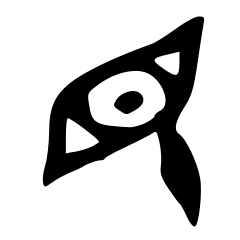
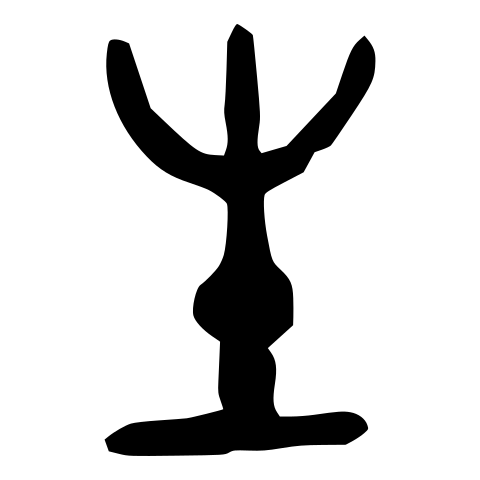
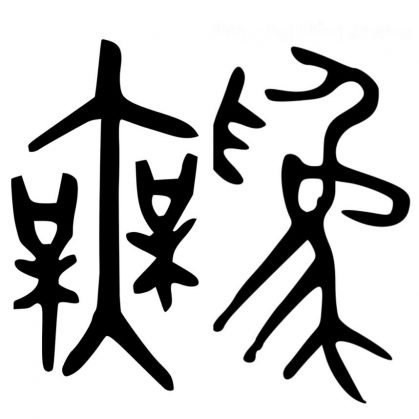
What does this drawing look like to you? Linguists say it was a pictogram of a person with something long dangling from each hand—maybe long tails or sleeves—dancing. It must be a fancy dance or maybe a shamanic one, judging by those tails/sleeves.

That drawing is the Western Zhou Bronze Inscription character, close to the kind of script I believe Lâozî would have used. Later—maybe toward the end of Lâozî’s era—this character evolved into a Seal Script form in which the horizontal and vertical bits got exaggerated:

From there, maybe we can see how it turned into the modern character:

But here’s the thing: I have a hard time understanding why a beautiful, powerful, evocative drawing of a dancer holding long flowing objects turned into a word that’s now translated as not, without, not having, free from, no, un-, nil, -less, non-, or some other negating concept. How did it go from portraying a person engaging in celebration/ritual to conveying a complete lack/undoing of something? And, more importantly to me, when did it undergo this change? Because, of course, you and I want to know how Lâozî actually experienced this character’s meaning.

Chinese has several “negation particles”—little words placed before or after other words to indicate the opposite or lack of that base word. English does too as evidenced by that list of translations in the previous paragraph. When this character was ‘borrowed” away from its original meaning and turned into a negation particle, a new character was created for the word dancing by modifying the original pictogram with some extra marks near the person’s feet to show they’re taking steps.

This change seem to have happened in or just before the Western Zhou Bronze (WZB) era. We know this because 1) Oracle Bone script didn’t use this negating form of , and 2) this new character for dancing appeared in the WZB era:

Later, by the time it turned into Seal Script, it looked like this:

And now it’s written as 舞. My point here is that some linguistic effort was made to change the original character just to retain its own original meaning because somehow this person dancing with long things flowing from their wrists was turned into… nothing. Literally. Or worse, it was turned into something that undoes or negates every kind of stuff or abstract idea that it’s attached to. Puzzling. Especially because there are others way to “undo” things.

Negation

And now we are going to go down a rabbit hole into nothingness. Literally. It’s an important part of the Dào, so it’s good to go there right up front. Bonus: contemplating it elicits a not-unpleasant sort of spaciousness.

As you remember, Oracle Bone (OB) script was the version of written Chinese immediately preceding Lâozî’s time, though he certainly was familiar with it since he was a court scribe. There were five negation particles found in Oracle Bone script, and our word-of-the-day (無) was not one of them because back then it still meant dancing. We see documentation that this word was indeed used quite often as a negator in Classical Chinese which was the main writing beginning in the 5th century BC—well after Lâozî’s time. But what was happening with this word in between, during Lâozî’s lifetime? This appears 43 times in the first 37 chapters of the Dào Dé Jīng. Why and how did Lâozî use it? Did Lâozî use it with the earlier OB meaning of dancing or with the later Classical meaning of negation… or both/neither? Conventional translators make it out to be a negation particle. I like to read through the text and substitute that dancing being for . It’s kind of wild that way. I am starting to wonder if, like Shakespeare, Lâozî hybridized and made up words and, indeed, changed the language of that time. It’s something to keep in mind as we move through the Dào.

What makes things even more tricky in translating—if you’re trying to use unique translations for each character—is that Lâozî uses other negators as well. The most common negation particle in OB was (不). And appears 113 times in the first 37 chapters of Lâozî’s Dào. It’s the most common negator in the book, so in this way, Lâozî is using a typical Oracle Bone style. The glyph which Lâozî would have used depicts a sepal—those outer, guard petals on a flower. I translate it as the husk of the initial protective bud casing—the sepal—but not really the true inner flower of… [whatever word follows it]. It looks like this:

is what’s called a p-type negative, and is an m-type negative. No one’s sure why there are two parallel series of negative particles. Some linguists hypothesize they represent a very old, possibly prehistoric fusing of two different peoples and dialects—maybe each group of people had a different sound they commonly used to mean “uh uh.”

It’s also not clear how the particles or their uses evolved, and furthermore there are different theories among linguists as to when and why a particular negation particle is used. Some say the the ptypes modified actions beyond the control of living people and the mtypes attached to words describing actions over which people thought they had control. Interesting. Since was most commonly used, I wonder if the people that used the bbbb/fffff sound to mean “nope” were more dominant than those that used the sound? Or did OB-era conversations tend to negate a lot more uncontrollable actions than controllable ones? Did Lâozî?

Now, brace yourself for what lies ahead. Chinese has a lot of homophones—words that are pronounced exactly the same as each other but mean something altogether different or, as in this case, they mean something similar but uniquely flavored and with a different written Chinese character. And it turns out that a separate m-type negation particle, also pronounced , was most commonly used as a negation particle during the Oracle Bone years: 毋. It derived from the character that meant mother. By the time of Western Zhou Bronze inscriptions, this other looked like this:

Lâozî doesn’t use this character at all in the Dào. So in this case Lâozî’s deviating from OB negation style completely. And yet… and yet using a word that sounds like the typical negator but looks like this fancy dancing person. Linguists have noted that in Zhou time, this character “was already phonetically confused with and read like 無.” So again we see these big changes in the negation particles happening during Lâozî’s era. Indeed there were all these different drawings to make this one sound and general meaning, but, I would say, each drawing has a different effect. I doubt scribes like Lâozî were just confused or careless with their spelling.

There’s also a THIRD (!) m-type negative pronounced : 勿. It’s an obsolete character whose pictogram was a bloody knife:

Wow. Hardcore. Lâozî uses this other character four times in Chapter 30, and that’s the only place in the Dào that it appears. I translate it as not—seriously like blood on a blade, just don’t… [Dramatic yet again, I know, but I’m only trying to keep it accurate!]

So far we’ve found that when it comes to the m-type negators, Lâozî prefers our word-of-the-day version of even though that hadn’t been the norm up until then. That being the case, all the m-types are still way out-numbered in the Dào by the p-type negator .

And Lâozî uses one other p-type negation particle: (弗). Its Western Zhou glyph is considered to depict either 1) two arrows leaning against each other and wrapped up to be straightened or 2) a bundle of sticks tied together to start a fire. (In English, the latter was called a faggot which shows really horrible things about our culture and language.) Lâozî uses this twice in Chapter 2 and nowhere else in the Dào.

Finally… there’s one more negator in the Dào, fēi (非). It doesn’t seem to be classified as either one of the older two types of negation particles—it came on the scene after the Oracle Bone years:

Some say this is a pictogram of a pair of broken wings on a baby bird. Others say it’s a combination of with a compound character that shows a heart and a short-tailed bird. I translate it as: is breaking the little wings off

Okay, that also sounds a little dramatic, but, dang. Either one of those possible etymologies is pretty harsh. Happily Lâozî only used this word fēi four times. Of course, two of those are right in the first chapter, which, by the way, is where we are, or were, before this side trip into negation…

Back to

I read somewhere that to write this character you begin with three horizontal lines and add eight kind of slashing or negating marks on top of it—four vertical ones downward through the three-line structure then four short diagonals spraying out from the bottom. It may just be the power of suggestion, but I do experience this repeated-negation sensation when writing out the character. Try it and see how it feels.

Because of the completely annihilating tone of all modern definitions as well as these eight “no no no no” kind of marks and the fact that I want a translation that will work in any setting, I decided to translate this character as noone-noway-no-never-nothing-nowhere-nohow-not-Being. You saw that phrase in the complete Chapter 1 translation I put in yesterday’s post.

Why did I include the word being? It allows me to use this phrase everywhere, including in places where other translators have felt the need for a noun and translated this term as nothing, nothingness, or non-being. Plus at least I’m throwing in a reference to the actual being that appears in the original pictogram.

But writing this post to you today has made me realize that I broke my own rules with this translation. I was so swayed by the singular modern focus on the negating aspect of this character that I completely left out the actual original image and its meaning. And my whole goal is to include those drawings for the reader to experience! So I’m officially changing my translation right here.

Then the question becomes: how can I keep the the extreme “nil” effect, the ability to be a noun as well as a modifier, and our dancer? I don’t think the dancing part can be the first or last thing without throwing off the negation. After many arrangements, I come up with:

no way—no one dancing with long tails flowing from their wrists—no, never, nothing, nowhere, nohow Not-Being.

It gives me goose bumps, and that’s my favorite kind of “yes.”

~

You can see how and why my translations are not short and catchy and why they’ve gone through so many iterations. It’s hard to have it any other way, given my goals and intentions. You can see why some people prefer to find a short-hand translation (like, in this case, Not-Being), and I fully support whatever they—or you—decide works. In fact I myself often silently shorten my own translations in my mind when looking through my book or thinking about a chapter. But for me, these longer historical written versions carry a fullness and a mysterious, evocative sense—even if they don’t look like regular, clear-cut writing. It feels like they constellate into something bigger… eventually.

Meanwhile, I stay open to what occurs. I’ve changed my translation for in the Chapter 1 tab and throughout my whole Dào document, so now I’ll be reading through and see if it works everywhere. And I’ll be getting ready for the next post when we’ll delve into something that may (or may not!) be the opposite of Not-Being: a timeless eternal piece of fabric.

Thank you for joining me on this journey! I hope you’ll use the comment section below or contact form to send me your thoughts and feelings. I’d love to hear them.

Betsy