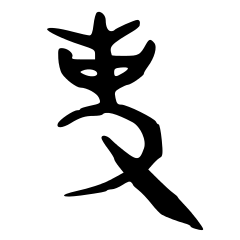
shî
Remember the many different pairs of “opposite” concepts in Chapter 2? We learned about how some pairs were formed, what that meant in terms of how some pairs mutually interacted, what that meant in terms of how some pairs played out in the sage’s life, and what THAT meant in terms of one particular man. Well… in Chapter 3, Lâozî continues the “opposites” theme to more completely give us a view of the world as it was.
~
First we learn that not-really-doing-certain things breeds (shî, 使) civilians to be not-really-doing-other things. This new list of opposites gives us these cause-and-effect relationships:
| Not really doing this… | … breeds civilians who are not really… |
| Elevating important rich people | Competing |
| Treasuring hard-earning’s transformation of riches | Efforting thievery |
| Seeing what’s definitely wanting or missing | Having a heart-core of confused anxiety |
Let’s just pause here and soak in the actual message before I get to exploring the translation. It all feels very true and free, doesn’t it? I’m enjoying thinking of examples I’ve witnessed of each case. And of the opposite. And also where I can relax into these not-real-ystates right now. Ahhh..
Presumably, if you, me, any leader, or a government DOES do those things in the left column, it causes themselves or others around them or under their leadership TO do the other things in the right column? Actually it’s not exactly phrased in a straight forward way. Maybe it’s written like it is because that “affirmative” causality actually doesn’t hold true? Or maybe it would have been impolitic to phrase it in that affirmative way—maybe it would alienate people currently in power when Lâozî was writing? We can’t say for sure. But refraining from the things in the left column does feel good.
~
If you read my complete translation of Chapter 3, you’ll see lots of interesting imagery built in to each of the words shown above in italics. I think a pivotal character in this section is the verb shî (使). See the left half of this character? It’s a drawing of a standing person in profile. And the right-hand sub-component comes from the following Western Zhou Bronze Inscription:
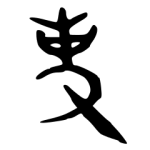
The bottom half of that drawing shows a hand…

… and it’s said to be holding what is believed to be a fountain pen. Some theorize that the hand and fountain pen are superimposed over a mouth, which you remember looks like this in the old bronze inscription scripts:

Others believe the fountain pen itself resembles the flagpole-and-drum structure that used to be placed in the center of a field to gather people. In the Western Zhou era it was drawn like this:

By the Spring and Autumn era, it had been simplified to very closely resemble its modern character:

We’ll see this character, zhōng (中), later in the Dào. Sometimes it’s a sub-component and sometimes its own word which I translate as in the center—like that drum with a flagpole placed in the middle of a field to gather the people, detect the wind.
But let’s get back to our main character. The above combination of the hand and pen is translated as history, historian, scribe. In the old days, it referred to a government official or gentleman. When combined with the the picture of a person, it makes our full compound character shî. That word’s modern translations are to order to do, to make (happen), to dispatch, and to employ, though in Cantonese it translates to have to or need to. In Quanzhou Min Nan (a Southern Mín dialect typical of Fujian province in southeast China before the 19th century), it’s used as a vulgarity comparable to English’s most famous four-letter f-word. Fujian is part of the territory of the Eastern Zhou dynasty where Lâozî was presumed to have lived. The Mín people are considered to be an ethnic-sub-category of the Hans, and interestingly enough, in our next post we’ll see them alluded to again.
In fact, most Dào translations don’t even specifically translate shî but rather just incorporate it in different ways with the word that follows it. A couple translators do call it out as the verb causes, but you know I like to get as complete of a visual image as possible in my mind’s eye for every character Lâozî might have drawn, so I translate shî as:
breeding—like a gentleman holding a fountain pen making something happen—
See how politely I included the Mín version?! Ahhhh…. just cracking myself up over here.
Please join me next time for more on the Mín people and on the other ways Lâozî used today’s word. Until then, thank you for being here, and please write me with any comments you have. I love hearing from you.
 The Dào of Lâozî