Categories
#4 cún 存 Qí 其 Shuî Yíng 沖

surviving—on the plane of a baby with health issues, maybe a large head, but still sprouting—

cún (存)

We left off pondering the exact nature of what appears to be a call to The Way of the loose-haired chieftain. (I apologize for the week off. I hit a big milestone in completing the screenplay treatment for a film version of Lâozî’s journey!! More on this later, as you might expect, but for now we return to how I pieced all this together.)

Happily, in the next paragraph of Chapter 4, Lâozî tells us more about this phenomenon of how you can be pouring water from a hollow drum and yet now, bearded, doing water-bucket-style work but not really overflowing one’s vessel:

In all four directions,

the myriad scorpion medicine-dancing Ten Thousand

Things cut off from you—all external matter like cows etc.—

has this

ancestral shrine:

So first we learn that everyone everywhere has honored what The Way calls one to do.

And then we get more information more about what this “ancestral shrine” involves:

pushing down to a sitting position on the ground…

what it holds a basket of ( 其):

a person speaking like an axe on metal—sharpening;

removing—a blade cutting the horn from an ox…

what it holds a basket of:

unravelling—separating thin silk with a blade into disorderliness;

harmonizing as a mouth organ…

what it holds a basket of:

brilliance—that shining fire over the head of a kneeling person;

Remember our discussion about “what it holds a basket of?” We were trying to figure out where this character points—in other words, what is the IT referred to? I concluded that this phrase doesn’t necessarily refer back to the word right in front of it. It most often points the reader back to the most recent “subject.” That would be this ancestral shrine (i.e., the call to The Way, to be pouring water from a hollow drum and yet now, bearded, you’re doing water-bucket-style work but not really overflowing one’s vessel).

Indeed the very careful and respectful translator, Yi Wu, translates this section to say The Way… blunts its own sharpness, unties its own tangles, tempers its own brightness.

BUT then again, in many places, many translators say “what it holds a basket of” DOES refer to the word right in front of it. In that case, you’d interpret this passage to mean that when it comes to The Way: pushing down to a sitting position has a sharpening similar to that of a person speaking like as a metal axe; removing like a blade cutting the horn from an ox has an unravelling like separating silk thin with a blade into disorderliness; and harmonizing as a mouth organ has a brilliance like that of shining fire over the head of a kneeling person.

As usual, it works both ways, in that manner typical of great poets and Lâozî in particular, adding up to all the paradox and ambiguity one might want in a mystical text!

Whichever “it” you consider…

spoken of altogether with one another—like all earthly, mortal, commonplace plates…

what it holds a basket of:

leaving dusty footprints in the dirt—like a deer streaked with soil.

We’ve seen this kind of naming in which things are “spoken of altogether” before. In the very first chapter, Lâozî described how Being and Not-Being are a matched pair that’s spoken of altogether when stepping out of their cave… at which point they then acquire differently-masked names. Now, presumably what’s being spoken of altogether is The Way… of pouring water from a hollow drum and yet now, bearded, you’re doing water-bucket-style work but not really overflowing one’s vessel. And this phenomenon leaves barely discernible tracks.

AND/OR: speaking of things altogether may, itself, have the characteristic of leaving barely discernible tracks.

Furthermore, it’s even harder to see whatever-this-is because it’s:

Concealed like sugar cane sweetness tucked in the ends of folded cloth and frozen like ice…

—Oh! A breath, like wind through tree branches!—

But also:

bearing a side-by-side personal resemblance, seems like:

“this particular territory—this enclave, defended by a weapon on a pole, plus its surroundings…”

surviving—on the plane of a baby that has health issues, like maybe a large head, but is sprouting. (cún, 存)

If you look back up to the top of this post, you see this particular territory—this enclave, defended by a weapon on a pole, plus its surroundings... was used in the first line of this Chapter 4, in what I’m considering to be The Call to Adventure. And now here we learn that the “territory” of this calling (to be pouring water from a hollow drum and yet now, bearded, doing water-bucket-style work but not really overflowing one’s vessel) looks very much like when an ill newborn survives and grows.

~

Let’s look at the character cún (存). It’s a compound character made from these two bronze inscription glyphs:
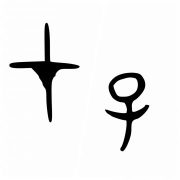
The sub-component on the left (cái, 才) is a pictogram of the sprouting of seeds. On its own, the modern meanings are ability, gifts, talent, or a person’s status/background. In Mín Nan (remember the Mín people?), it’s used as a classifier for describing a volume of wood or area of paper or other sheet materials. It’s considered the phonetic element of this word, signaling to the reader to give it that “c” sound. My first translation kind of ignored this character, but I’ve added it is to be consistent with my goal to represent all images found in the glyphs. Doing so with this character is especially satisfying to me as in my other interest—physics—surface area is one of the master keys to understanding most phenomena. And since we see references to marking out 2-and3-D spaces elsewhere in the text, it helps tie together potential connections to be consistent and include it here.

The sub-component on the right (, 子) is considered the semantic part that gives the character its meaning. The pictogram is an image of a baby. Etymological dictionaries specifically say it’s “a baby with a large head and spread arms; the legs are wrapped in a blanket.” Its modern meaning is child, offspring, son, and descendant. But also it can mean master or teacher, and indeed was used as a suffix in Lâozî’s own name as well as Confucius’ name (Kôngzî). It’s also used as the alternate for seed and can mean egg, young, tender, or small.

The overall compound character translates as exist; cherish, harbor; store, retain; stock, reserve. Dào translators use different words in different chapters, ranging from exist, be present, and is there, to preserve, survive, and places where it’s hard to even figure out what they’re actually calling this word because it’s combined with the other words around it into a new phrase.

I can’t help but believe it’s a mistake to ignore the character’s original image so thoroughly. Because I believe that Lâozî’s given us a detailed picture of The Call: its revered nature, what it does, and what it looks like. We don’t want to discard any information in that message even if it would simplify things to do so! The description we end up with is mysterious and provocative as usual.

Consider there’s that bearding… and it leads directly to a result that resembles a newborn baby living through health issues. Maybe it’s because of that last line that so many other images in the chapter bring pregnancy, childbirth, and gestation issues to my mind (e.g., pouring water from the center like from a hollow drum water, pushing down to sitting position, and even removing something that’s unraveling).

But also the more typical interpretation of this chapter’s meaning is compelling. Consider Yi Wu’s translation:

“The Way appears empty;
in use, it may not overflow.
Fathomless, it seems to be the ancestor of all things.
It blunts its own sharpness,
unties its own tangles,
tempers its own brightness,
unites itself with dust.
Deep but clear, it seems to exist and not to exist.”

And that of Gia-fu Feng and Jane English:

“The Tao is an empty vessel; it is used, but never filled.
Oh, unfathomable source of ten thousand things!
Blunt the sharpness,
Untangle the knot,
Soften the glare,
Merge with dust.
Oh, hidden deep but ever present!

It’s one of my favorite passages. That may be partly because it’s the first one I ever considered closely. When I met my husband and discovered his copy of Feng and English’s translation, I found a piece of rice paper tucked inside onto which he’d copied these very lines.

Why those lines, I wondered? How does this shape his way of going about life? In fact, the more I’ve gotten to know him, the more I see how those lines describe him and his intentions so perfectly.

What do they feel like to you? Do they sound desirable? Boring? Attainable? Easy? Impossible? And… how would one go about living this way?

Now, too, the more I’ve gotten to know the Dào, I appreciate the Feng-English version’s poetry and simplicity, and yet when I read it, I miss seeing the glyphs’ images. I miss those references to concrete, daily life. I like to think that maybe those images not only serve as metaphors to get across the big abstract message that these other translators capture so beautifully, but ALSO describe some details of Lâozî’s world. What a masterful feat the sage accomplished if that’s so. AND it’s done with rhyme, alliteration, and meter! I hope you’re seeing more and more why I’m so fascinated with not just the text by its brilliant writer.

There’s one final line in this chapter, and we’ll look at it in the next post. Thanks for being here today. Please send me your comments and questions using the contact form. See you next time.
Categories
#3 Cháng Mín 民 Qí 其 Wú 無 Yôu zhì 治

civilians—like the Mín people enslaved by blinding with a dagger—

Mín

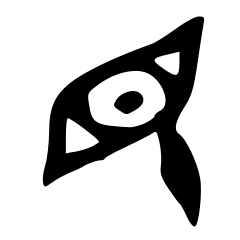
An eye pierced by a dagger. That’s the pictogram for today’s word, 民, which is modernly translated as people, citizens, folk, popular, and civilian.

Wow. This is why the images within the characters matter to me. The above picture of an eye and dagger is what Lâozî most likely would have drawn while writing down the 37 chapters we now call The Dào. Eye-piercing was an historic method for enslaving people. I’ve read that this practice was associated with enslaving the Mín people, hence this word and their name. Words from the Mín dialect make their way into the Dào in several places that I’ll note as we go along. We saw our first one in the last post, and—possibly not coincidentally?— that word (shî) occurs directly before today’s word (Mín) the first four times we see either one used.

As you recall, Chapter 3 opens with a list of three attitudes to avoid. If you avoid these, then you have a populace that doesn’t do three corresponding bad things. –>Not really elevating the elite rich means people don’t really compete (like with two hands clawing over a plow). –>Not really treasuring hard-earned transformation of riches means people don’t really “effort” thievery. –>And not really seeing something as definitely wanting or missing means peoples’ hearts aren’t really in a confused anxiety where their tongues are like twisted threads with one remnant string hanging out.

But, to be specific, each of those three prohibitions is spelled out according to this formula:

Not really doing [fill in the blank]

is breeding (like a gentleman holding a fountain pen)

civilians (like the Mín people enslaved by blinding with a dagger)

who don’t really do [fill in the blank].

I found this to be a nice time to re-read our last post and really reflect on that image of a government official holding in his hand a “fountain pen” that resembles “a flagpole sticking out of a drum.” Remember too: this image possibly shows that tool superimposed over a mouth. And of course there was the charming information that its meaning—to make someone do something—means to f*@# in the Mín dialect. So is it just me or does it sound like “breeding civilians” is another way of saying f*@#-ing the lowly masses who were enslaved by blinding their eyes with a dagger.

Does my heart suddenly seem rather dark to you?! Okay before I get all carried away seeing something horrible where it doesn’t exist, let’s find out what happens in the rest of the chapter and how these two words (shî mín) are used there. After all, this chapter is actually the only place that this shî character’s used at all.

~

What immediately follows is another instance of Lâozî telling us the suns sees indeed that this means something about the grounded sage. In this case, that description of what breeds civilians to be a certain way means the grounded sage has a particular style for governing (zhì, ).

If you look at this modern character for zhì, you see it has two sub-components. The left side evolved from the pictogram from water:

The right-hand sub-character (台), when it’s by itself, is pronounced in Mandarin and was the original form of the word for happy or pleased. It depicts a mouth (the square) below another character. Most often that arrangement of a mouth means speaking about though sometimes it actually does seem to carry the meaning of a mouth, a cave, or a similar type opening.

In this case the mouth is drawn below a character that’s sometimes thought to be a plow or a symbol for turned or revolving. More often, and more specifically, it’s thought to be a variation of (以) which we investigated in a previous post. There I translated it as already… finishing it in the womb based on its typical translations and the original pictogram which is said to be either a snake or a fetus. Nowadays, when this character’s combined with the mouth character to make , it seems to refer to some aspect of talking about oneself. The result’s translated as I or me or sometimes as what. It no longer carries the original meaning of happy/pleased, harmony, or joy unless it’s combined with a character showing a heart to the left of it: 怡.

When that same happy character was combined with the pictogram of water to form , the resulting meaning was often an ancient river name (pronounced either and chí). In modern usage, though, it’s pronounced zhî and translated as to govern, regulate, or administer. Historically it was used to describe a seat of local government. Dáo translators generally prefer the terms govern, governing, and government, but sometimes you’ll also see them translate it as rules or leads. Here’s how I translate it to include all the imagery:

governing—regulating by harnessing the river named Happy or speaking of turning yourself

I know it gets kind of wild when I translate this way, but I do so love the results. I love how it associates harnessing the River Happy with regulating or turning yourself around…. and with governing.

UPDATE: I look into this character a little more in a later post here.

~

So, to continue on, Lâozî says that in light of that list of what kinds of attitudes do or don’t breed what kinds of civilians, a sage’s governing looks like this:

The sun—walking across the sundial a while, stopping a while—sees indeed

this means…

the grounded sage—listening and speaking, standing connected to earth as well as the heavens,

that person

has this

governing—regulating by harnessing the river named Happy or speaking of turning yourself:

~ emptying—like lifted land…

what it holds a basket of…

heart-core

~ really filling—like a building with strings of solid cowry-like riches…

what it holds a basket of…

inside—the gut, the meat belly;

~ being as fragile as a matching pair of decorative bows or little wings…

what it holds a basket of…

having heart-core determination and aspiration

~ strengthening like an insect—turning yourself as a venomous snake-like bow…

what it holds a basket of…

that bony will that comes from a skeleton framework.

What “it” is referred to in the phrase “what it holds a basket of?” This character, (其) puzzles me. We first looked at this little connecting word back in one of our earliest posts. But when translating Chapter 3, I decided to go back and review all 61 times it occurs in the first 37 chapters of the Dào Dé Jīng and compare how it’s handled by different translators (especially Chinese translators). I ultimately decided it’s safe to say that this phrase doesn’t necessarily refer back to the word right in front of it. Rather it points the reader back to the most recent “subject.”

In other words, Lâozî probably isn’t saying that “emptying has heart-core.” More likely this phrase says that the sage’s governing empties the sage’s heart-core, fills the sage’s inside/gut, is fragile in the sage’s heart-core determination, and strengthens the sage’s bony will. However only Chia-Hsu Chen translates it this way.

Most translators say the sage’s govern empties the people’s hearts, fills their bellies, weakens their ambition, and strengthens their will. They think “it” refers back to Lâozî’s previous “paragraph.” Other translators leave out the whole question of whose basket is in question! They say the sage’s governing empties the heart, fills the belly, weakens ambition, strengthens will.

What bothers me is that these approaches aren’t consistent in how they decide what the connecting word is pointing to. And when you read the different options I pose here, this subtlety really makes a difference, doesn’t it? Maybe this is another example of Lâozî the poet being intentionally ambiguous. Maybe “it” could be any of those things. “It” could be the sage, the governing itself, the people, or it could even be the word right in front of “it.” Maybe it COULD mean “emptying has heart.” (I like that last version a lot. I translated it that way myself until I more thoroughly analyzed .)

So why do I belabor this?

Because it makes a difference on a very important point: does the sage’s way of governing have anything to do with making the civilians be a certain way? It’s easy to assume so. After all we usually do think of governing as controlling others. And in the first part of this chapter, we just saw some gentleman a fountain pen was making them do stuff. But it seems to me that the point of this next section here is that the sage doesn’t do that. Maybe the sage is just over here minding the sage’s own heart, gut, ambition, and will. The very particular way that Lâozî drew the “governing” character could support that—governing could be about turning yourself, harnessing your own Happy river.

Let’s see where else Lâozî goes with these topics in this chapter. It’s pretty interesting.

~

As you remember, in the very first sentence of Chapter 1, Lâozî set up a conflict between the definitive “” version of things and the cháng version—the ever-present traditional, timeless, constant version of things as symbolized by the head cloth that men donned upon becoming official adults. Now we learn more about the cháng (常) version. We’re going to learn about what happens with that traditional version of breeding civilians:

The ever-present square fabric which our grown men wrap around the ‘little bird’ top knots on their heads after receiving their public courtesy-names—what we know as the timeless, whole head-cloth ‘ji’ version of

breeding—like a gentleman holding a fountain pen making something happen—

civilians—like the Mín people enslaved by blinding with a dagger:

~ nothing—no one dancing with long tails flowing from their wrists—nope, never, no way, nowhere, nohow Not-Being…

firing arrows from the mouth—sure;

~ nothing—no one dancing with long tails flowing from their wrists—nope, never, no way, nowhere, nohow Not-Being…

wanting what’s been eroded from this ravine

We know two things about the traditional version of breeding civilians:

  • Not-Being… sure
  • Not-Being… wanting what’s missing

Does this mean the traditional version of breeding civilians breeds civilians that aren’t sure and aren’t wanting or missing anything? OR that in the traditional version of breeding civilians, someone who is a Not-Being is sure and is wanting something that’s missing? It’s our old familiar debate about the nature of the shamanic dancer Not-Being character, , and the meat-holding character we call Being, yôu. Are they people or are they negative and affirmative parties? Does it depend on context? Let’s keep reading with an open mind.

When we do so, we see in the very next sentence Lâozî tells us a third thing about the traditional version of breeding, and this is for sure about this particular man with a hairpin and public courtesy name (). We met this character in Chapter 2. There we learned he was absent and therefore not really leaving. Here we learn that he’s a person who, in the traditional version of breeding, is sure:

breeding—like a gentleman holding a fountain pen making something happen—

that is to say, this particular grown man with a hairpin and public courtesy name…

“firing arrows from the mouth—sure” as the sun, daily

—now this is cooking!—

the husk of the initial protective bud casing—the sepal—but not really the true inner flower of

daring—lightly hitting ears on both sides of the head—

efforting—like lifting up an elephant,

—yes, that too, vagina!

~

All right, all right. Before I continue, I want to address the elephant in the room—and no, I don’t mean the actual elephant we once again see inside the image for “efforting!” I mean that last exclamation and its reference to female genitalia. Is this gratuitous sensationalism on my part? You tell me. I will give you the facts… in our next post. Because this one’s getting soooo long, and I want to tell you about all of Lâozî’s colorful interjections at one time.

Until next time, be sure to use the contact form to send me your questions and comments. Thank you for being here!

Categories
#1 Guān Qí 其

wanting (what’s been eroded from this ravine)

Things go better when we don’t confuse “desire” and “want”—whether in translation OR in our own lives.

  • “Desire” is when something pulls you; you feel it. It moves you. In English, we describe the most essential such experience as our “heart’s desire.” Perhaps it IS always our heart pulling us when we feel that inexplicable longing to do something… to go somewhere, make something, or talk to someone. Whatever the action, like a river pulled by the invisible force of gravity toward its sea, desire always leads us into some movement, into falling into what pulls us… into the very next step.
  • “Wanting” is when something’s missing and/or you think it is—it indicates a lack of something. This is a more unsettling feeling, not particularly an energizing feeling, but still a part of our human life and nothing to be ashamed of.

Both situations will occur in a human life, but how we feel is different as is our typical behavior and also… what would be most helpful.

Our word-of-the-day (欲) gets translated as both desire and want—often by the same translator. It’s also called wish which is something else altogether since it pulls in a wistful sort of request for supernatural help.

So, which of these options best represents ? Let’s look at what the old scripts of Lâozî’s times show us in their pictograms.

You can see right away that we’re dealing with a compound character. The left sub-component is considered the phonetic one that tells the reader how to pronounce the word, and I guess does indeed rhyme with . ‘s modern character is , and the Western Zhou Bronze (WZB) inscription looked like this:

I’m relieved this looks so much like the left-hand side of the very first character I showed you above because that one’s written in the Warring States (WS) Chu Slip script that came just after Lâozî (check out the Dates, Dynasties and Their Scripts tab to follow that timeline). You know I prefer the Western Zhou Bronze inscriptions, but I couldn’t find any such version of the whole compound character. The similarity between the two scripts in this sub-component gives me confidence that the WS script is a good approximation of how Lâozî may have written this character. It depicts a stream running between two mountains and is translated as valley, gorge, ravine.

The right-hand sub-component, qiàn (欠) translates as to lack, be deficient, yawn. Depending on which linguist you listen to, it shows either a knife (⺈) or a mouth:

atop a person (人).

I have almost always lived in landscapes where ravines are commonplace—playing in them as a child, hiking them as an adult, and surveying and analyzing their dimensions and changes as a stream restoration hydrologist. What I’ve experienced is that a yawning, slashed, eroded gully has way more in common with what’s “wanting” than with “desire” or “wish.” Nonetheless, “desire” is so ubiquitous in others’ translations that I tried to incorporate it along with the pictogram in my own initial translation: desiring what’s wanting—what’s been eroded from this ravine…

~

Let’s try out my translation to see if Chapter 1‘s structure and content sheds any light on the subject. Both times our word occurs, it’s followed by these words:

this means:

keeping watch from the temple tower for

what it holds a basket of…

Here’s a quick breakdown of those characters:

~ , 以: This is a very common word in the Dào Dé Jīng. Its left component carries the meaning but remains a mystery. In the WZB it looked like this:

Some say it’s a plough; others say its a turned version of the symbol for a snake or a fetus. The right-hand component of the current character 以 wasn’t added until modern times. It’s a person, and in Western Zhou Bronze Inscription that looks like this:

We’ll see this character a lot as we go forward. The word is translated as by, by means of, according to, so, so as to, in order to, therefore and other connecting, almost causal or at least logically-linking transitional words. I fiddled with a lot of ways to make it work in all 46 contexts where it occurs in the first 37 chapters and came up with: this means… I don’t like that I haven’t included the pictogram itself, but the options are too different for me to decide on one yet. That could change in future posts as we learn about the sub-component’s use in other words and get a feel for it.

~ guān, 觀: In this compound character, the left side shows a heron. Its old WZB form is beautiful:

The right-hand component means watchtower, platform, or temple—it was drawn as an eye over a pair of legs:

This compound word now means observe, watch, see. I translate it as: keeping watch from the temple tower for

~ , 其: Here’s yet another seemingly inconsequential word that’s translated many ways, usually something like its or has but also he, she, it, they, one, his, hers, theirs, that, those, probably, perhaps, therein… You know I do not like the predicament this creates, consistency-wise! The WZB inscriptions shows a basket on a stand:

After another chunk of time fiddling around for something that can work anywhere, I just went pretty much only with the image, as I think it says it all: what it holds a basket of… So does that mean “what the basket is made of” or “what’s inside the basket?” Hmmm. Either way, and with that double possibility, I think it’s in keeping with all the translation choices in the list you just read.

Look here at how all these words work together:

desiring what’s wanting—what’s been eroded from this ravine…
this means:
keeping watch from the temple tower for
what it holds a basket of…

It looks like Lâozî just straight-out gave us a clear way to interpret our word-of-the-day: when someone “wants” something, that’s saying they are looking for their own stuff. They feel like some of what their life holds—contains or is made of—is lacking, like the soil that was washed away to make a ravine. And when that happens to us humans, we very much do “want for” whatever basic ingredient we feel is missing—we maintain a sort of vigilance and sense of lack. Lâozî’s words definitely make sound like it’s more about what’s missing than about being pulled toward a heart’s desire or making a wish.

That decides it. I’m changing my translation. Mixing this word up with desire is unnecessary and misleading. We don’t want to mislead ourselves into thinking that any further information Lâozî gives us about wanting is pertinent to desire. Bonus: my new translation’s simpler, and it still can be used as either a verb or a noun:

wanting (what’s been eroded from this ravine)

~

So what else does Lâozî teach us about wanting here? You’ll remember that just before this section, Chapter 1 introduced us to two seemingly opposite or complementary characters Not-Being and Being. Specifically, in this first use of them, Lâozî linked them up with míng (personal childhood name) to explain that “Not-Being míng” and “Being míng” are each the origin of something… something unique for each one.

Names as an origin? That puts me very much in mind of quantum physics as well as the thought-provoking psychologic, neurolinguistic, and anthropological research indicating that if we can’t name something, we can’t really develop our perception or understanding of that thing. And as we learned in a previous post, both approaches to naming are the origin of cool stuff: Not-Being, its name is Sky-Earth’s beginning like conception in and by a woman; Being, its name is all the manifest stuff’s nourishment like being suckled by a woman.Very cool. But there’s more.

Lâozî says there’s something that’s followed logically for many generations…

Here’s where learn about exactly what might be “wanting” in two different aspects of experience. Before getting specific, Lâozî specifies that we’re now talking about the timeless, constant, ever-present version of it all—as represented by the traditional “you’re-officially-an-adult” males’ head-cloth.

Then, Lâozî tells us what “wanting” means for 1) the timeless mens’ head-cloth version of “Not-Being” wanting and 2) the timeless mens’ head-cloth version of “Being” wanting. Here’s my summary, in table form:

STATE, QUALITY, ASPECT, OR PERSONA:

Not-Being—————-> ————————–

Being———————> —————————

This “personal naming” is the origin of:

Sky-Earth’s beginning, like in and by woman

10,000-external things’ suckling, like being fed by a woman

In “timeless/head- cloth way,” wanting /looking for:

mysterious feminine essence

delineated surface

This makes sense. If “Being, its name,” at the most intimately known level, nourishes and rears the myriad of manifested things out in the world, then it follows that “Being wanting” also would have to do with this concrete kind of stuff. We know when something’s wanting, it will involve looking for the stuff IT HOLDS or IS MADE OF, and in this case, Lâozî says that’s going to be a clearly-marked outward surface. As you remember from when we broke down that word in a previous post, this is a feature that was defined by drawing a sword tip left to right. In mathematics/geometry/physics, such a lined-out surface is a plane—a 2-dimensional feature. The surface is what we see of the universe—of what exists. It’s obviously an important, vital part of our lives. In fact, it’s usually what we pay attention to. Lâozî says that in the eternally constant grown-man-head-cloth version of Being wanting, what we’re missing and keeping an eye out for is that surface plane. This seems correct and like the useful thing to do.

And Lâozî also reminds us of another part of our experience: something more mysterious and hard to describe or touch. It’s not concrete, and indeed Lâozî describes it as an absence. “Not-Being, its name” gives us the very beginning, the Source, or what some call the Divine, Sky-Earth, heaven. And when considering this “Not-Being” in terms of “wanting,” Lâozî says the stuff missing is mysterious feminine essence. That’s what it holds a basket of.

~

Wait. How can Not-Being Wanting be missing anything at all?

Here’s where we get a clear notion that Not-Being Wanting isn’t the same as not wanting. If it were simply “not wanting,” then that might be pleasant (or even noble in the eyes of a puritanical interpretation that confuses wanting with desire and desire with lust or greed). But nothing would be missing. And yet here we are with something missing, albeit a non-concrete mysterious essence of a something.

What exactly is this “Not-Being?” And if it’s something other than a simple modifier meaning “not,” then what does that tell us about its complement, “Being?” Is that something other than just a confirmation that something’s happening?

Review the tortuous logic I took you through in this post! Now you’re seeing why I did it this way for myself originally and why I laid it out for you here. I wanted us to follow exactly what we’ve read thus far about the nature of these Being and Not-Being characters. The structure I outlined in the table above is exactly how it’s laid out in Chapter 1… and it’s exactly parallel for Being and Not-Being. I’m pretty sure it drives us to the conclusion that Not-Being is as much of a something as Being.

Of course I don’t have an answer for you as to what these two terms mean. They’ve been the source of discussions about the Dào since… ever since this text was written as far as I can tell. But somehow I felt relief in clarifying for myself and you that they indeed are not simple little modifiers. There is something going on here. It’s baffling and disorienting. And that’s perfect.

Let me skip ahead for a minute to Chapter 3. There Lâozî comes right out and describes the Sage’s strategy in dealing with civilians — in “governing” them or rather, in the literal old images I prefer, “harnessing the river happy!” A fundamental step in the strategy is to create confusion—”Not-Being sure.” Ha! I would say Lâozî’s succeeding at that with this entire book! At least thus far. In the end of Chapter 3, and increasingly clearly all throughout the rest of the book, Lâozî shows us how this strategy leads to a deep rightness.

We have to unlearn some things to learn other new things. We have to get baffled to crack open enough to take in something bigger than we previously held, to increase our capacity. So I’m going to keep trying to suspend you and me in uncertainty. We can do it. We can tolerate it. We can even enjoy it. We’re built for this.

~

Whatever they are, the egalitarian structure of this chapter indicates that the not-so-visible “Not-Being” name/wanting is equally as important as the concrete “Being” version of those things. Lâozî even clarifies that these two parts are “a matched pair, like a harness of oxen yokes” presumably pulling things along nicely and evenly when they’re both involved.

Moving along forward… that’s where your life is happening. The Dào has a lot to tell us about living with and from and for the heart—that’s the stuff of desire and movement. Lâozî devotes the entire second half of the Dâo Dé Jīng specifically to that straight heart path (AKA the Dé or Te), and there’s lots of information on it coming up in this first half also. Until then, when you feel your heart pulling you somewhere, take a step.

But today’s word is about the inevitable times when we feel ourselves not moved to move but like we’re sitting up on a watchtower, staring out over a valley because we feel we’re lacking somehow. Thats part of being human. And then it is fine to keep a watch for what’s missing. It helps to know what you’re looking for though. Sometimes it will indeed be the surface stuff—specifically it will look like a boundary, a line drawn with the tip of your sword. That’s true whether you consider yourself a sword-bearing frontiersman on patrol (remember that was part of the original image) or not. And sometimes it will be a mysterious feminine mist of an essence—that’s true whether you’re a man or woman. When your wanting isn’t very definable—you can’t figure out what or how to draw a boundary or address the surface or even see it and so you keep watching and waiting and watching—then feel around for an essence and breathe it in. We’ll get more specific instructions as we work through the book, but honestly it just comes back to that.

Thank you for joining me in floating in—heck, diving into—Not-Being sure. I’ll see you tomorrow.