Categories
Dào

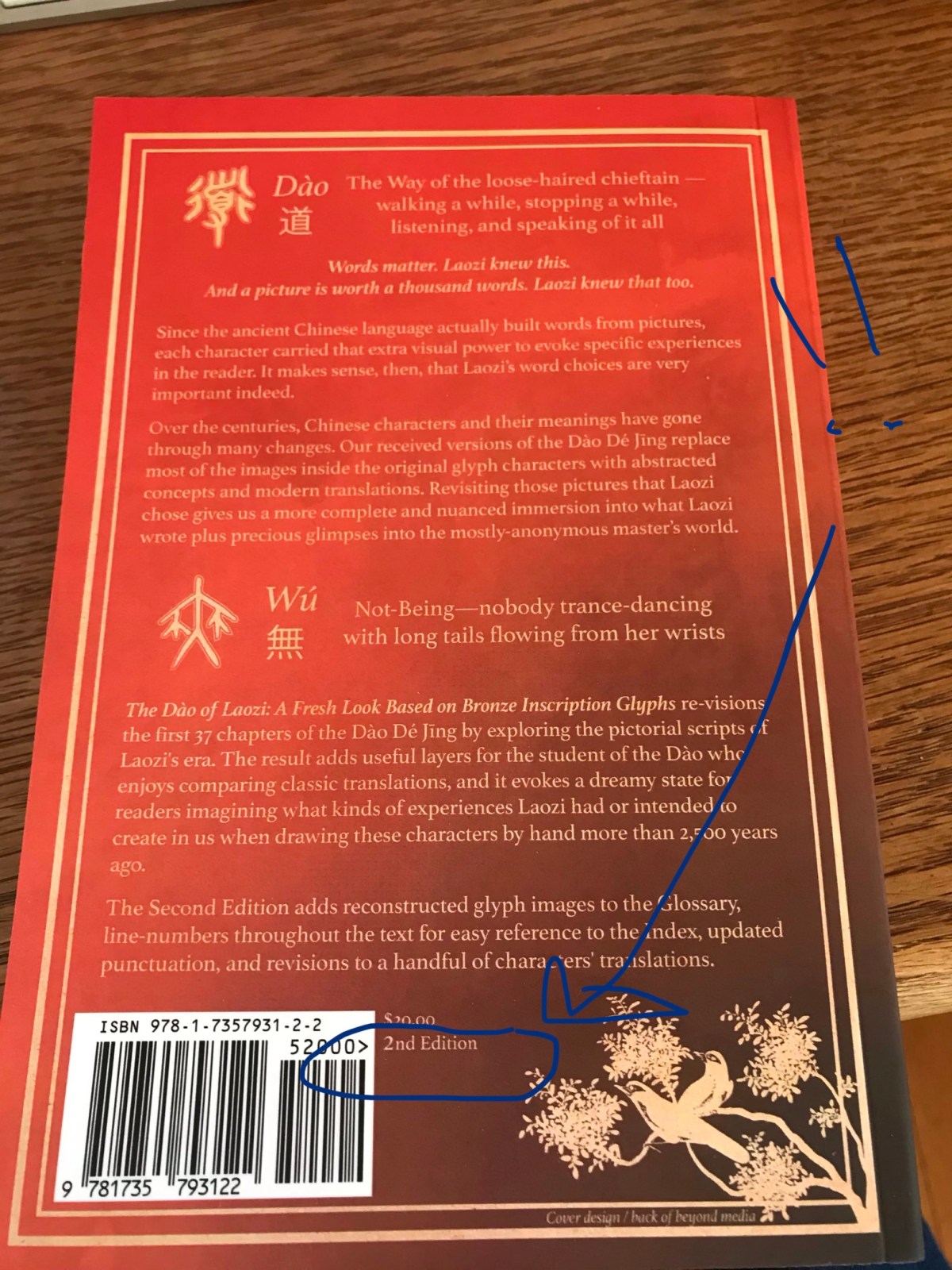
2nd edition…

… yes, already! Because hand-assembling glyph versions of the compound characters’ sub-components went really quickly once I hired a wonderful research assistant (thank you Annie!). The new edition also has numbering of all lines for easy reference to the Index and the Glossary. Now you can look in the back of the book and see a list of every where a particular character appears… which puts us that much closer to the mind and experience of Laozi. And that’s always my goal.

The book’s available for any bookseller to order from their usual distributor (Ingrams). The new edition’s slowly get placed on to online sites as well.

IF YOU BOUGHT A FIRST EDITION, please allow me to send you a copy of the second edition at my cost: $9.00. Send me a note using the contact form, and I’ll send you an email coordinating your address and the fee.

Thank you for being here. I’m working on a fable form of Laozi’s story, now that I have the source document I wanted to use! We are also working on the Dé—assembling those glyphs. It’s coming together quickly thanks to Annie, so I’ll keep you posted on both of these projects. Thanks for reading. Have a beautiful solstice and holiday season, wherever you are and whatever that means for you and yours.

Betsy

Categories
Dào

It’s a book!

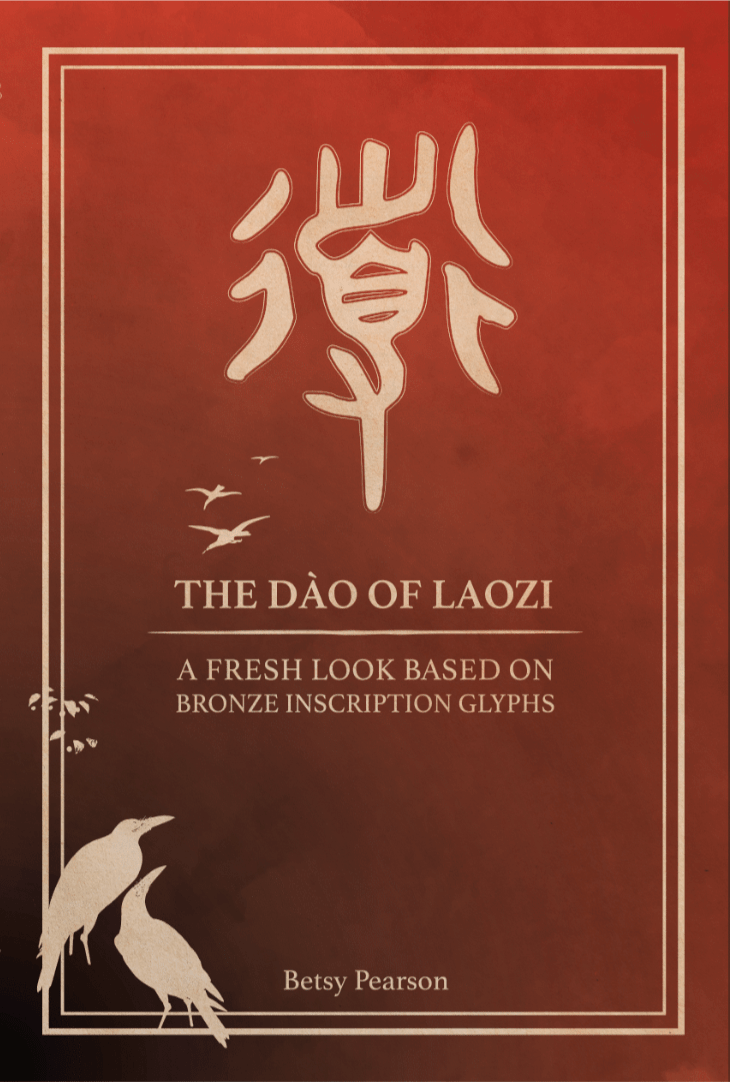
Today is the publication date of The Dào of Laozi: A Fresh Look Based on Bronze Inscription Glyphs. It’s also my 60th birthday, and this is my present to myself. I frankly adore it. The gorgeous cover was created by David Huebner of Back of Beyond Media, and as he understatedly says, “it has a good vibe.” It really does. Thank you, Dave.

Allowing time for the birthing of this book is part of why the blog paused for so long. Another part was the events that transpired here in the US this year and how they came to a head June 2nd. Like everyone, I had a lot of intense reactions, but I wasn’t sure of my intentional response. Finally, after lots of listening, it seems clear that halting our Creativity is an insult to those who are kept from expressing their own Creativity, either partly—because they are ill or held down by culture and systems—or completely—because they died or were murdered. So I doubled down on my creative efforts and especially the scary ones where I feel vulnerable, like this Dào project. Because I can. And that’s an obligation as well as a right and a beloved bit of good fortune.

I also created The Stairway of Surprise: A Daybook of Wonder, a surprise journal that came out October 1st. Both books are published under the auspices of Sunwarmed Sage Press, where I will be publishing other very content-specific non-fiction books that I find soothing and that I hope will have the same effect on others and our collective nervous systems.

I didn’t get ahead of the shipping schedule like I wanted to, so it will be a few more days before you’ll be able to order copies of The Dào of Laozi. I’ll keep you posted. Meanwhile, thanks for being here and for celebrating with me.

Categories
#6 cún 存 Cháng Dào dì 帝 Fú 夫 lâo 老 mián 綿 ruò 若 Tiān Xuán xī 希

someone compliantly combing their loose hair seems to be saying: ‘this is as if…’

ruò (若)

Within that valley mouth between two mountains,

a lightning god…

the husk of the initial protective bud casing—the sepal—but not really the true inner flower of

being mortal—going from a standing person to a pile of bones;

the sun—walking across the sundial a while, stopping a while—sees indeed

what it’s called when speaking from the gut—words, like slaves or criminals branded by a chisel emerging from a mouth,

the hard-to-see dark structure—like a figure-eight skein of string-dyed-black:

a mother’s lap—a cow with an arrow… a vagina.

“Hard-to-see dark structure—like a figure-eight skein of string-dyed-black,

a mother’s lap—a cow with an arrow… a vagina,

has this

double-winged gateway… “[from Chapter 1]

the sun—walking across the sundial a while, stopping a while—sees indeed

what it’s called when speaking from the gut—words, like slaves or criminals branded by a chisel emerging from a mouth:

Heaven (that sky level above the human head)-Earth (this soil vagina)…

root of the family tree—penis…

barely perceptible—like the fine, white silk threads making up that ever-present, timeless, whole head-cloth ‘ji’ our grown men wrap around the ‘little bird’ top knots on their heads once they’ve received their adult, public courtesy-names.

Barely perceptible—like the fine, white silk threads making up that ever-present, timeless, whole head-cloth ‘ji’ our grown men wrap around the ‘little bird’ top knots on their heads once they’ve received their adult, public courtesy-names…

someone compliantly combing their loose hair seems to be saying: ‘this is as if…’ (ruò, 若)

surviving—on the plane of a baby with health issues, maybe a large head, but still sprouting… (cún,存)

doing truly useful work like a water bucket—by means of carrying-capacity

has this…

the husk of the initial protective bud casing, but not really the true inner flower, of

exerting with force—working hard with the strength of an arm, a bladed tool, or a plough on the soil.

That’s all of Chapter 6 in its entirety. It’s a pivotal chapter because here we meet a new character, ruò, 若. Its bronze inscription character is a pictogram of a person combing their hair:

Its modern translations are to be obedient or compliant, to trim vegetables, to choose, you/yours, he/his, like, as if, and supposing. Dào translators usually interpret it as is like, seems, or as. Or they just ignore it altogether or use “is” in its place. In two key places in Chapter 37, the final chapter of the Dào part of the Dào Dé Jīng, they almost universally translate it as “if.” As is my custom, I incorporate the modern meanings, the pictogram, and the traditional translations into one consistent translation every where it occurs:

someone compliantly combing their loose hair seems to be saying: ‘this is as if…’

Since there are other, more specific, ways to say each of the traditional meanings (if, like), I think this character has some particular use for Lâozî.

~

It’s interesting that ruò so prominently features hair since that’s a recurring motif… beginning with The Way itself. In the character for Dào, the head very obviously has a head of big loose hair.

And in Chapter 1, right away we’re struck by how that seems to very obviously differ from the conventional hairstyle of a grown man with a top knot (, 夫) and especially from a grown man whose top knot’s covered by a traditional head cloth. This head cloth image occurs not only in that word for the timeless, never-changing traditional version of things (cháng, 常) but also in the characters showing God in Heaven or emperor (, 帝, as we saw in Chapter 4), barely perceptible (mián, 綿, as we see in this chapter), and sparse (, 希).

Hair style appears in many other characters including, not least of all, lâo, 老: an old man with long hair and a cane. This word is the first part of Lâo Zî’s honorific name.

~

It’s fascinating to me that this character ruò first appears in this particular place in our story. In Joseph Campbell’s classic Hero’s Journey story arc, this is the place where the hero would get outside help, usually from a supernatural, larger-than-life, or unexpected source.

In the last chapter, there was the doubtful sentiment of “pah, can you?!” The call to the daunting adventure of living according to The Way of the Loose-Haired Chieftain seemed rather undoable. But now we have someone compliantly combing their loose hair who seems to be saying: ‘this is as if’ surviving—on the plane of a baby with health issues, maybe a large head, but still sprouting.

Chapter 4 introduced the possibility of surviving. But here, our magic someone not only rather drolly says that’s what’s happening but elaborates what this means: the doing of truly useful work (like a water bucket) has this: non-exertion.

OHHHHH. Doing useful work like a water bucket without overflowing (while pouring water our from the center hollow drum!) was the calling for The Way at the beginning of Chapter 4.

So what does Chapter 6 tell us?

  • Here’s the situation: The lightning god within that valley mouth between two mountains isn’t really turning into a pile of bones. Phew.
  • The sun sees indeed what it’s truly called, that hard-to-see dark structure—like a figure-eight skein of string dyed black:a mother’s lap/vagina…
  • and the “hard-to-see dark structure, a mother’s lap/vagina’s double-winged gateway” (remember that phrase dramatically ending Chapter 1?) is truly called… Heaven-Earth… root-of-the-family-tree or penis…
  • barely perceptible. Mián, 綿, or “barely perceptible” is drawn by showing the fine, white silk threads making up that ever-present, timeless, whole head-cloth ‘ji’ that grown men wrap around the ‘little bird’ top knots on their heads once they’ve received their adult, public courtesy-names. The modern translation of this word is soft, downy, or sometimes cotton. Dào translators variously call it continuously, always present, like a veil, lingering like gossamer, or invisible.

As usual, the lack of punctuation and various potential syntaxes make those first five lines interpretable in many ways. Also as usual, I interpret it based on how the drawings and double-meanings make something occur to me. What with all the pregnancy and baby images, I’m starting to think that Heaven (tiān, that sky level above the human head)-Earth (dì, this soil vagina) refers to a spirit from above when it is down here, manifest, in the womb. In other words a fetus.

In the Western Zhou bronze inscription age just preceding Lâozî’s era, tiān was drawn as a person with a large head:

In the even older Shang oracle bone script, it was drawn with a line above a person’s head, supposedly indicating a higher level:

It is thought that the oldest meaning was sky. It’s also been used to mean heavens, celestial, heaven as a place for deities or departed souls, heaven as a deity, overhead, top, climate, a 24-hour day, daytime, season, nature, natural, innate.

So is my interpretation far-reaching? Maybe. But when I re-read everywhere this phrase occurs, it totally can fit this secondary-level interpretation at the same time that it fits into a meta- or symbolic story about “Heaven on Earth” or “Heaven and Earth.” In this use of it, I see someone literally trying to figure out what’s going on inside a laboring uterus and barely being able to discern the fetus. Maybe they can tell it’s a boy? Or maybe they know that after the fact. Or maybe the vagina’s product is called the family root, attributed to the work of a penis. Okay back to what we see for sure…

  • Even though it’s barely perceptible, our magically helpful someone, compliantly combing their loose hair, seems to be saying: ‘this is as if’ it’s surviving —on the plane of a baby with health issues, maybe a large head, but still sprouting. Now you can see how, based on my imagination and the previous and following chapters, I like to think of our someone as a midwife helping with premature labor.
  • And given this situation, she says that surviving means doing truly useful work like a water bucket, by means of carrying capacity, has this “not really exerting with force.” I see that as “the most useful work now is just to carry that baby. Don’t labor. Especially don’t push.”

There you go… I’ve fully bared my most wild, favorite theory. And you can understand my admiration for Lâozî, given that this story is buried within characters that ALSO can be translated as a cosmic, existential, life handbook. Here’s how Yi Wu translates this chapter:

The spirit of the valley never dies;
It is called the mysterious female.
The gate of the mysterious female is called the root of Heaven and Earth.
Continuously it seems to exist.
There is no labour in its use.

And here’s how Feng and English translated it:

The valley spirit never dies;
It is the woman, primal mother.
Her gateway is the root of heaven and Earth.
It is like a veil barely seen.
Use it; it will never fail.

Thomas Cleary translates it as:

The valley spirit not dying is called the mysterious female.
The opening of the mysterious female is called the root of heaven and earth.
Continuous, on the brink of existence, to put in into practice, don’t try to force it.

Is this non-forcing possible? Sometimes—whether because you’re in actual labor or you’ve found yourself in the habit of over-efforting in life and not relying on the “female” type of creativity—it doesn’t seem like it. Can our magical someone help in ways more tangible than just saying “don’t labor; don’t force it?”

We’ll find out next time. And now, until then, please use the contact form to send me your responses to my theory! I hope you’ll go back and re-read all the chapters we’ve looked at thus far and see how my ideas do or don’t make sense to you. Thanks for being here.

Categories
#4 Bù 不 Dào dì 帝 Zī 子

‘God of Heaven’—as we call our emperors, for they’re like flower sepals connecting to above

(帝)

I—we—our five mouths…

the husk of the initial protective bud casing—the sepal—but not really the true inner flower of

firing arrows from the mouth—sure

of whom the short-tailed bird speaks, the one that

has this

baby with arms wide open and legs swaddled [this word is the second, “zî’,子”part of Lâozî’s honorific name]…

likeness—like an elephant skeleton letting us imagine a living elephant—of

‘God of Heaven’—as we call our emperors, for they’re like flower sepals connecting to above with their covering of that ever-present, timeless, whole head-cloth ‘ji’ square fabric which our grown men wrap around the ‘little bird’ top knots on their heads once they’ve received their adult, public courtesy-names— (, 帝)

has this

being long before—like one’s dead ancestor.

That’s the last line of Chapter 4. As you recall, Lâozî began Chapter 4 with some details about following The Way of the loose-haired chieftain. Specifically it involves pouring water from the center, like from the hollow drum at the base of a flagpole, and yet now bearded, you’re doing truly useful work like a water bucket by means of carrying capacity. And at the same time, this particular territory is not really full to overflowing it vessel. It’s concealed like sugar cane sweetness tucked in the ends of folded cloth and frozen like ice—Oh! A breath like wind through tree branches!—and surviving like a baby that has health issues but still is sprouting. That’s a relief, whether we’re considering The Way or this little baby used to symbolize survival.

And now here, in the next line, Lâozî concludes Chapter 4 by saying “I am not really sure whose baby… it looks like the God of Heaven’s ancestor.” Other translators keep some aspects of these old glyph images of child/parenthood in their versions of this line:

Yi Wu translates it as:

I do not know whose son it is.
It symbolizes that which precedes the Creator.

Feng and English translate it as:

I do not know from whence it comes.
It is the forefather of the gods.

~

This is the only place in the first 37 chapters of the Dào Dé Jīng where we see the word (帝):

The image is sometimes considered to be a sepal, like that which we see so commonly in the word (不) which has this pictogram:

Indeed if you compare the drawings, you see that does seem to be a big part of the character though not all of it. Others consider the central element in the character’s composition to be jin 巾, the traditional head cloth for adults:

And yet other etymologists say the character is a picture of tied up firewood (perhaps for a sacrifice) or an altar. At any rate, early on, this image was used to mean “God of Heaven” and then emperor.

~

What all did we learn in Chapter 4?

Point 1: This is the first time since Chapter 1 that Lâozî circles back and actually starts talking about The Way of the loose-haired chieftain. We learn its paradoxical pouring out of water “and yet, now, bearded,” doing of useful work in the fashion of a water bucket has this particular territory: it’s not overflowing its vessel.

So… how do you pour out water, do useful work, and not overflow your vessel? Use a bucket. Or maybe: be like a bucket.

Point 2: And this particular territory is concealed and surviving like a vulnerable but sprouting baby.

So… that seems like good news. Although, to be honest, until now I didn’t know it was in danger of not surviving. This makes me re-read the intervening list of paradoxes with a new eye. Is it a list of the dangers of this particular territory? Or a list of corrective actions taken to make this particular territory survive? Re-read our last post yourself and see what you think.

Point 3: And by the way: we don’t know whose baby it is, but it looks like God/the emperor’s ancestor.

So…The Way’s origin isn’t known, but it pre-dates even God.

And/or there’s a baby whose parenthood isn’t known, but it looks like the emperor.

Or both.

~

Once more, I’m filled with curiosity, some wild theories, and great admiration for Lâozî’s ability to write short lines of one-syllable words with complex images that carry multiple (!) layers of meaning.

In the next chapter, we’ll see if our hero is up to this call to the Way, whether it’s a literal Way of working and having a baby or the meta-Way so beloved by philosophers and meaning-seekers for millenia.

Thanks for being here, and be sure to use the contact form to let me know what you’re thinking. See you next time!

Categories
#2 Dào Fú 夫 Fú 弗 Fū 夫

that is to say, this exact grown man with a hairpin and public courtesy name…

Chapter 2 introduces another character that shows up in pivotal times throughout the Dào: (夫). The Western Zhou Bronze Inscription starts with an image of a man…

… and adds a hairpin ():

I don’t know for sure if this image has to be male or if that’s just how it gets translated now. Women also wore hairpins, but maybe this image shows the pin men wore after their Guan Li naming ceremony when they officially became an adult man. Modern translations of this character when it’s pronounced are just that: male adult, man; husband; person; manual worker.

But there’s another pronunciation of this same character: . That’s how it’s usually been transcribed in the received versions of the Dào Dé Jīng. Its modern translations are as a generic personal pronoun—he, she, it, they—or a particular “demonstrative” pronoun like this, that, these, those. Translators of the Dào also interpret it variously as you, for, just, because, this very, the, ones, people, that is, and only. A lot of times it’s somehow combined with words like therefore, and, so or other introductory or transitional words or just dropped altogether and considered to be a meaningless particle. Perhaps, the translators think it’s been added for rhyme meter, and alliteration.

The thing is, its unique status as a particular character is lost when we do that. So, as you know, just in case it meant something to Lâozî, I give each character a unique translation that includes its pictogram image and can be used in every instance it occurs. For 夫, I have come up with:

that is to say, this particular grown man with a hairpin and public courtesy name…

Notice how it includes both of the key themes we saw in our summary of Chapter 1: hairstyles and naming types!

~

This particular grown man character is introduced to us in Chapter 2, just where we left off upon learning that when it comes to real work completing, the grounded sage, as one bearded, is absent as sticks that were tied together in a bundle to start a fire—’fff!’—not abiding or dwelling where birthed. Immediately after that line, Lâozî specifies:

That is to say, this particular grown man with a hairpin and public courtesy name…

essentially and only—like the heart of the ‘short-tailed bird’—

“absent as sticks that were tied together in a bundle to start a fire—’fff!’—not

abiding—dwelling where birthed…”

the sun—walking across the sundial a while, stopping a while—sees indeed

this means:

the husk of the initial protective bud casing—the sepal—but not really the true inner flower of

withdrawing like a person with a mouth or cave between their legs—leaving.

This is the particular format in which we most often see the 夫 character used: after a list describing various aspects of someone’s situation. After a list, Lâozî highlights one of the list’s conditions by repeating it and referring to this particular man to whom this applies. And then Lâozî reaches a conclusion about that particular man.

In this case, Lâozî says that the particular grown man who’s completely “not there” when it comes to abiding is “not really leaving.”

In other words, this guy who never stayed isn’t really going away. Makes sense. You could say this particular person already has left—like a bundle of twigs lit to start a fire, “Pfft!” It gets things going at the beginning, and then is gone. This character, rather poetically, is also pronounced but with a rising tone. Its pictogram shows two sticks tied together, which you can still see in the modern character: 弗. (An alternate explanation is that they are two bent arrows tied together to be straightened. Either way, its usage is dialectical and not commonly used now. It’s most often translated as “not,” but our friend is much more commonly used as that kind of negative particle.)

~

Have you ever felt like that bundle of twigs? You start the whole thing, and that’s your contribution. Maybe intentionally, that was your plan, or maybe the feeling of being “used up” came as a surprise to you. Maybe no one notices you’re not really there anymore. I can imagine this feeling bad—like “burnt out” or even taken for granted. But also I can see it being fine—like you’re a pivotal, essential “fire starter” and not part of the ongoing cooking or heating or whatever.

What’s the difference between these two versions? And more importantly: what do you do now? How we frame what happened—our mindset—is going to matter.

~

All this talk of leaving puts me in mind of the fact that, legendarily, the Dào Dé Jīng was imparted to a border guard as Lâozî departed from the country. Perhaps Lâozî is self-revealing something here. Perhaps Lâozî’s not really leaving—maybe because Lâozî wasn’t even still there to begin with.

As we go, let’s be on the lookout for more clues about Lâozî’s story and experience of it as well as maybe some insights on how we can frame our own experiences in not-really-leaving somewhere because we left long ago. Thank you for being here with me—please use the Contact form to send me your responses. See you next time!

Categories
#1 Ér Dào Fēi 非 Jiâo Míng Miào Tiān Wú 無 Yôu

By way of introduction… Chapter 1 summary

Here’s how I see it. Please consider it a light fanciful daydream if it offends your sense of the Dào Dé Jīng!

Setting the stage: conflict!

Yinxi the border guard recognizes Lâozî as he’s departing the country, allegedly fed up with politics in Zhou. He asks the renowned wiseman to leave behind some helpful words, presumably about his philosophy and the way to go about things. Lâozî says… well you might want to click here to read Chapter 1 and then pop right back. But basically Lâozî says…

The Way that I can describe to you as definitively The Way breaks the little wings off our traditional version of The Way.

Wow. What a great first sentence. It’s very overt and rather patronizingly graphic in setting up all sorts of conflict and questions… especially with those actual Western Zhou Bronze Inscription characters that Lâozî used! (Yes, I’m making lots of assumptions here, as do all translators. Mine are described here.)

What follows sets up some idiosyncratic themes for the whole book.

Hair

Somehow hairstyle figures prominently in this first sentence and the entire text! Here’s my full version of the first sentence:

The Way of the loose-haired chieftain—walking a while, stopping a while, listening, and speaking of it all—about which you can purse your lips like a piece of cane and puff: “Yup, that’s it, definitely The Way of the loose-haired chieftain—walking a while, stopping a while, listening, and speaking of it all—” is breaking the little wings off the ever-present square fabric which our grown men wrap around the ‘little bird’ top knots on their heads after receiving their public courtesy-names—or what we know as the timeless, whole-cloth ‘jin’ version of The Way of the loose-haired chieftain—walking a while, stopping a while, listening, and speaking of it all.

So we have a roaming prophet-like chieftain with loose hair. And then we have a sort of opposite: the current tradition in which men wrap their hair in a top knot on their head and cover it with a cloth as part of their puberty ritual. We’ll encounter some other hair and headdress images later in the book, but that theme’s established right here in the initial line.

What’s in a name

Different types of names also figure prominently throughout this whole first chapter. I count four different namings.

1.Above we learned about how when boys turned to men in ancient China, they received a new formal name.

2. The next sentence talks about the childhood name the boys gave up, a name you can still use with intimates after you’re a grownup:

Its personal, childhood name—what it says to identify itself urself by moonlight—about which you can purse your lips like a piece of cane and puff: “Yup, that’s it, definitely personal, childhood naming—what you say to identify yourself by moonlight” is breaking the little wings off our traditional its personal, childhood name—what it says to identify itself urself by moonlight.

[Yes, I shortened the ever-present square fabric which our grown men wrap around the ‘little bird’ top knots on their heads after receiving their public courtesy-names—or what we know as the timeless, whole-cloth ‘jin’ version of (chàng) into “our traditional.” Yes, it’s both a big assumption on my part AND a useful space saver! That character’s described in detail here.]

So here’s yet another harsh difference between tradition and what Lâozi could say. This time it’s over personal naming in particular. Now we feel like names might be key in the conflict that’s been staged for us.

Lâozi goes on to differentiate two kinds of personal names: Being, its personal name, and Not-Being, its personal name. In this simple step, Lâozi introduces two of our most central and most baffling characters and puts them squarely into this naming conflict… but more on them later. Let’s see what other kinds of naming are discussed in the first chapter.

3. There’s also how things are spoken of altogether with one another—like all earthly, mortal, commonplace plates. Lâozi uses THAT title when talking about Being and Not-Being when they’re a yoked pair, just before they’re stepping out “of a cave” and into their two different, masked personal namings.

4. To really describe them altogether like that, Lâozi adds in yet another kind of naming: what it’s called when speaking from the gut—words, like slaves or criminals branded by a chisel emerging from a mouth.

Later in the book, we’ll see some significant permutations of these naming types, and we’ll really notice them too, since the basics are pointedly noted in the first chapter.

Being, Not-Being, their altogetherness, their differently masked names once they step out of the cave and get bearded, plus the crux of the mystery:

Most importantly, in this introductory chapter we meet and learn a little something about two of the book’s fundamental characters. The facts we get, in order of appearance:

  • Not-Being is shown by a pictogram of a mysterious, shaman-like dancer and is often taken to mean “null” or “nothingness.” Lâozi tell us its personal naming is the conception of Heaven-Earth (merged to be something like… the whole universe or “heaven and earth”).
  • Being is shown by a pictogram of a hand holding a piece of meat. Lâozi says its personal naming is the rearing, raising, or “suckling” of all the gazillion of material things in that universe, literally 10,000 Things—all matter external or cut off from you.
  • In the traditional version, Not-Being is “wanting.” It’s missing something that’s been eroded, and that is a mysterious feminine essence called miào.
  • In the traditional tradition, Being is “wanting.” It’s missing something that’s been eroded, and that is delineated surface—like a patrolled frontier border lightly hit with a sword tip from left to right (jiâo).
  • Whoa, though! Really they’re a matched pair and can be spoken of in this state where they’re altogether—as common as daily dishes—stepping out of their cave…
  • But. Once they step out, lots of “buts” apply. The first, main, and most unusual and specific “but” is a character that’s a pictogram of a beard (èr). The instant they step out, Lâozi starts describing them with a qualifier: and yet now, bearded…. Every time this èr character’s used, I can’t help but harken back to its intro here as a description of Not-Being and Being as they step out of the cave.
  • So they’re altogether stepping out of a cave and yet now, bearded…. they have differently masked personal names (presumably this refers back to the “Being” and “Not-Being” personal names described before).
  • What they’re called from the gut when they’re altogether has this hard-to-see darkness—the figure-eight structure of a skein of string-dyed-black (xuán). Based on how the text’s written, I think the entire set-up described beforehand—what I summarized in the above bullet points—constitutes that xuán. But I guess it could be something as yet unspecified, something that we discover later.
  • And here’s the kicker… that hidden structure has its own hard-to-see dark figure-eight structure of string-dyed-black.
  • And THIS, my friends, is the mysterious feminine essence’s double-winged gateway. Ending the first chapter here leaves us with miào feeling somehow central to the whole story.

What’s this have to do with our original conflict between The Way and our tradition?

I guess that’s the question Lâozî’s setting up for the suspenseful tale about to unfold to Yinxi, me, and you.

What stands out to you?

I’m going to give you some time to ponder this introduction and my question and send me your answers before I prejudice you with mine—because they’re doozies! And with that cliff-hanger… I thank you for being here with me and for sending me your comments. It means the world to me.

Categories
Cí 慈 Dào Qīn 親 Xīn 心 Xīn 心

heart

xīn

In honor of Saint Valentines Day and love of every kind, here’s a special post featuring, yes: love. We see three kinds of love as we go through the first 37 chapters (the “Dào part”) of the Dào Dé Jīng.

~

First, we’ll meet ài (愛). Its modern translation is, quite simply, to love. Specifically it’s to treasure, or be fond of and also can be an honorific for someone else’s daughter or an adjective like affectionate or beloved. I love this bronze inscription image from the Warring States period (it’s the closest I can find to what Lâozî might have drawn):

In the later Qin dynasty, a foot (夊) was added to the bottom of this character—you can see it if you study the modern character, 愛. It’s thought this was done to show that this character had to do with people. But the original character’s meaning was carried by the picture of a heart. Originally in Oracle Bone inscriptions it looked much (thrillingly much!) like the Valentine heart I hope you draw somewhere today:

Aw! We’ll see this character, xīn (心), on its own and as a sub-component in many places throughout the Dào. By Western Zhou times, the bronze inscription had morphed to what, honestly, looks a lot less like a heart to me (?!):

The upper sub-component of ài is considered to be the phonetic part that just gives the word its sound. It’s pronounced , and its original Oracle Bone Script character looked like this:

It shows a kneeling figure… but with those extra lines from the top of the head to the neck. This character means: when food becomes stuck in the throat. Oh my gosh. When it comes to the heart, we all know that feeling. That’s why I’ve translated ài to mean:

loving—your heart-core in your throat—

Lâozî uses this character in three places:

  • First, in terms of a leader loving the civilians.
  • Second, in terms of oneself, when really making an effort, loving Heaven-Below (usually assumed to mean this earthly world).
  • Third, in terms a “virtuous” person loving the “materials” they work with (AKA “not-really virtuous people!”)

Lots of food for thought in this character and how it’s used. I love the idea that Lâozî’s main characters get choked up over the world at large, the masses, the “non-virtuous.” Those mystics tend to do that, don’t they.

~

The next kind of love is a person, an intimate: qīn (親). In modern times, this character can mean any kind of bosom beloved including a close friend, parent, brother, sister, or other blood relative. It also can mean marriage, kissing, or being close to someone. Look at this gorgeous old character:

The character on the right’s considered the part that gives the word its meaning: it’s someone looking and seeing, a big old eye for their head.

The left character’s considered to be the phonetic part. Like the heart above, it’s pronounced xīn. Interesting, huh. But what it shows breaks one’s heart: it’s a picture of a chisel used to mark slaves and criminals. Etymologically, its oldest Proto-Sino-Tibetan root meant liver, heart, bile, bitter.

Since I like to include all aspects of a character, I translate it for myself as:

intimate — a loved one you see closely even in suffering like from that chisel used to mark slaves and criminals

Qīn appears twice in the Dáo. Once it refers to the second-best kind of leader—this beloved one. The other time, it’s when talking about the unfortunate consequences that follow when “the six intimates are not really harmonizing.” Very mysterious. We will delve into those implications later when we deal more fully with Chapters 17 and 18.

Until then, this character has a big effect one me because seeing one another, to me, is truly love. Actually seeing one another, wounds and all, and holding everything in safety and love is profound for both the seer and the seen. (The New Testament describes Jesus loving a particular individual only one time. It was the rich guy who had as much chance of getting to heaven as would a camel in sliding through the eye of a needle. Here’s what the Bible says about that: “Jesus, seeing him. loved him.” Seeing seem to be a lot of what love’s about.)

~

Lastly, we have (慈). This character shows two skeins of silk string dyed black atop a heart:

Modern translations are the kind of love or affection shown from someone older to someone younger, benevolent, and, in the more classic sense, the honorific for a mother. Throughout the Dào, I call it:

benevolent as doubly-profound parental love, mysterious as two loops of string dyed black over the heart-core

It’s also become the character for the Buddhist concept of maitrī: loving-kindness, good will, friendliness. That’s about right isn’t it. The best part of Valentine’s Day.

In my house, we celebrate this day of love with ALL heart-shaped and red foods. Mashed potatoes! Cake! Meatloaf for the non-vegetarians! This tradition started with my qīn college roommate, Polly—who died way too young of a BRCA-associated breast cancer—and the other beloveds we lived with (Nancy, Gwen, and Ann). Every Valentine’s Day since, I’ve delighted in that tradition, whether it was alone, with friends, with my little kids, with my grown kids, or with my honey. As a result, I’ve never once had those Valentine Day blues that the modern “romantic” take on this day causes in so many people. I hope you treat yourself with just this kind of today and every single day. Thanks for reading along here with me. I love you.

Categories
Dào

Your Chapter 1 Worksheet

Now it’s time. It’s time to step back and read this chapter as a whole… with all of the previous two weeks’ images in our conscious and unconscious minds and hearts.

The way I do this is to have a “shorthand” in my mind, and then read the chapter aloud to myself with the appropriate pauses for line breaks. This works best if you make up your OWN shorthand. To that end, I made this worksheet for you:

You can print it out, or you can pull out a piece of paper and just write down your answers on it. Then read it aloud to yourself.

And then we’ll meet here tomorrow to talk about what occurs to us when we do that.

Thank you for checking back in today. I’m asking the most of you on this, the blog’s two-week anniversary. I really love thinking about you out there. See you tomorrow.

Categories
#1 Dào

The Way of the Loose-Haired Chieftain

Dào 

The first character in the first line of the first chapter of the Dào Dé Jīng (AKA Tao Te Ching) is, quite fittingly, Dào itself. I can think of no better way to kick off this new year and new decade than by starting here, at what is perhaps, after all, the end game of its author, Lâozî (AKA Lao Tze or Lao Tzu).

It seems likely that Lâozî actually wrote in something most closely resembling ancient Western Zhou Bronze Inscription script. Its glyph of Dào is shown above. The center part of the drawing shows a person with a long mouth and a pronounced head of hair. On its own, this sub-component means head or chief/leader and was drawn like this:

The marks on the outsides of the glyph mean step, and those at the bottom show a footprint, meaning to halt. In modern Mandarin script, these have been consolidated into one sub-component on the left side:

This character can mean explain; talk about; method or principle; and, more commonly nowadays, way, path, road. It has been translated as head in motion, walkie-talkie, or, more expansively, as traveling through life with one’s attention on non-duality or unity with nature. In Buddhism, it’s commonly called The Way.

So well known is this word that many translations simply stick with the Mandarin Pinyin transcription: Dào. In keeping with my goal of providing a translation that includes every pictorial element as well as the more abstract evolutions of a character, I translate Dào as:

The Way of the loose-haired chieftain—walking a while, stopping a while, seeing and speaking of it all

I have to come love this phrase and the person it describes—that person that I’ve come to think of as the author Lâozî. With each additional image, line, and chapter in this book, I feel we get closer to this wandering, free observer of life.

~

Chapter 1 of the Dào Dé Jīng introduces many key characters that appear over and over in the rest of the book. Each one is filled with the same kinds of subtleties you’ve seen in considering just this first word, so I’ll look into more specific words during the course of this week. But since this first chapter feels like a summary of The Dào and things to come, I present the entire first chapter for you below. As always, I give each character its own line, and each line from the original text is presented here as one paragraph.

~

1.

The Way of the loose-haired chieftain—walking a while, stopping a while, listening, and speaking of it all—

about which you can purse your lips like a piece of cane and puff: ‘Yup, that’s it, definitely

The Way of the loose-haired chieftain—walking a while, stopping a while, listening, and speaking of it all—’


is breaking the little wings off

the ever-present square fabric which our grown men wrap around the ‘little bird’ top knots on their heads after receiving their public courtesy-names—or what we know as the timeless, whole-cloth ‘jin’ version of

The Way of the loose-haired chieftain—walking a while, stopping a while, listening, and speaking of it all.


Its personal, childhood name—what it says to identify itself by moonlight—

about which you can purse your lips like a piece of cane and puff: ‘Yup, that’s it, definitely

its personal, childhood name—what it says to identify itself by moonlight—’


is breaking the little wings off

the ever-present square fabric which our grown men wrap around the ‘little bird’ top knots on their heads after receiving their public courtesy-names—what we know as the timeless, whole-cloth ‘jin’ version of

its personal, childhood name—what it says to identify itself by moonlight.


No-one-noway-no-never-nothing-nowhere-nohow-not-Being…

its personal, childhood name—what it says to identify itself by moonlight…

Sky(that level above the human head)-Earth(this soil vagina)

has this

conception.


Flesh-and-blood meat-holding-Being…

its personal, childhood name—what it says to identify itself by moonlight…

the swarm of Ten-Thousand Things, 

all external matter—like cows—cut off from you

has this

suckling.


Anciently, for ten generations, this therefore lightly hits and leaves a mark of reason:

the ever-present square fabric which our grown men wrap around the ‘little bird’ top knots on their heads after receiving their public courtesy-names—what we know as the timeless, whole-cloth ‘jin’ version of

No-one-noway-no-never-nothing-nowhere-nohow-not-Being…

desiring what’s wanting—what’s been eroded from this ravine…


this means:

keeping watch from the temple tower for

what it holds a basket of…

mysterious feminine essence—a few drops of that womanly mist;


the ever-present square fabric which our grown men wrap around the ‘little bird’ top knots on their heads after receiving their public courtesy-names—what we know as the timeless, whole-cloth ‘jin’ version of

Flesh-and-blood meat-holding-Being…

desiring what’s wanting—what’s been eroded from this ravine…


this means:

keeping watch from the temple tower for

what it holds a basket of…

delineated surface—a patrolled frontier border lightly hit with a sword tip from left to right.


This here—the foot stops a person here on their footprint:

a matched pair, like a harness of ox yokes

—now this is cooking!—

altogether with one another—as together as a commonplace plate with a mouth—

stepping out of their cave,


and yet now, bearded:

differently-masked,

its personal, childhood name—what it says to identify itself by moonlight.


Altogether with one another—as together as a commonplace plate with a mouth:

what that’s really called—from the gut—

has this

mysterious infinity-loop of string dyed black.


Mysterious infinity-loop of string dyed black

has this

again—on the right hand—

mysterious infinity-loop of string dyed black.


The sun shining down like an eye on the people sees all this, sees

mysterious feminine essence–a few drops of that womanly mist–

has this

double-winged gateway.

~

Whaaaat?! I hope that’s your reaction, as it was mine when I built this. Don’t worry though—as we look at different characters and the way this chapter is organized, you’ll come away with some clearer sense of the parts and the whole. It’s still going to feel wild, though. That I can promise.

As we move through this book together, I look forward to your comments on what, I know, is a somewhat radical approach to this beloved classic. Please know that I have only respect for the received translations and for the traditions and lineages that came out of those texts. What follows here and in the rest of this project is my own fun investigation to help me directly experience this invaluable, mysterious document in a personal way. I hope it does the same for you.

Happy New Year and new decade!

Last tinkered with 3/10/20