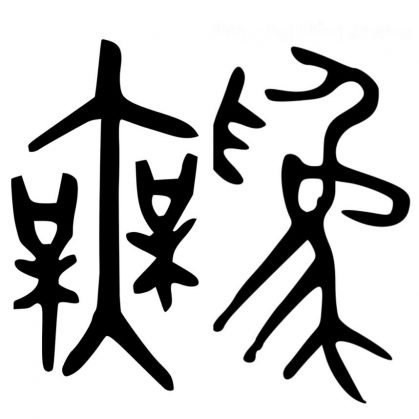
wú wéi
“Not-Being efforting.” This phrase is in some ways the most obscure phrase in the Dào Dé Jīng. I posit it’s also the clearest.
We first encounter this phrase in the second half of Chapter 2 where, just a paragraph beforehand, Lâozî painstakingly lays out two examples illustrating the essential nature of “efforting.” As we saw in our last post:
When public opinion defines something with great certainty, that constitutes a forceful “efforting” of that thing. Such “efforting” results in cutting off and defining the very opposite of that original something before it’s actually developed in its own right.
Lâozî then lists a series of opposite conditions linked to one another in mutual interaction (like a seen tree and the eye seeing it… both are required for the interaction to happen):
The first such pair of opposites listed is Not-Being vs Being. Lâozî says they are mutually birthing.
Because of Lâozî’s careful set-up, I think it’s safe and indeed important to assume that this linking of opposites happens because of someone “efforting” one of the pair. I think we can conclude that the mutual birthing of Not-Being and Being has its roots in these two options:
- Not-Being is efforting and therefore peremptorily defining Being, and/or
- Being is efforting and therefore peremptorily defining Not-Being.
Let’s look at this in the context in which it’s first used. If you read the second half of Chapter 2, you see a list of things that a grounded sage person does in certain circumstances. Here’s the first such situation:
The sun—walking across the sundial a while, stopping a while—sees indeed
this means:
the grounded sage—speaking and listening with both feet on the ground,
this person…
staying-remaining at home at the tea table, chaste and unmarried, following something slowly from behind with tiger fur-
nothing—no one dancing with long tails flowing from their wrists—nope, never, no way, nowhere, nohow Not-Being
efforting—like holding up an elephant…
has this
personal, manual role—what one does with a weapon, a flag, or a pen;
So first we are going to learn about what the grounded sage does when they are chù (處) or staying. It’s usually translated as remains, but the Western Zhou Bronze Inscription character is, as usual, a lot more evocative and complex than that:

The top component (虍) shows tiger fur:

which is usually considered the phonetic sub-component (hū). Below that there are two semantic components considered to give the word its meaning. First is:

which shows two legs followed by something from behind and in modern times (夂) is translated to mean exactly that. Also shown is:

which shows a stool, and again the modern translation (几) matches the old pictogram.
The modern translation of the overall character chù, however, includes not just stay, remain, reside, live, and dwell, but also “staying at home, not assuming a government position or not married.” It also includes virginity and chastity as well as manage, deal with, punish, discipline, and get along with. This reads to me like a laundry list of what it meant to be an unmarried woman in most parts of the world in “the old days!” At any rate, as you can see above, I included all these elements in as neutral a way as possible.
And what does a grounded sage do when staying—remaining at home at the tea table, chaste and unmarried, following something slowly from behind with tiger fur? Well, then their personal role is Not-Being efforting.
And that, we suspect, means it lops off and defines Being (yôu 有).
Fascinating. We’ll delve more into the grounded sage next time, as we continue to feel our way into what it means that their role when “staying” is cleverly lopping off a basket of and therefore defining Being.
Thank you for joining me here again. I hope you’ll re-read Chapter 2 again and enjoy letting all these ideas percolate in your unconscious as well as conscious mind. Meanwhile please use the contact form to send me your comments, ideas. and questions. Until next time!
 The Dào of Lâozî