the husk of the initial protective bud casing—the sepal—but not really the true inner flower of
firing arrows from the mouth—sure
of whom the short-tailed bird speaks, the one that
has this
baby with arms wide open and legs swaddled [this word is the second, “zî’,子”part of Lâozî’s honorific name]…
likeness—like an elephant skeleton letting us imagine a living elephant—of
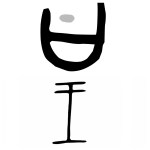
‘God of Heaven’—as we call our emperors, for they’re like flower sepals connecting to above with their covering of that ever-present, timeless, whole head-cloth ‘ji’ square fabric which our grown men wrap around the ‘little bird’ top knots on their heads once they’ve received their adult, public courtesy-names— (dì, 帝)
has this
being long before—like one’s dead ancestor.
That’s the last line of Chapter 4. As you recall, Lâozî began Chapter 4 with some details about following The Way of the loose-haired chieftain. Specifically it involves pouring water from the center, like from the hollow drum at the base of a flagpole, and yet now bearded, you’re doing truly useful work like a water bucket by means of carrying capacity. And at the same time, this particular territory is not really full to overflowing it vessel. It’s concealed like sugar cane sweetness tucked in the ends of folded cloth and frozen like ice—Oh! A breath like wind through tree branches!—and surviving like a baby that has health issues but still is sprouting. That’s a relief, whether we’re considering The Way or this little baby used to symbolize survival.
And now here, in the next line, Lâozî concludes Chapter 4 by saying “I am not really sure whose baby… it looks like the God of Heaven’s ancestor.” Other translators keep some aspects of these old glyph images of child/parenthood in their versions of this line:
Yi Wu translates it as:
I do not know whose son it is. It symbolizes that which precedes the Creator.
Feng and English translate it as:
I do not know from whence it comes. It is the forefather of the gods.
~
This is the only place in the first 37 chapters of the Dào Dé Jīng where we see the word dì (帝):
The image is sometimes considered to be a sepal, like that which we see so commonly in the word bù (不) which has this pictogram:
Indeed if you compare the drawings, you see that does seem to be a big part of the dì character though not all of it. Others consider the central element in the character’s composition to be jin 巾, the traditional head cloth for adults:
And yet other etymologists say the dì character is a picture of tied up firewood (perhaps for a sacrifice) or an altar. At any rate, early on, this image was used to mean “God of Heaven” and then emperor.
~
What all did we learn in Chapter 4?
Point 1: This is the first time since Chapter 1 that Lâozî circles back and actually starts talking about The Way of the loose-haired chieftain. We learn its paradoxical pouring out of water “and yet, now, bearded,” doing of useful work in the fashion of a water bucket has this particular territory: it’s not overflowing its vessel.
So… how do you pour out water, do useful work, and not overflow your vessel? Use a bucket. Or maybe: be like a bucket.
Point 2: And this particular territory is concealed and surviving like a vulnerable but sprouting baby.
So… that seems like good news. Although, to be honest, until now I didn’t know it was in danger of not surviving. This makes me re-read the intervening list of paradoxes with a new eye. Is it a list of the dangers of this particular territory? Or a list of corrective actions taken to make this particular territory survive? Re-read our last post yourself and see what you think.
Point 3: And by the way: we don’t know whose baby it is, but it looks like God/the emperor’s ancestor.
So…The Way’s origin isn’t known, but it pre-dates even God.
And/or there’s a baby whose parenthood isn’t known, but it looks like the emperor.
Or both.
~
Once more, I’m filled with curiosity, some wild theories, and great admiration for Lâozî’s ability to write short lines of one-syllable words with complex images that carry multiple (!) layers of meaning.
In the next chapter, we’ll see if our hero is up to this call to the Way, whether it’s a literal Way of working and having a baby or the meta-Way so beloved by philosophers and meaning-seekers for millenia.
Thanks for being here, and be sure to use the contact form to let me know what you’re thinking. See you next time!
doing of truly useful work—like a water bucket—by means of carrying-capacity
has this…
this particular territory—this enclave, defended by a weapon on a pole, plus its surroundings:
the husk of the initial protective bud casing—the sepal—but not really the true inner flower of (bù, 不)
full to overflowing its vessel. (yíng (沖)
As you remember, I’m exploring the idea that the Dào part of the Dào Dé Jīng follows Joseph Campbell’s story template. If so, then Chapter 4 would give us the hero’s “call to adventure.” And I do think it opens straight away with that call. It’s a call to The Way of the loose-haired chieftain—walking a while, stopping a while, listening, and speaking of it all. And it specifically calls for this:
Pouring water from the center of one’s “hollow drum” and yet, now bearded, do truly useful work like a water bucket… not really overflowing one’s vessel.
That is indeed quite a calling.
~
Yíng (沖)’s bronze inscription looks like this:
You recognize the sub-component on the right side of that image from this post where we learned it’s a picture of a drum with a flagpole. This kind of structure was traditionally placed in the middle of a field to call people to gather with drumming, provide a center point for that gathering, as well as detect wind and serve to foster group-identity and morale. The left sub-component shuî is the pictogram for a river or running water:
(And yes, that’s the same shuî from “Feng shui!”)
Modern definitions of the complete character yíng (沖) are to pour water on; to rinse; to flush; to wash; to infuse; to make drinks. More classic definitions included to soar; to rise; to shoot up. Dào translators have gone a different way. They translate it as like an empty bowl, appears empty, is an empty vessel, is like a well, is unimpeded harmony. I combine the images with the traditional definitions and translate it as:
pouring water from the center, like from the hollow drum at the base of the flagpole
This is the only place in the first 37 chapters of the Dào Dé Jīng that this word appears.
~
But the next part of “the call” is familiar to us from earlier in the Dào since we discussed this character here. Doing of truly useful work—like a water bucket—by means of carrying capacity is one of several different ways Lâozî describes work or getting things done. In this kind of work, something or someone uses their receptivity or negative space’s carrying capacity (as opposed to laboring forcefully, actively shaping something, etc.).
So, on The Way, the loose-haired chieftain is pouring water from their hollow drum and yet, “bearded” something else is also happening now. They’re doing this water-bucket-style-work WHILE not really overflowing their vessel.
No wonder the next line interjects:
The deep water—Oh! A breath, like wind through the tree branches!
Because that’s a tall order as well as a pleasantly puzzling paradox to consider.
Have you ever poured water from your hollow drum? In a literal sense, it reminds me more of having your water break during pregnancy than it does urinating… probably because I definitely looked like a drum when I was pregnant!
In a symbolic sense, water might mean lots of things. Carl Jung thought water was one of the few universal symbols—he believed it symbolized the unconscious. Considering the words that follow this phrase, Lâozî indeed could be alluding to how we work with the unconscious in our life. On the other hand, since Lâozî’s taking great care to describe the particular type of work that’s best described with the image of a bucket, the water may be a stand-in for whatever we may be working with at any given time.
No matter which of those meanings we adapt, what does it mean to have the water pour out of us but now, bearded, to do that useful, carrying-capacity kind of work while not really overflowing?
~
Here, I find myself wanting to go back and investigate that bearded character. As you remember, we looked at ér (而) in a previous post. Its most common translations are something like “and yet, now.” Its original glyph was a drawing of a beard:
A beard is a good image for trying to illustrate the concept that some original situation is yet existing (i.e., the unshaven face is yet there under the beard), and at the same time, now there’s a new situation. You can see how it also gets translated as but or but now because a change in the situation is apparently an important part of the word’s meaning. BUT (ha!) you can also see how neither’s exactly the same as saying “yet.” Yet is also a translation of this character, and it more closely matches the glyph. So do whereas and while.
Let’s think more specifically about the glyph image itself. What do we know about a beard? It’s is a sign of manhood. And it’s something that changes the look of a face even while the face is still under there—for that reason, it’s always been a popular disguise.
The other character Lâozî uses to impart a meaning akin to “but” is also in this first sentence of Chapter 4: bù (不). We talked about it here when we were looking at all the “negative particles” in the Dào Dé Jīng. It’s in fact the most common negative particle in the Dào.
From what I can find, ér isn’t talked about as a common negative particle in Classical Chinese (despite that fact, I do find versions of some historical documents from the 4th century translating ér as “and yet” ). Rather, when I re-examine information about this character, I see its “literary” translation is you or your. I’m not sure how I missed this before. Maybe because I didn’t know at first that the literary meaning usually corresponds to the older historical meaning for a word.
Interesting! A beard as a symbol for you… and also as a symbol for and yet now. I think I’ll modify my translation to include this information! Ér (而) will now appear as:
“and yet now, bearded, you”
Okay, I have to disappear for a bit and see what happens when I make that change everywhere! While I do that, I hope you’ll sit with the call, just let IT flow from you, and yet now, bearded, do the water-bucket kind of work while not really overflowing—maybe just experience this concept without words. And I also hope you’ll let me know what you found. See you next time with the rest of Chapter 4 (and maybe more on the implications of this big change I just made?!)
Last time, in the second half of Chapter 2, we met a new character: shèng, 聖.
This character’s sub-component 耳 (êr) is a pictogram of an ear and considered to be what gives the overall character its meaning. This character is also the second part of what’s widely believed to be Lâozî’s own personal childhood name, Lî Êr. Its bronze inscription glyph looks like this:
The other sub-component, 呈 (chéng), is considered to be the phonetic part that gives shèng its sound. Its glyph is in turn also a compound of two pictograms. The first is a mouth (口):
The second may be a carrying pole (壬) or, more likely, the symbol representing king (王, three lines that represent Heaven, Man, and Earth):
When you put those two together as the character chéng it looks like this:
In its modern form, chéng is translated as flat, submit, show, appear, petition, or memorial. Etymologists say this old glyph represents a man standing on the ground, speaking. It’s interesting to me that it’s like a king BUT ALSO listening and speaking. That’s an important distinction. You remember our main character, Dáo, The Way of the Loos-Haired Chieftain is ALSO listening and speaking BUT isn’t standing still. Rather that person is walking awhile and stopping awhile on a path. It feels to me as if the latter is more part of the world and regular life.
When you put all the components together for shèng, we get:
Modern meanings of this word are noble, holy, sacred, saint, sage, Confucius, master, professional, emperor, and king. Translators of the Dào most commonly use master or sage. My translation carries all that (with the exception of Confucius himself who is said to have been born the year Lâozî left the country and disappeared):
the grounded sage—listening and speaking, standing connected to earth as well as the heavens
Many people think this character refers to Lâozî as well as other wise people who follow the Dào, but there are other places where Lâozî actually says “I.” Shèng appears 11 times in the Dào part of the Dào Dé Jīng (i.e., the first 37 chapters). In eight of the appearances it’s preceded by a phrase that carries a lofty, objective perspective (“the sun sees that this means…“). This all combines to make me wonder if the grounded sage is an image of a theoretical, idealized wise person and not Lâozî per se. For these reasons, I treat it as its own character.
~
Lâozî introduces this ideal person in Chapter 2. Directly after giving us the list of paired opposites, Lâozî segues into a description of the sage during certain conditions:
As we saw last time, the first thing we learn about the grounded sage is that with respect to “staying,” the sage’s personal role has this Not-Being efforting. Here’s the rest of the list…
When it comes to being out in public moving, the grounded sage’s teaching has this: just the husk of, butnot really, speaking.
When it comes to the Ten Thousand Things, the grounded sage’s getting up and going to work, and yet now, as one bearded, is just the husk of, but not really, falling into some empty-language style of governing.
When it comes to birthing, the grounded sage, as one bearded, is just the husk of, but not really, Being.
When it comes to real work completing—that final nail in the weapon on a pole—the grounded sage, as one bearded, is absent as sticks that were tied together in a bundle to start a fire—’fff!’—not abiding.
Very clear… and also puzzling of course. It feels straightforward that the sage teaches without too much speaking and that the sage works with all the many realities of the world without really falling into empty-worded governance. But then, when it gets to “birthing,” we float into that familiar uncertainty that comes with the characters Being and Not-Being. And THEN… then the sage is actually completely absent when it comes to work-completing. Perhaps the sage was “burnt up” in starting some metaphorical fire. What is going on here?
The sage, as well as Being and Not-Being, are prominent characters in the narrative arc of the Dào. For that reason, we’re going to pause here and devote the next post to the “birthing” that links these three characters. Hopefully more will be revealed to us.
~
Until then, what’s my takeaway?
I like to unravel the Dào for a couple reasons. One is to learn about Lâozî, and the other is to learn what ideas this book holds for my own life. Even without solving the whole mystery of the story or even deciding for sure on the meaning of any one character, I still get a lot out of any snippet… whether it be a word, line, or chapter. A big theme for me is allowing myself to rest in not being certain about things. That holds true in every post thus far as well as every aspect of my life. This character of the sage is already posing some useful and pleasant-feeling variations on that theme. Consider the pictures in that character: listening, as well as speaking, feet on the ground even as connected to the loftiness above us. Getting a visual image of that sensation makes me so grateful to Lâozî.
Thank you for being here! If you have any comments for me before next time, please use the contact form (click on the Contact tab). I love getting your notes.
Lâozi starts Chapter 2 talking to us about how people here on earth talk about beauty:
“Heaven-down below (lower level) public opinion—that clear, plain back and forth between people: firing arrows from the mouth sure of admired beauty—picture someone wearing a ram’s horn headdress…”
Mêi (美), “beauty,” is a picture of just what I’ve described: someone wearing a ram’s horn headdress. Then Lâozi describes this approach to beauty with a particular character, saying it results in:
“efforting—like lifting up an elephant—beauty
Oh, Wéi (為). I love this word, it’s pivotal in the rest of the Dào (occurring in 51 crucial spots, in these first 37 chapters), AND it took me awhile to land on this translation of “efforting.” It will have its own blog post very soon!
Meanwhile… Lâozî tells us that effortfully defining beauty in this strong-arming way has a side effect. It is:
“thuscleverly lopping off a basket of, and thereby defining, a disdained ‘ugliness’—an inferior-hearted evil right outside, touching the house—already… finishing it in the womb.”
Lâozî seems to be saying that when we work hard to forcefully set some very certain kind of beauty, we are insinuating that everything else is ‘not beauty.’ Or is Lâozî saying that approaching beauty in that way is itself ugly? Probably it’s both and either, as is so often the case in good poetry.
~
Sī (斯) shows a basket on the left and an axe on the right:
Writing this for you, I realized that I didn’t have the basket in my old translation in the first post, so I’ve revised it as you see here:
thuscleverly lopping off a basket of and thereby defining…
This symbol was used to depict a traditional unit of weight (about 1/2 kg or a “catty” which is a little more than one pound), but also means axe, and keen or shrewd. This chapter is the only place this word’s used in the Dào.
~
Yî (已) now means stop, finish, already, or have done [something]. In the Dâo, translators call it as arisen, become, stopping in time, be done, get it, succeed, attained success, and achieve results. Often it’s hard to tell for sure how they translate this word because it gets buried as some simple word like is. In fact, this word seems to occur in especially convoluted obscure sentences, and as you’ve seen, that’s saying something when it comes to this document!
The first etymological reference I read said yî comes from the symbol for fetus or snake (pronounced sì and now meaning snake and written as 巳):
So my translation combined that with the abstract meanings:
already… finishing itin the womb
But since then I’ve seen others say this version of yî absolutely should not be confused with that symbol. Nor, they added, should it be confused with this other old symbol that looked similar and is pronounced jî (己). This image is considered to be a silk cord used to bind things; it now means see, oneself, personal, or private. Those words combined with the suggestive images of a fetus put me in mind of an umbilical cord:
I’m not sure why our yî (已) should never be associated with these other two similar sounding and looking images nor why there’s no alternative interpretation for our image’s origins. It’s confusing. My first thought was that I could see why a person wouldn’t want to think a fetus is the original symbol for “stop, finish, already, or have done something” as it could put us in mind of sad and oft-hidden events like miscarriage or abortion. But then again it doesn’t necessarily have to mean those things either. It could also represent the later evolutions of this word: achieved, results etc. It does show something that developed inside, privately. All these layers filter together in that evocative uncertain way we are getting used to Lâozî creating in us, so I will leave it at that.
~
So to review: Lâozi used today’s two words sī and yî together in a particular construction to say that when public opinion’s firing arrows sure of a particular beauty, it by default “lops off” and thus defines the opposite “already, finishing it in the womb.” Next, Lâozi uses this same construction to tell us what happens when public opinion’s firing arrows sure of traditional virtue (shàn, 善). The old bronze inscription version of this character shows a sacrificial offering of a goat together with a mouth emanating words that are branded by a chisel, in the same way that slaves or criminals were marked. This image gives me the feeling that Lâozi didn’t admire this kind of virtue. I wonder if the beautiful person wearing the ram’s horn headdress carries that same tone of hypocrisy for Lâozi. Anyway, being sure of this kind of virtue has the same hard-core effect of efforting, in this second case it’s effortingtraditional virtue…
“…thus cleverly lopping off a basket of, and thereby defining, the husk of the initial protective bud casing—the sepal—but not really the true inner flower of traditional virtue already… finishing it in the womb.”
Being certain of that particular kind of virtue means everything else is automatically, privately, successfully defined as “not really virtuous.”
~
Here Lâozî uses one very specific way of saying “not____.” Bù (不) shows us what biologists call a sepal—that little husk around the outside of a flower. The Bronze Inscription character shows those dried up little petals hanging off below a bloom:
The sepal starts out looking like a bud’s outermost petals, but ends up peeling back and drying up once the true blossom is open. This husk is made up off former “guard petals”—it played a crucial role!—but it’s not really the true flowerof the thing we’re talking about.
We talked about different negative particles in this post. As with this sepal husk, most of the negative particles’ images show something where outer appearance doesn’t match reality. Èr uses the beard image for but now or and yet. Yì uses a masked person for the word different:
Other images in Chapter 1 also showed us hidden or obscured versions reality. The pictogram for mìng (personal naming) shows a mouth speaking under the cover of night by moonlight. Chàng (the ever-present, constant, timeless version of something) shows the jìn head-cloth covering the hair of an adult man. Xuàn—the very structure of the miáo stuff that is the conception of Heaven-and-Earth—is a hard-to-see darkness… a figure-eight of string dyed black. And of course wù gives us a Not-Being—a mysterious dancer swinging tails from each wrist—as a symbol of something so different than normal reality that we don’t even know what to call it other than just “not.” Lâozî is a true poet, weaving an entire spell for us using even the smallest words as part of the overall tone.
~
So what does Lâozî do in Chapter 2 after setting up this construction for us in which public opinion’s sure-fire efforting a set definition of anything cuts off and defines its opposite? The next long and quite famous part of Chapter 2 begins by saying:
“anciently, for ten generations, this therefore lightly hits and leaves a mark of reason…”
What follows is a list of opposites that define each other, presumably, based on Lâozî’s set-up, because of public opinion’s strong-arming, effortful certainty of one of the pair of traits:
Not-Being vs Being
solidly hard vs changeable
lengthy vs short
high above vs down below
one tone vs many sounds
forward vs behind
Ahem: did you notice that Not-Being and Being are set out on their own here and not used as positive or negative particles simply modifying other words?! It’s as we suspected. They are almost beyond adjective, adverb, or status. As one reader put it: “ohhhh… the characters ARE characters!” And being effortfully certain about one gives birth to the other.
What does this mean? We’ll see in the second half of Chapter 2. Meanwhile, you can read the full text of that chapter here and ponder it. Please use the comment icon at the top of this post or the comment form to send me your thoughts, feelings, experiences, and questions—I love receiving them and they impact me and this project.
Thank you for joining me here today! I apologize for the little lapse that just happened in my posting. I really got off track trying to make a video summarizing all of Chapter 1 for you! Every one of the many many attempts I’ve made has been too clunky, long, simplistic, awkward, or otherwise difficult. My conclusion is that it’s not yet time for that to happen. I so wanted a tidy package for you, but it’s too early. I will continue coming up with a nice verbal way to deliver this information to you, but, meanwhile, I’m going to carry on with flowing the written translation process to you in as organic a way as possible. It means you will be floating in uncertainty longer… and I think Lâozî and other sages would approve. As I’m typing this, my daughter texted me a quote from Dolly Parton:
“There are just some things in life you don’t explaint it, you just live it, and know it, and be it.”
What does this drawing look like to you? Linguists say it was a pictogram of a person with something long dangling from each hand—maybe long tails or sleeves—dancing. It must be a fancy dance or maybe a shamanic one, judging by those tails/sleeves.
That drawing is the Western Zhou Bronze Inscription character, close to the kind of script I believe Lâozî would have used. Later—maybe toward the end of Lâozî’s era—this character evolved into a Seal Script form in which the horizontal and vertical bits got exaggerated:
From there, maybe we can see how it turned into the modern character:
無
But here’s the thing: I have a hard time understanding why a beautiful, powerful, evocative drawing of a dancer holding long flowing objects turned into a word that’s now translated as not, without, not having, free from, no, un-, nil, -less, non-, or some other negating concept. How did it go from portraying a person engaging in celebration/ritual to conveying a complete lack/undoing of something? And, more importantly to me, when did it undergo this change? Because, of course, you and I want to know how Lâozî actually experienced this character’s meaning.
Chinese has several “negation particles”—little words placed before or after other words to indicate the opposite or lack of that base word. English does too as evidenced by that list of translations in the previous paragraph. When this wú character was ‘borrowed” away from its original meaning and turned into a negation particle, a new character was created for the word dancing by modifying the original pictogram with some extra marks near the person’s feet to show they’re taking steps.
This change seem to have happened in or just before the Western Zhou Bronze (WZB) era. We know this because 1) Oracle Bone script didn’t use this negating form of wú, and 2) this new character for dancing appeared in the WZB era:
Later, by the time it turned into Seal Script, it looked like this:
And now it’s written as 舞. My point here is that some linguistic effort was made to change the original character just to retain its own original meaning because somehow this person dancing with long things flowing from their wrists was turned into… nothing. Literally. Or worse, it was turned into something that undoes or negates every kind of stuff or abstract idea that it’s attached to. Puzzling. Especially because there are others way to “undo” things.
Negation
And now we are going to go down a rabbit hole into nothingness. Literally. It’s an important part of the Dào, so it’s good to go there right up front. Bonus: contemplating it elicits a not-unpleasant sort of spaciousness.
As you remember, Oracle Bone (OB) script was the version of written Chinese immediately preceding Lâozî’s time, though he certainly was familiar with it since he was a court scribe. There were five negation particles found in Oracle Bone script, and our word-of-the-day wú (無) was not one of them because back then it still meant dancing. We see documentation that this word was indeed used quite often as a negator in Classical Chinese which was the main writing beginning in the 5th century BC—well after Lâozî’s time. But what was happening with this word in between, during Lâozî’s lifetime? This wú appears 43 times in the first 37 chapters of the Dào Dé Jīng. Why and how did Lâozî use it? Did Lâozî use it with the earlier OB meaning of dancing or with the later Classical meaning of negation… or both/neither? Conventional translators make it out to be a negation particle. I like to read through the text and substitute that dancing being for wú. It’s kind of wild that way. I am starting to wonder if, like Shakespeare, Lâozî hybridized and made up words and, indeed, changed the language of that time. It’s something to keep in mind as we move through the Dào.
What makes things even more tricky in translating—if you’re trying to use unique translations for each character—is that Lâozî uses other negators as well. The most common negation particle in OB was bù (不). And bù appears 113 times in the first 37 chapters of Lâozî’s Dào. It’s the most common negator in the book, so in this way, Lâozî is using a typical Oracle Bone style. The bù glyph which Lâozî would have used depicts a sepal—those outer, guard petals on a flower. I translate it as the husk of the initial protective bud casing—the sepal—but not really the true inner flower of… [whatever word follows it]. It looks like this:
Bù is what’s called a p-type negative, and wú is an m-type negative. No one’s sure why there are two parallel series of negative particles. Some linguists hypothesize they represent a very old, possibly prehistoric fusing of two different peoples and dialects—maybe each group of people had a different sound they commonly used to mean “uh uh.”
It’s also not clear how the particles or their uses evolved, and furthermore there are different theories among linguists as to when and why a particular negation particle is used. Some say the the p–types modified actions beyond the control of living people and the m–types attached to words describing actions over which people thought they had control. Interesting. Since bù was most commonly used, I wonder if the people that used the bbbb/fffff sound to mean “nope” were more dominant than those that used the wú sound? Or did OB-era conversations tend to negate a lot more uncontrollable actions than controllable ones? Did Lâozî?
Now, brace yourself for what lies ahead. Chinese has a lot of homophones—words that are pronounced exactly the same as each other but mean something altogether different or, as in this case, they mean something similar but uniquely flavored and with a different written Chinese character. And it turns out that a separate m-type negation particle, also pronounced wú, was most commonly used as a negation particle during the Oracle Bone years: 毋. It derived from the character that meant mother. By the time of Western Zhou Bronze inscriptions, this other wú looked like this:
Lâozî doesn’t use this character at all in the Dào. So in this case Lâozî’s deviating from OB negation style completely. And yet… and yet using a word that sounds like the typical negator but looks like this fancy dancing person. Linguists have noted that in Zhou time, this character “was already phonetically confused with and read like 無.” So again we see these big changes in the negation particles happening during Lâozî’s era. Indeed there were all these different drawings to make this one sound and general meaning, but, I would say, each drawing has a different effect. I doubt scribes like Lâozî were just confused or careless with their spelling.
There’s also a THIRD (!) m-type negative pronounced wú: 勿. It’s an obsolete character whose pictogram was a bloody knife:
Wow. Hardcore. Lâozî uses this other wú character four times in Chapter 30, and that’s the only place in the Dào that it appears. I translate it as not—seriously like blood on a blade, just don’t… [Dramatic yet again, I know, but I’m only trying to keep it accurate!]
So far we’ve found that when it comes to the m-type negators, Lâozî prefers our word-of-the-day version of wú even though that hadn’t been the norm up until then. That being the case, all the m-types are still way out-numbered in the Dào by the p-type negator bù.
And Lâozî uses one other p-type negation particle: fú (弗). Its Western Zhou glyph is considered to depict either 1) two arrows leaning against each other and wrapped up to be straightened or 2) a bundle of sticks tied together to start a fire. (In English, the latter was called a faggot which shows really horrible things about our culture and language.) Lâozî uses this fú twice in Chapter 2 and nowhere else in the Dào.
Finally… there’s one more negator in the Dào, fēi (非). It doesn’t seem to be classified as either one of the older two types of negation particles—it came on the scene after the Oracle Bone years:
Some say this is a pictogram of a pair of broken wings on a baby bird. Others say it’s a combination of bù with a compound character that shows a heart and a short-tailed bird. I translate it as: is breaking the little wings off…
Okay, that also sounds a little dramatic, but, dang. Either one of those possible etymologies is pretty harsh. Happily Lâozî only used this word fēi four times. Of course, two of those are right in the first chapter, which, by the way, is where we are, or were, before this side trip into negation…
Back to wú無
I read somewhere that to write this wú character you begin with three horizontal lines and add eight kind of slashing or negating marks on top of it—four vertical ones downward through the three-line structure then four short diagonals spraying out from the bottom. It may just be the power of suggestion, but I do experience this repeated-negation sensation when writing out the character. Try it and see how it feels.
Because of the completely annihilating tone of all modern definitions as well as these eight “no no no no” kind of marks and the fact that I want a translation that will work in any setting, I decided to translate this wú character as noone-noway-no-never-nothing-nowhere-nohow-not-Being. You saw that phrase in the complete Chapter 1 translation I put in yesterday’s post.
Why did I include the word being? It allows me to use this phrase everywhere, including in places where other translators have felt the need for a noun and translated this term as nothing, nothingness, or non-being. Plus at least I’m throwing in a reference to the actual being that appears in the original pictogram.
But writing this post to you today has made me realize that I broke my own rules with this translation. I was so swayed by the singular modern focus on the negating aspect of this character that I completely left out the actual original image and its meaning. And my whole goal is to include those drawings for the reader to experience! So I’m officially changing my translation right here.
Then the question becomes: how can I keep the the extreme “nil” effect, the ability to be a noun as well as a modifier, and our dancer? I don’t think the dancing part can be the first or last thing without throwing off the negation. After many arrangements, I come up with:
no way—no one dancing with long tails flowing from their wrists—no, never, nothing, nowhere, nohow Not-Being.
It gives me goose bumps, and that’s my favorite kind of “yes.”
~
You can see how and why my translations are not short and catchy and why they’ve gone through so many iterations. It’s hard to have it any other way, given my goals and intentions. You can see why some people prefer to find a short-hand translation (like, in this case, Not-Being), and I fully support whatever they—or you—decide works. In fact I myself often silently shorten my own translations in my mind when looking through my book or thinking about a chapter. But for me, these longer historical written versions carry a fullness and a mysterious, evocative sense—even if they don’t look like regular, clear-cut writing. It feels like they constellate into something bigger… eventually.
Meanwhile, I stay open to what occurs. I’ve changed my translation for wú in the Chapter 1 tab and throughout my whole Dào document, so now I’ll be reading through and see if it works everywhere. And I’ll be getting ready for the next post when we’ll delve into something that may (or may not!) be the opposite of Not-Being: a timeless eternal piece of fabric.
Thank you for joining me on this journey! I hope you’ll use the comment section below or contact form to send me your thoughts and feelings. I’d love to hear them.




 The Dào of Lâozî