the husk of the initial protective bud casing—the sepal—but not really the true inner flower of
firing arrows from the mouth—sure
of whom the short-tailed bird speaks, the one that
has this
baby with arms wide open and legs swaddled [this word is the second, “zî’,子”part of Lâozî’s honorific name]…
likeness—like an elephant skeleton letting us imagine a living elephant—of
‘God of Heaven’—as we call our emperors, for they’re like flower sepals connecting to above with their covering of that ever-present, timeless, whole head-cloth ‘ji’ square fabric which our grown men wrap around the ‘little bird’ top knots on their heads once they’ve received their adult, public courtesy-names— (dì, 帝)
has this
being long before—like one’s dead ancestor.
That’s the last line of Chapter 4. As you recall, Lâozî began Chapter 4 with some details about following The Way of the loose-haired chieftain. Specifically it involves pouring water from the center, like from the hollow drum at the base of a flagpole, and yet now bearded, you’re doing truly useful work like a water bucket by means of carrying capacity. And at the same time, this particular territory is not really full to overflowing it vessel. It’s concealed like sugar cane sweetness tucked in the ends of folded cloth and frozen like ice—Oh! A breath like wind through tree branches!—and surviving like a baby that has health issues but still is sprouting. That’s a relief, whether we’re considering The Way or this little baby used to symbolize survival.
And now here, in the next line, Lâozî concludes Chapter 4 by saying “I am not really sure whose baby… it looks like the God of Heaven’s ancestor.” Other translators keep some aspects of these old glyph images of child/parenthood in their versions of this line:
Yi Wu translates it as:
I do not know whose son it is. It symbolizes that which precedes the Creator.
Feng and English translate it as:
I do not know from whence it comes. It is the forefather of the gods.
~
This is the only place in the first 37 chapters of the Dào Dé Jīng where we see the word dì (帝):
The image is sometimes considered to be a sepal, like that which we see so commonly in the word bù (不) which has this pictogram:
Indeed if you compare the drawings, you see that does seem to be a big part of the dì character though not all of it. Others consider the central element in the character’s composition to be jin 巾, the traditional head cloth for adults:
And yet other etymologists say the dì character is a picture of tied up firewood (perhaps for a sacrifice) or an altar. At any rate, early on, this image was used to mean “God of Heaven” and then emperor.
~
What all did we learn in Chapter 4?
Point 1: This is the first time since Chapter 1 that Lâozî circles back and actually starts talking about The Way of the loose-haired chieftain. We learn its paradoxical pouring out of water “and yet, now, bearded,” doing of useful work in the fashion of a water bucket has this particular territory: it’s not overflowing its vessel.
So… how do you pour out water, do useful work, and not overflow your vessel? Use a bucket. Or maybe: be like a bucket.
Point 2: And this particular territory is concealed and surviving like a vulnerable but sprouting baby.
So… that seems like good news. Although, to be honest, until now I didn’t know it was in danger of not surviving. This makes me re-read the intervening list of paradoxes with a new eye. Is it a list of the dangers of this particular territory? Or a list of corrective actions taken to make this particular territory survive? Re-read our last post yourself and see what you think.
Point 3: And by the way: we don’t know whose baby it is, but it looks like God/the emperor’s ancestor.
So…The Way’s origin isn’t known, but it pre-dates even God.
And/or there’s a baby whose parenthood isn’t known, but it looks like the emperor.
Or both.
~
Once more, I’m filled with curiosity, some wild theories, and great admiration for Lâozî’s ability to write short lines of one-syllable words with complex images that carry multiple (!) layers of meaning.
In the next chapter, we’ll see if our hero is up to this call to the Way, whether it’s a literal Way of working and having a baby or the meta-Way so beloved by philosophers and meaning-seekers for millenia.
Thanks for being here, and be sure to use the contact form to let me know what you’re thinking. See you next time!
We left off pondering the exact nature of what appears to be a call to The Way of the loose-haired chieftain. (I apologize for the week off. I hit a big milestone in completing the screenplay treatment for a film version of Lâozî’s journey!! More on this later, as you might expect, but for now we return to how I pieced all this together.)
Happily, in the next paragraph of Chapter 4, Lâozî tells us more about this phenomenon of how you can be pouring water from a hollow drum and yet now, bearded, doing water-bucket-style work but not really overflowing one’s vessel:
In all four directions,
the myriad scorpion medicine-dancing Ten Thousand
Things cut off from you—all external matter like cows etc.—
has this
ancestral shrine:
So first we learn that everyone everywhere has honored what The Way calls one to do.
And then we get more information more about what this “ancestral shrine” involves:
pushing down to a sitting position on the ground…
what it holds a basket of (qí 其):
a person speaking like an axe on metal—sharpening;
removing—a blade cutting the horn from an ox…
what it holds a basket of:
unravelling—separating thin silk with a blade into disorderliness;
harmonizing as a mouth organ…
what it holds a basket of:
brilliance—that shining fire over the head of a kneeling person;
Remember our discussion about “what it holds a basket of?” We were trying to figure out where this character points—in other words, what is the IT referred to? I concluded that this phrase doesn’t necessarily refer back to the word right in front of it. It most often points the reader back to the most recent “subject.” That would be this ancestral shrine (i.e., the call to The Way, to be pouring water from a hollow drum and yet now, bearded, you’re doing water-bucket-style work but not really overflowing one’s vessel).
Indeed the very careful and respectful translator, Yi Wu, translates this section to say The Way… blunts its own sharpness, unties its own tangles, tempers its own brightness.
BUT then again, in many places, many translators say “what it holds a basket of” DOES refer to the word right in front of it. In that case, you’d interpret this passage to mean that when it comes to The Way: pushing down to a sitting position has a sharpening similar to that of a person speaking like as a metal axe; removing like a blade cutting the horn from an ox has an unravelling like separating silk thin with a blade into disorderliness; and harmonizing as a mouth organ has a brilliance like that of shining fire over the head of a kneeling person.
As usual, it works both ways, in that manner typical of great poets and Lâozî in particular, adding up to all the paradox and ambiguity one might want in a mystical text!
Whichever “it” you consider…
spoken of altogether with one another—like all earthly, mortal, commonplace plates…
what it holds a basket of:
leaving dusty footprints in the dirt—like a deer streaked with soil.
We’ve seen this kind of naming in which things are “spoken of altogether” before. In the very first chapter, Lâozî described how Being and Not-Being are a matched pair that’s spoken of altogether when stepping out of their cave… at which point they then acquire differently-masked names. Now, presumably what’s being spoken of altogether is The Way… of pouring water from a hollow drum and yet now, bearded, you’re doing water-bucket-style work but not really overflowing one’s vessel. And this phenomenon leaves barely discernible tracks.
AND/OR: speaking of things altogether may, itself, have the characteristic of leaving barely discernible tracks.
Furthermore, it’s even harder to see whatever-this-is because it’s:
Concealed like sugar cane sweetness tucked in the ends of folded cloth and frozen like ice…
—Oh! A breath, like wind through tree branches!—
But also:
bearing a side-by-side personal resemblance, seems like:
“this particular territory—this enclave, defended by a weapon on a pole, plus its surroundings…”
surviving—on the plane of a baby that has health issues, like maybe a large head, but is sprouting. (cún, 存)
If you look back up to the top of this post, you see this particular territory—this enclave, defended by a weapon on a pole, plus its surroundings... was used in the first line of this Chapter 4, in what I’m considering to be The Call to Adventure. And now here we learn that the “territory” of this calling (to be pouring water from a hollow drum and yet now, bearded, doing water-bucket-style work but not really overflowing one’s vessel) looks very much like when an ill newborn survives and grows.
~
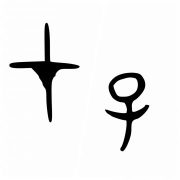
Let’s look at the character cún (存). It’s a compound character made from these two bronze inscription glyphs:
The sub-component on the left (cái, 才) is a pictogram of the sprouting of seeds. On its own, the modern meanings are ability, gifts, talent, or a person’s status/background. In Mín Nan (remember the Mín people?), it’s used as a classifier for describing a volume of wood or area of paper or other sheet materials. It’s considered the phonetic element of this word, signaling to the reader to give it that “c” sound. My first translation kind of ignored this character, but I’ve added it is to be consistent with my goal to represent all images found in the glyphs. Doing so with this character is especially satisfying to me as in my other interest—physics—surface area is one of the master keys to understanding most phenomena. And since we see references to marking out 2-and3-D spaces elsewhere in the text, it helps tie together potential connections to be consistent and include it here.
The sub-component on the right (zî, 子) is considered the semantic part that gives the character its meaning. The pictogram is an image of a baby. Etymological dictionaries specifically say it’s “a baby with a large head and spread arms; the legs are wrapped in a blanket.” Its modern meaning is child, offspring, son, and descendant. But also it can mean master or teacher, and indeed was used as a suffix in Lâozî’s own name as well as Confucius’ name (Kôngzî). It’s also used as the alternate for seed and can mean egg, young, tender, or small.
The overall compound character translates as exist; cherish, harbor; store, retain; stock, reserve. Dào translators use different words in different chapters, ranging from exist, be present, and is there, to preserve, survive, and places where it’s hard to even figure out what they’re actually calling this word because it’s combined with the other words around it into a new phrase.
I can’t help but believe it’s a mistake to ignore the character’s original image so thoroughly. Because I believe that Lâozî’s given us a detailed picture of The Call: its revered nature, what it does, and what it looks like. We don’t want to discard any information in that message even if it would simplify things to do so! The description we end up with is mysterious and provocative as usual.
Consider there’s that bearding… and it leads directly to a result that resembles a newborn baby living through health issues. Maybe it’s because of that last line that so many other images in the chapter bring pregnancy, childbirth, and gestation issues to my mind (e.g., pouring water from the center like from a hollow drum water, pushing down to sitting position, and even removing something that’s unraveling).
But also the more typical interpretation of this chapter’s meaning is compelling. Consider Yi Wu’s translation:
“The Way appears empty; in use, it may not overflow. Fathomless, it seems to be the ancestor of all things. It blunts its own sharpness, unties its own tangles, tempers its own brightness, unites itself with dust. Deep but clear, it seems to exist and not to exist.”
And that of Gia-fu Feng and Jane English:
“The Tao is an empty vessel; it is used, but never filled. Oh, unfathomable source of ten thousand things! Blunt the sharpness, Untangle the knot, Soften the glare, Merge with dust. Oh, hidden deep but ever present!“
It’s one of my favorite passages. That may be partly because it’s the first one I ever considered closely. When I met my husband and discovered his copy of Feng and English’s translation, I found a piece of rice paper tucked inside onto which he’d copied these very lines.
Why those lines, I wondered? How does this shape his way of going about life? In fact, the more I’ve gotten to know him, the more I see how those lines describe him and his intentions so perfectly.
What do they feel like to you? Do they sound desirable? Boring? Attainable? Easy? Impossible?And… how would one go about living this way?
Now, too, the more I’ve gotten to know the Dào, I appreciate the Feng-English version’s poetry and simplicity, and yet when I read it, I miss seeing the glyphs’ images. I miss those references to concrete, daily life. I like to think that maybe those images not only serve as metaphors to get across the big abstract message that these other translators capture so beautifully, but ALSO describe some details of Lâozî’s world. What a masterful feat the sage accomplished if that’s so. AND it’s done with rhyme, alliteration, and meter! I hope you’re seeing more and more why I’m so fascinated with not just the text by its brilliant writer.
There’s one final line in this chapter, and we’ll look at it in the next post. Thanks for being here today. Please send me your comments and questions using the contact form. See you next time.
doing of truly useful work—like a water bucket—by means of carrying-capacity
has this…
this particular territory—this enclave, defended by a weapon on a pole, plus its surroundings:
the husk of the initial protective bud casing—the sepal—but not really the true inner flower of (bù, 不)
full to overflowing its vessel. (yíng (沖)
As you remember, I’m exploring the idea that the Dào part of the Dào Dé Jīng follows Joseph Campbell’s story template. If so, then Chapter 4 would give us the hero’s “call to adventure.” And I do think it opens straight away with that call. It’s a call to The Way of the loose-haired chieftain—walking a while, stopping a while, listening, and speaking of it all. And it specifically calls for this:
Pouring water from the center of one’s “hollow drum” and yet, now bearded, do truly useful work like a water bucket… not really overflowing one’s vessel.
That is indeed quite a calling.
~
Yíng (沖)’s bronze inscription looks like this:
You recognize the sub-component on the right side of that image from this post where we learned it’s a picture of a drum with a flagpole. This kind of structure was traditionally placed in the middle of a field to call people to gather with drumming, provide a center point for that gathering, as well as detect wind and serve to foster group-identity and morale. The left sub-component shuî is the pictogram for a river or running water:
(And yes, that’s the same shuî from “Feng shui!”)
Modern definitions of the complete character yíng (沖) are to pour water on; to rinse; to flush; to wash; to infuse; to make drinks. More classic definitions included to soar; to rise; to shoot up. Dào translators have gone a different way. They translate it as like an empty bowl, appears empty, is an empty vessel, is like a well, is unimpeded harmony. I combine the images with the traditional definitions and translate it as:
pouring water from the center, like from the hollow drum at the base of the flagpole
This is the only place in the first 37 chapters of the Dào Dé Jīng that this word appears.
~
But the next part of “the call” is familiar to us from earlier in the Dào since we discussed this character here. Doing of truly useful work—like a water bucket—by means of carrying capacity is one of several different ways Lâozî describes work or getting things done. In this kind of work, something or someone uses their receptivity or negative space’s carrying capacity (as opposed to laboring forcefully, actively shaping something, etc.).
So, on The Way, the loose-haired chieftain is pouring water from their hollow drum and yet, “bearded” something else is also happening now. They’re doing this water-bucket-style-work WHILE not really overflowing their vessel.
No wonder the next line interjects:
The deep water—Oh! A breath, like wind through the tree branches!
Because that’s a tall order as well as a pleasantly puzzling paradox to consider.
Have you ever poured water from your hollow drum? In a literal sense, it reminds me more of having your water break during pregnancy than it does urinating… probably because I definitely looked like a drum when I was pregnant!
In a symbolic sense, water might mean lots of things. Carl Jung thought water was one of the few universal symbols—he believed it symbolized the unconscious. Considering the words that follow this phrase, Lâozî indeed could be alluding to how we work with the unconscious in our life. On the other hand, since Lâozî’s taking great care to describe the particular type of work that’s best described with the image of a bucket, the water may be a stand-in for whatever we may be working with at any given time.
No matter which of those meanings we adapt, what does it mean to have the water pour out of us but now, bearded, to do that useful, carrying-capacity kind of work while not really overflowing?
~
Here, I find myself wanting to go back and investigate that bearded character. As you remember, we looked at ér (而) in a previous post. Its most common translations are something like “and yet, now.” Its original glyph was a drawing of a beard:
A beard is a good image for trying to illustrate the concept that some original situation is yet existing (i.e., the unshaven face is yet there under the beard), and at the same time, now there’s a new situation. You can see how it also gets translated as but or but now because a change in the situation is apparently an important part of the word’s meaning. BUT (ha!) you can also see how neither’s exactly the same as saying “yet.” Yet is also a translation of this character, and it more closely matches the glyph. So do whereas and while.
Let’s think more specifically about the glyph image itself. What do we know about a beard? It’s is a sign of manhood. And it’s something that changes the look of a face even while the face is still under there—for that reason, it’s always been a popular disguise.
The other character Lâozî uses to impart a meaning akin to “but” is also in this first sentence of Chapter 4: bù (不). We talked about it here when we were looking at all the “negative particles” in the Dào Dé Jīng. It’s in fact the most common negative particle in the Dào.
From what I can find, ér isn’t talked about as a common negative particle in Classical Chinese (despite that fact, I do find versions of some historical documents from the 4th century translating ér as “and yet” ). Rather, when I re-examine information about this character, I see its “literary” translation is you or your. I’m not sure how I missed this before. Maybe because I didn’t know at first that the literary meaning usually corresponds to the older historical meaning for a word.
Interesting! A beard as a symbol for you… and also as a symbol for and yet now. I think I’ll modify my translation to include this information! Ér (而) will now appear as:
“and yet now, bearded, you”
Okay, I have to disappear for a bit and see what happens when I make that change everywhere! While I do that, I hope you’ll sit with the call, just let IT flow from you, and yet now, bearded, do the water-bucket kind of work while not really overflowing—maybe just experience this concept without words. And I also hope you’ll let me know what you found. See you next time with the rest of Chapter 4 (and maybe more on the implications of this big change I just made?!)




 The Dào of Lâozî