Categories
#2 #3

Chapter 3 summary

Together with the Chapter 2 summary, Chapter 3 sets the stage for us. Lâozî’s described the world where the story we are about to hear takes place:

It’s a world where extreme efforting of one trait cuts off and defines its opposite in something… before its even fully developed and born. Or to look at it in terms of the opposites: it’s a place where NOT doing certain extreme things means you’re “breeding civilians” WITHOUT certain corresponding bad behaviors.

Given this world, an ideal sage would have certain habits:

~ in dwelling, the sage would be Not-Being efforting;

~ in practicing on a public road, they’d be not really speaking;

~ birthing, yet now bearded… not really flesh-and-blood, meat-holding Being;

~ efforting, yet now bearded… not really expecting that will be holding one’s heart-core like a mother;

~ completing real work, and yet now bearded, you’re… not-abiding (like the sticks tied together as a fire starter are gone, pfft!);

~ and in “governing like regulating a River Happy or speaking of turning one’s self,” the sage would be emptying their heart, filling their belly, fragile in aspiration, and strengthening their bony will.

Also in this world, the traditional ever-present, timeless, constant version (as symbolized by the head cloth that men donned upon becoming official adults) of “breeding civilians” involves Not-Being sure, Not-Being missing something.

And amid all this there is, that is to say, this particular grown man with a traditional head cloth and formal public name who we see is not really withdrawing—despite the fact that a sage is “not-abiding pfft!”—but also the traditional version of breeding civilians causes him to be “not really daring efforting…

efforting… Not-Being efforting…”

After following this example, Not-Being… not really “governing like regulating a river named Happy or speaking of turning one’s self.”

~

That’s the state of affairs. It does seem to be an old world, set in its ways despite some alternate ideas and some currently ambiguous and somehow unsatisfying consequences. What’s going to put change in motion? It all starts in Chapter 4, as we’ll see in the next post.

Thank you for being here and for using the contact form to send me your ideas and questions. If you haven’t done so yet, I officially invite you to use the contact page to do so! See you next time.

Categories
#3 Fú 夫 Wéi 為 Wú 無 zhì 治

governing—regulating by harnessing the river named Happy or speaking of turning yourself—

zhì

Last time we were looking at what the traditional version of breeding does to our old friend, , this particular grown man:

breeding—like a gentleman holding a fountain pen making something happen—

that is to say, this particular grown man with a hairpin and public courtesy name…

“firing arrows from the mouth—sure” as the sun, daily…

—now this is cooking!—

the husk of the initial protective bud casing—the sepal—but not really the true inner flower of

daring—lightly hitting ears on both sides of the head—

efforting—like lifting up an elephant…

—yes, that too, vagina!

efforting—like lifting up an elephant…

nothing—no one dancing with long tails flowing from their wrists—nope, never, no way, nowhere, nohow Not-Being

efforting—like lifting up an elephant;

We left off with that evocative “efforting… Not-Being efforting.” Here’s what comes next:

after following this sacrificial blade-and-cauldron-like ritual example, standard, or regulation…

nothing—no one dancing with long tails flowing from their wrists—nope, never, no way, nowhere, nohow Not-Being…

the husk of the initial protective bud casing—the sepal but not really the true inner flower of

“governing—regulating by harnessing the river named Happy or speaking of turning yourself.”

What we learn here is that in following that example of the grown man who doesn’t really dare efforting… efforting Not-Being efforting, then Not Being… not really governing.

Lâozî used this same “governing” character zhì (治) earlier in the chapter when telling us about how the sage governs. There we learned that because breeding civilians a certain way had a certain effect, “the sage has this governing” which Lâozî described in some detail for us.

~

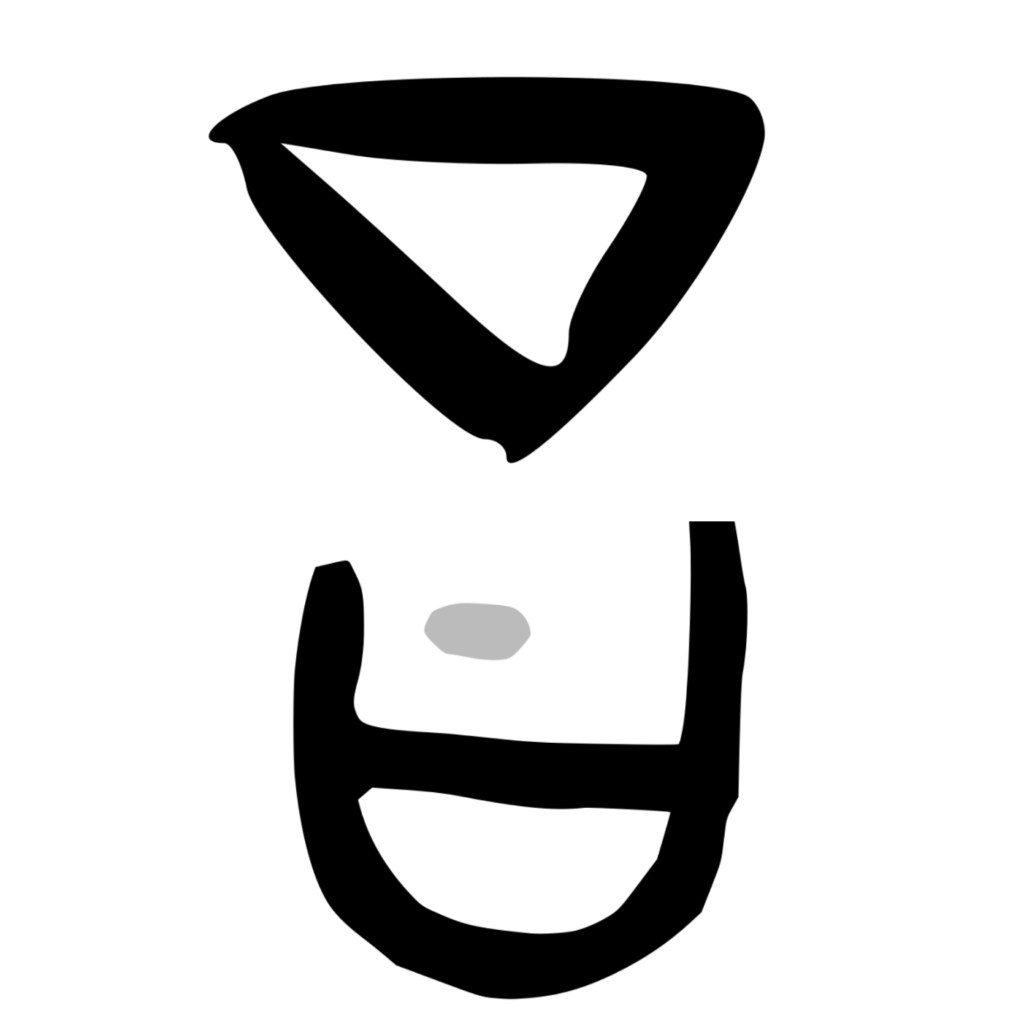
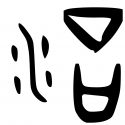
Remember, the zhì (治) character shows water or a river in its left sub-component. The right sub-component is a pictogram incorporating a mouth below a very mysterious element, 厶. I mentioned before that this element variously been identified as a plow turning, a fetus finishing in the womb, or an abstract symbol for being selfish, but I decided to look into it a little more today. Its bronze inscription glyph looked like this:

It’s such a classic and evocative symbol in all of the oldest cultures. What does it “mean?”

The oldest etymology of Chinese characters was compiled in the Shuowen Jiezi during the Han dynasty. From what I can tell, a lot of etymology still references this work, though more recent discoveries about the oldest oracle bone scripts seem to have really cast doubt on its conclusions. The Shuowen Jiezi’s description of this mysterious triangle said that “in olden times, when Cangjie invented the system of writing, a self-encircling element was designated as the character for ‘private.'” They compared it to the symbol for ‘public’ which was 公, and it is possible to see the connection when looking at the modern characters.

But this is a good example of how the Shuowen Jiezi’s descriptions were flawed since its author(s) didn’t have access to the oldest scripts. It turns out that the bronze inscription for the “public” character looked like this:

And the even older oracle bone script like this:

You can see there’s no triangle. But by the time of Shuowen Jiezi, the 厶 character had evolved to look like this:

Now you can see how the Shuowen Jiezi authors thought it was related to the character (以) which we investigated in a previous post. I translated it as already… finishing it in the womb based on its typical translations and the original pictogram which is said to be either a snake or a fetus as it came from this bronze inscription:

And this original oracle bone script:

But neither of those resemble the triangle that was the original symbol for the 厶 we see in our character zhì (治). We still don’t know what the triangle symbol originally meant, though I think we are safe in saying it’s not necessarily the opposite of “public.”

We might learn more about the triangle by looking at how it was combined with the pictogram of grain to make the character (私), which some people believe meant a person’s private grain field. It now means self, private, personal. In Classical Chinese it meant I, me. In later times it morphed into not only self but even selfish as well as illegal, secret, stealthy. Most recently it’s the word that means to Private Message or Direct Message someone on the internet!

I’m going into this detail not only because I find it interesting but so you and I can remember how tricky it is to go with the modern or even sort-of-old meanings for the old glyphs of Lâozî’s time. If you’ve been following along, you’ll note that my previous posts and definitions of terms were more influenced by newer meanings that they are now. The more time I spend with the glyphs, the more I don’t trust the modern definitions or even the Shuowen Jiezi. So I will now be going back and changing any translations where I used the “selfish” or “private” connotations for these characters discussed here.

MEANWHILE what does the triangle mean?!

Let’s look at the whole right sub-component of zhì (治). Here the triangle character (厶) sits atop a mouth. Here’s what those original glyphs might have looked like together:

This was the original character for the word happy but then evolved into talking about oneself or I/me. (When that happened, the character for happy became . You can see that they just put a picture of a person in front of the original character. This is such an interesting and typical kind of evolution in the language.)

Combined with its left hand component which was the picture of a river, a glyph version of zhì (治) would have looked like this:

I think it’s still difficult to say what the triangle alone meant, but putting the pieces altogether, here’s my translation of zhì:

governing—regulating by harnessing the river named Happy or speaking of turning yourself—

*I love this image as a representation of governing. It revolves around one’s self in the best way: Harness the River Happy! Turn yourself somehow and speak of that! No wonder Lâozî used this character to describe a sage’s governing. My favorite leaders have in fact acted in just this way. How can I implement this in my life? How can you?*

~

Back to the end of Chapter 3 where we saw Not-Being… not really truly governing like the sage.

If Not-Being were the negative particle “not,” then we’d have a double negative here: not not-really governing. That would mean that after following the example described in the previous post, there is this kind of governing happening. That feels so dang convoluted. But maybe Lâozî does indeed use all the “nots” to emphasize that all this is such a receptive and non-grinding way of going about things.

On the other hand… what if Not-Being is actually a person with non-person status—a non-being? Then the text would mean: after following this example, the Not-Being isn’t really governing.

What’s the correct interpretation? Well there’s no way to know of course. Each translator and each tradition has its own idea. It’s tempting to simplify things so I can land on an answer, but I try to withhold making conclusions until I’ve read the whole Dào. And… we have quite a long way to go! I know it’s frustrating, but for me that’s balanced by the thought experiments, take-aways, curious puzzles, and tiny hints we find in each character, line, section, and chapter. I hope you’re finding some satisfaction too, as well as some of that disorientation that must be part of Lâozî’s plan.

Next time, I’ll prepare a summary of Chapter 3 that hopefully will clarify things without getting rigid. Until then, please use the contact form to let me know your feedback. I love the comments I get, and if you haven’t sent one yet, now is a good time to start. Thank you for that and for being here.

Categories
#3 Fú 夫 Wéi 為 Wú 無

Efforting… Not-Being efforting

wéi wú wéi

Before I got side-tracked by interjections—oh my!— we were finishing up Chapter 3. We had been looking at: 1. what it means to “breed civilians” in certain ways, 2. how the sage governs, 3. the implications of the traditional version of breeding civilians for Not-Being, and, 4. lastly, we were just at the part where we were learning what that traditional version of breeding does to our old friend, , this particular grown man:

breeding—like a gentleman holding a fountain pen making something happen—

that is to say, this particular grown man with a hairpin and public courtesy name…

“firing arrows from the mouth—sure” as the sun, daily…

—now this is cooking!—

the husk of the initial protective bud casing—the sepal—but not really the true inner flower of

daring—lightly hitting ears on both sides of the head—

efforting—like lifting up an elephant…

—yes, that too, vagina!

efforting—like lifting up an elephant…

nothing—no one dancing with long tails flowing from their wrists—nope, never, no way, nowhere, nohow Not-Being

efforting—like lifting up an elephant;

after following this sacrificial blade-and-cauldron-like ritual example, standard, or regulation…

nothing—no one dancing with long tails flowing from their wrists—nope, never, no way, nowhere, nohow Not-Being…

the husk of the initial protective bud casing—the sepal but not really the true inner flower of

“governing—regulating by harnessing the river named Happy or speaking of turning yourself.”

Let’s parse this out.

  • We see that the traditional version of breeding civilians is breeding this particular man one way: very sure.
  • And this very sure grown man is not really daring “efforting.” He isn’t really being brave enough to get himself to do that grinding approach to things. Is this foreshadowing that our hero isn’t rising to the occasion?

Lâozî has talked to us about this efforting (wéi) approach before. We first examined this character here, at the beginning of Chapter 2. We saw that an “efforting” of any particular kind of quality resulted in “lopping off and defining” a rather opposite quality in something before that thing was even born.

And later in Chapter 2 we looked at it again here because Lâozî used the phrase “Not-Being efforting.” It could simply mean “not efforting.” I also did wonder if “Not-Being efforting” resulted in a lopping off and defining of Being before it was even fully developed and born. Now, considering the weird things we keep seeing about Not-Being and Being, I wonder if this phrase was talking about a person who has an outsider status. Maybe it’s describing someone who was considered a “non-being” and was doing some efforting! Well, bear with me and let’s see what happens here in Chapter 3 when Lâozî brings that Not-Being character back into a discussion of efforting.

  • Efforting… Not-Being efforting.” That is one whole line. Just those three words, all by themselves. Wow—okay I’m taking a breath! What’s this mean?
    • Maybe it’s a short list of two opposites, like we saw in the list in Chapter 2. It could be saying: “ok, so we have efforting and we have not-being efforting… now let’s talk about them both.”
    • Or maybe this line’s talking about when “hard work isn’t hard work.” Maybe it’s talking about when getting stuff done is somehow magically easy. “Doing not-doing.” That’s the usual interpretation, and it is a beautiful one that I love. But. If this is the correct interpretation, then our shamanic dancing character (Not-Being) is simply the negative particle “not.” That’s how most translators in fact translate this word—except in some cases when they don’t!
      • Sometimes the word’s just sitting by itself, and so they let it have a life of its own. That throws me and makes me wonder if is truly just a particle in other cases like this one. Furthermore, why use (“just the husk and not really”) as a negative particle sometimes and (the dancing Not-Being) other times? You remember I did delve into that question here. In short, ptype particles like  originally seemed to modify actions beyond the control of living people, and the mtypes like seemed to attach to actions over which people thought they had control. In the part of Chapter 3 I translated at the top of this post, would you say “daring” is something over which we have NO control, and “efforting” is something over which we DO have control? That’s hard for me to believe. That’s why I’m going to consider what it would mean if Not-Being were more than just “not.” What if Not-Being has full status as a character of its own..
    • Maybe the proper interpretation of this line is: “efforting… to be a Not-Being who is efforting:”
    • Or maybe: “an efforting that is… a Not-Being who is efforting:”

In any of these interpretations, the next line is super important because it’s going to modify this one and tell us something important about it. We’ll explore that next time.

Meanwhile… I hope you’ll play a little mind experiment and explore what it would feel like to you to be:

really muscularly trying… nothing—no one dancing with long tails flowing from their wrists—nope never, no way, nowhere, nohow Not-Being really muscularly trying

Please use the contact form to let me know your feedback. I love the comments I get, and if you haven’t sent one yet, now is a good time to start. Thank you for that and for being here.

Categories
#3 Hū 乎 Mín 民 Xī 兮 Yê 也 Zhê 者

—both armpits sweat this too!

(亦)

When we left off last time, I provocatively left you with an excerpt from Chapter 3 in which Lâozî proclaims:

breeding—like a gentleman holding a fountain pen making something happen—

that is to say, this particular grown man with a hairpin and public courtesy name…

“firing arrows from the mouth—sure” as the sun, daily

—now this is cooking!—

the husk of the initial protective bud casing—the sepal— but not really the true inner flower of

daring—lightly hitting ears on both sides of the head—

efforting—like lifting up an elephant,

—yes, that too, vagina!—

I didn’t even begin to address the meaning of that line because I figured you may have been as distracted as I was by the “exclamatory particle” at the end! Before you decide whether or not I was being dramatic, I wanted to tell you how I came up with these words and, while I’m at it, get into all of Lâozî’s different “interjections.”

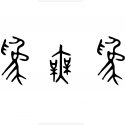
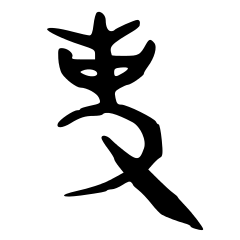
So let’s start with the phrase that began this discussion. The thirteenth line of Chapter 3 ends with the character (也). Here’s the way this character was drawn in the Spring and Autumn Bronze Inscription script that Lâozî probably used:

This pictogram has been seen as female genitalia, an ancient funnel, a wash basin. Actually some linguists think it was an early version of another character, 匜, that means vessel and sounds kind of similar (). Its original Shang Oracle Bone Script character looked like this:

Um. I did not make this up or draw this and neither did the 6th grade boy down the street. Like most of the images I use here, it’s courtesy of the Richard Sears website that so graciously has put gazillions of bronze inscription, oracle, and seal characters’ images into the public domain from original sources. And I’m really starting to think some of these old characters are rather earthy indeed.

Back to our character. It’s what’s known as an “emphatic final particle.” Humans have always had these little words we use at the end of a sentence for emphasis, man! Those words just vary over location and time. Each new generation seems to like to use their own emphatic final particle, dude! Lâozî just happened to choose vagina, b$#@&! Sorry. I’m just pointing out that in modern times some of our emphatic final particles also are gender-specific and even crude. You can think of many more examples, I’m sure. Lâozî uses this one— —in four other locations throughout these 37 chapters of the Dào. I see no reason not to paint a picture of this character’s image just as accurately as I’ve been trying to do with the others. This character’s modern translations are also, too, as well; neither, either; indeed. Most Dào translators just leave it out, but why? It spices up and humanizes the text, for sure. My translation is:

yes, that too, vagina!

~

Lâozî uses other emphatic particles as well. As we also saw above and even back in Chapter 1, Lâozî sometimes interjects in the middle of a sentence or list. For example, zhê (者) occurs—get this!—43 times in the first 37 chapters! Dào translators often ignore this as well, but I think it’s important to know what Lâozî thought was worthing emphasizing. Zhê is used to pause after a term and indicate that you’re about to define it. It can be translated as this. It’s hard to track down its etymology, but I’ve read that its pictogram was the original character either for boiling (煮) or for sugarcane (蔗). I originally included the sugarcane in my translation but later removed it simply because when I look at these two characters, the latter doesn’t look so much like the zhê character. Those four marks below both characters ( 灬)  show fire, like that under a cook pot, so I just made a judgement call that boiling is the common part of these definitions and translate it as:

—now this is cooking!

~

Lâozî also uses the exclamation or 30 times in the Dào. The modern character 兮 looks very much like the old Western Zhou Bronze Inscription:

Some etymologists say the bottom part of this character is a picture of a tree with a fork in it, 丂 (kâo):

The additional two upper marks are then thought to be fine branches, perhaps to conjure up the sound produced by wind blowing through the tree. In some places 兮 and the words descended from it are said to have meant breath, exhale, sigh, yell, call out, air, wind, or the howling sound of wind. But now they’re usually translated as particles like oh, in, at, on. This character’s usually just left out by Dào translators, though some (like Gia-fu Feng and Jane English) translate it as “Oh.” My version is:

Oh! A breath, like wind through tree branches!

Actually, yet another of Lâozî’s interjections is one of the words descended from that same wind-in-the-trees character. “” even sounds like the very sound it describes and is drawn with a couple extra branches: 乎. Translators mostly seem to agree that Lâozî uses this as a “speculative” or “interrogative particle.” It basically turns a sentence into a question, you know? On many of the nine occasions it’s used in the first 37 chapters, translators turn it into can you, is it possible, how true is that, or what can __ do?” Of course, sometimes, they just leave it out. I incorporate the onomatopoeia as well as the questioning sense in my translation everywhere it appears:

~

—pah, can you?!

~

In the last third of the Dào, a completely different kind of exclamation’s introduced and used 7 times. (亦) looked like this back in Lâozî’s time:

Yes, that’s a picture of a person with water falling from their armpits! It’s the original form of the modern character for armpit, but as time went on, this character itself came to mean also, too, likewise; only; already; and although. As far as I can tell, Dào translators completely ignore this word when it appears or at least they fold it into the sentence in such a way that I can’t pick it out. But I can’t ignore such an image, so I translate it as:

—both armpits sweat this too!

It adds a little excitement everywhere it appears, and I think Lâozî intended that! Why else draw someone sweating?

I think that’s it for interjections—phew! Next time we can get back to where we were in Chapter 3, learning about how the traditional version of breeding civilians is breeding this particular man: sure as the sun.

Thanks for being here, and please contact me using this form if you have any comments or questions. See you next time!

Categories
#3 Cháng Mín 民 Qí 其 Wú 無 Yôu zhì 治

civilians—like the Mín people enslaved by blinding with a dagger—

Mín

An eye pierced by a dagger. That’s the pictogram for today’s word, 民, which is modernly translated as people, citizens, folk, popular, and civilian.

Wow. This is why the images within the characters matter to me. The above picture of an eye and dagger is what Lâozî most likely would have drawn while writing down the 37 chapters we now call The Dào. Eye-piercing was an historic method for enslaving people. I’ve read that this practice was associated with enslaving the Mín people, hence this word and their name. Words from the Mín dialect make their way into the Dào in several places that I’ll note as we go along. We saw our first one in the last post, and—possibly not coincidentally?— that word (shî) occurs directly before today’s word (Mín) the first four times we see either one used.

As you recall, Chapter 3 opens with a list of three attitudes to avoid. If you avoid these, then you have a populace that doesn’t do three corresponding bad things. –>Not really elevating the elite rich means people don’t really compete (like with two hands clawing over a plow). –>Not really treasuring hard-earned transformation of riches means people don’t really “effort” thievery. –>And not really seeing something as definitely wanting or missing means peoples’ hearts aren’t really in a confused anxiety where their tongues are like twisted threads with one remnant string hanging out.

But, to be specific, each of those three prohibitions is spelled out according to this formula:

Not really doing [fill in the blank]

is breeding (like a gentleman holding a fountain pen)

civilians (like the Mín people enslaved by blinding with a dagger)

who don’t really do [fill in the blank].

I found this to be a nice time to re-read our last post and really reflect on that image of a government official holding in his hand a “fountain pen” that resembles “a flagpole sticking out of a drum.” Remember too: this image possibly shows that tool superimposed over a mouth. And of course there was the charming information that its meaning—to make someone do something—means to f*@# in the Mín dialect. So is it just me or does it sound like “breeding civilians” is another way of saying f*@#-ing the lowly masses who were enslaved by blinding their eyes with a dagger.

Does my heart suddenly seem rather dark to you?! Okay before I get all carried away seeing something horrible where it doesn’t exist, let’s find out what happens in the rest of the chapter and how these two words (shî mín) are used there. After all, this chapter is actually the only place that this shî character’s used at all.

~

What immediately follows is another instance of Lâozî telling us the suns sees indeed that this means something about the grounded sage. In this case, that description of what breeds civilians to be a certain way means the grounded sage has a particular style for governing (zhì, ).

If you look at this modern character for zhì, you see it has two sub-components. The left side evolved from the pictogram from water:

The right-hand sub-character (台), when it’s by itself, is pronounced in Mandarin and was the original form of the word for happy or pleased. It depicts a mouth (the square) below another character. Most often that arrangement of a mouth means speaking about though sometimes it actually does seem to carry the meaning of a mouth, a cave, or a similar type opening.

In this case the mouth is drawn below a character that’s sometimes thought to be a plow or a symbol for turned or revolving. More often, and more specifically, it’s thought to be a variation of (以) which we investigated in a previous post. There I translated it as already… finishing it in the womb based on its typical translations and the original pictogram which is said to be either a snake or a fetus. Nowadays, when this character’s combined with the mouth character to make , it seems to refer to some aspect of talking about oneself. The result’s translated as I or me or sometimes as what. It no longer carries the original meaning of happy/pleased, harmony, or joy unless it’s combined with a character showing a heart to the left of it: 怡.

When that same happy character was combined with the pictogram of water to form , the resulting meaning was often an ancient river name (pronounced either and chí). In modern usage, though, it’s pronounced zhî and translated as to govern, regulate, or administer. Historically it was used to describe a seat of local government. Dáo translators generally prefer the terms govern, governing, and government, but sometimes you’ll also see them translate it as rules or leads. Here’s how I translate it to include all the imagery:

governing—regulating by harnessing the river named Happy or speaking of turning yourself

I know it gets kind of wild when I translate this way, but I do so love the results. I love how it associates harnessing the River Happy with regulating or turning yourself around…. and with governing.

UPDATE: I look into this character a little more in a later post here.

~

So, to continue on, Lâozî says that in light of that list of what kinds of attitudes do or don’t breed what kinds of civilians, a sage’s governing looks like this:

The sun—walking across the sundial a while, stopping a while—sees indeed

this means…

the grounded sage—listening and speaking, standing connected to earth as well as the heavens,

that person

has this

governing—regulating by harnessing the river named Happy or speaking of turning yourself:

~ emptying—like lifted land…

what it holds a basket of…

heart-core

~ really filling—like a building with strings of solid cowry-like riches…

what it holds a basket of…

inside—the gut, the meat belly;

~ being as fragile as a matching pair of decorative bows or little wings…

what it holds a basket of…

having heart-core determination and aspiration

~ strengthening like an insect—turning yourself as a venomous snake-like bow…

what it holds a basket of…

that bony will that comes from a skeleton framework.

What “it” is referred to in the phrase “what it holds a basket of?” This character, (其) puzzles me. We first looked at this little connecting word back in one of our earliest posts. But when translating Chapter 3, I decided to go back and review all 61 times it occurs in the first 37 chapters of the Dào Dé Jīng and compare how it’s handled by different translators (especially Chinese translators). I ultimately decided it’s safe to say that this phrase doesn’t necessarily refer back to the word right in front of it. Rather it points the reader back to the most recent “subject.”

In other words, Lâozî probably isn’t saying that “emptying has heart-core.” More likely this phrase says that the sage’s governing empties the sage’s heart-core, fills the sage’s inside/gut, is fragile in the sage’s heart-core determination, and strengthens the sage’s bony will. However only Chia-Hsu Chen translates it this way.

Most translators say the sage’s govern empties the people’s hearts, fills their bellies, weakens their ambition, and strengthens their will. They think “it” refers back to Lâozî’s previous “paragraph.” Other translators leave out the whole question of whose basket is in question! They say the sage’s governing empties the heart, fills the belly, weakens ambition, strengthens will.

What bothers me is that these approaches aren’t consistent in how they decide what the connecting word is pointing to. And when you read the different options I pose here, this subtlety really makes a difference, doesn’t it? Maybe this is another example of Lâozî the poet being intentionally ambiguous. Maybe “it” could be any of those things. “It” could be the sage, the governing itself, the people, or it could even be the word right in front of “it.” Maybe it COULD mean “emptying has heart.” (I like that last version a lot. I translated it that way myself until I more thoroughly analyzed .)

So why do I belabor this?

Because it makes a difference on a very important point: does the sage’s way of governing have anything to do with making the civilians be a certain way? It’s easy to assume so. After all we usually do think of governing as controlling others. And in the first part of this chapter, we just saw some gentleman a fountain pen was making them do stuff. But it seems to me that the point of this next section here is that the sage doesn’t do that. Maybe the sage is just over here minding the sage’s own heart, gut, ambition, and will. The very particular way that Lâozî drew the “governing” character could support that—governing could be about turning yourself, harnessing your own Happy river.

Let’s see where else Lâozî goes with these topics in this chapter. It’s pretty interesting.

~

As you remember, in the very first sentence of Chapter 1, Lâozî set up a conflict between the definitive “” version of things and the cháng version—the ever-present traditional, timeless, constant version of things as symbolized by the head cloth that men donned upon becoming official adults. Now we learn more about the cháng (常) version. We’re going to learn about what happens with that traditional version of breeding civilians:

The ever-present square fabric which our grown men wrap around the ‘little bird’ top knots on their heads after receiving their public courtesy-names—what we know as the timeless, whole head-cloth ‘ji’ version of

breeding—like a gentleman holding a fountain pen making something happen—

civilians—like the Mín people enslaved by blinding with a dagger:

~ nothing—no one dancing with long tails flowing from their wrists—nope, never, no way, nowhere, nohow Not-Being…

firing arrows from the mouth—sure;

~ nothing—no one dancing with long tails flowing from their wrists—nope, never, no way, nowhere, nohow Not-Being…

wanting what’s been eroded from this ravine

We know two things about the traditional version of breeding civilians:

  • Not-Being… sure
  • Not-Being… wanting what’s missing

Does this mean the traditional version of breeding civilians breeds civilians that aren’t sure and aren’t wanting or missing anything? OR that in the traditional version of breeding civilians, someone who is a Not-Being is sure and is wanting something that’s missing? It’s our old familiar debate about the nature of the shamanic dancer Not-Being character, , and the meat-holding character we call Being, yôu. Are they people or are they negative and affirmative parties? Does it depend on context? Let’s keep reading with an open mind.

When we do so, we see in the very next sentence Lâozî tells us a third thing about the traditional version of breeding, and this is for sure about this particular man with a hairpin and public courtesy name (). We met this character in Chapter 2. There we learned he was absent and therefore not really leaving. Here we learn that he’s a person who, in the traditional version of breeding, is sure:

breeding—like a gentleman holding a fountain pen making something happen—

that is to say, this particular grown man with a hairpin and public courtesy name…

“firing arrows from the mouth—sure” as the sun, daily

—now this is cooking!—

the husk of the initial protective bud casing—the sepal—but not really the true inner flower of

daring—lightly hitting ears on both sides of the head—

efforting—like lifting up an elephant,

—yes, that too, vagina!

~

All right, all right. Before I continue, I want to address the elephant in the room—and no, I don’t mean the actual elephant we once again see inside the image for “efforting!” I mean that last exclamation and its reference to female genitalia. Is this gratuitous sensationalism on my part? You tell me. I will give you the facts… in our next post. Because this one’s getting soooo long, and I want to tell you about all of Lâozî’s colorful interjections at one time.

Until next time, be sure to use the contact form to send me your questions and comments. Thank you for being here!
Categories
#3 shî 使 zhōng 中

breeding—like a gentleman holding a fountain pen making something happen—

shî

Remember the many different pairs of “opposite” concepts in Chapter 2? We learned about how some pairs were formed, what that meant in terms of how some pairs mutually interacted, what that meant in terms of how some pairs played out in the sage’s life, and what THAT meant in terms of one particular man. Well… in Chapter 3, Lâozî continues the “opposites” theme to more completely give us a view of the world as it was.

~

First we learn that not-really-doing-certain things breeds (shî, 使) civilians to be not-really-doing-other things. This new list of opposites gives us these cause-and-effect relationships:

Not really doing this
… breeds civilians who are not really
Elevating important rich peopleCompeting
Treasuring hard-earning’s transformation of richesEfforting thievery
Seeing what’s definitely wanting or missingHaving a heart-core of confused anxiety

Let’s just pause here and soak in the actual message before I get to exploring the translation. It all feels very true and free, doesn’t it? I’m enjoying thinking of examples I’ve witnessed of each case. And of the opposite. And also where I can relax into these not-real-ystates right now. Ahhh..

Presumably, if you, me, any leader, or a government DOES do those things in the left column, it causes themselves or others around them or under their leadership TO do the other things in the right column? Actually it’s not exactly phrased in a straight forward way. Maybe it’s written like it is because that “affirmative” causality actually doesn’t hold true? Or maybe it would have been impolitic to phrase it in that affirmative way—maybe it would alienate people currently in power when Lâozî was writing? We can’t say for sure. But refraining from the things in the left column does feel good.

~

If you read my complete translation of Chapter 3, you’ll see lots of interesting imagery built in to each of the words shown above in italics. I think a pivotal character in this section is the verb shî (使). See the left half of this character? It’s a drawing of a standing person in profile. And the right-hand sub-component comes from the following Western Zhou Bronze Inscription:

The bottom half of that drawing shows a hand…

… and it’s said to be holding what is believed to be a fountain pen. Some theorize that the hand and fountain pen are superimposed over a mouth, which you remember looks like this in the old bronze inscription scripts:

Others believe the fountain pen itself resembles the flagpole-and-drum structure that used to be placed in the center of a field to gather people. In the Western Zhou era it was drawn like this:

By the Spring and Autumn era, it had been simplified to very closely resemble its modern character:

We’ll see this character, zhōng (中), later in the Dào. Sometimes it’s a sub-component and sometimes its own word which I translate as in the center—like that drum with a flagpole placed in the middle of a field to gather the people, detect the wind.

But let’s get back to our main character. The above combination of the hand and pen is translated as history, historian, scribe. In the old days, it referred to a government official or gentleman. When combined with the the picture of a person, it makes our full compound character shî. That word’s modern translations are to order to do, to make (happen), to dispatch, and to employ, though in Cantonese it translates to have to or need to. In Quanzhou Min Nan (a Southern Mín dialect typical of Fujian province in southeast China before the 19th century), it’s used as a vulgarity comparable to English’s most famous four-letter f-word. Fujian is part of the territory of the Eastern Zhou dynasty where Lâozî was presumed to have lived. The Mín people are considered to be an ethnic-sub-category of the Hans, and interestingly enough, in our next post we’ll see them alluded to again.

In fact, most Dào translations don’t even specifically translate shî but rather just incorporate it in different ways with the word that follows it. A couple translators do call it out as the verb causes, but you know I like to get as complete of a visual image as possible in my mind’s eye for every character Lâozî might have drawn, so I translate shî as:

breeding—like a gentleman holding a fountain pen making something happen—

See how politely I included the Mín version?! Ahhhh…. just cracking myself up over here.

Please join me next time for more on the Mín people and on the other ways Lâozî used today’s word. Until then, thank you for being here, and please write me with any comments you have. I love hearing from you.