Categories
#1 Wú 毋 Yôu

flesh-and-blood meat-holding-Being

yôu1

What you see above is a hand () holding a piece of meat (). The modern character means to have, possess, or there are.

Yôu occurs 42 times in the first 37 chapters of the Dào Dé Jīng. (Remember, I’m looking at those chapters first because together they constitute the “Dào part” of Lâozî’s classic text.) Quite often, especially when it’s sort of the subject of a sentence, translators call it Being. But many times they also use it as what I would call an “affirmation particle.” For example, when yoû is in front of a word like “name,” they translate this combination as “is named” or “with a name” or some such equivalent to “being named.”

Yôu plays a big role in Chapter 1 where Lâozî sets it up in juxtaposition to our old friend (無), no way—no one dancing with long tails flowing from their wrists—no, never, nothing, nowhere, nohow Not-Being.

Being and Not-Being. These are either really big cosmic ideas OR simple things you can put in front of other words to indicate that other word’s either happening or not happening. Or both. Most translators use them both ways, depending on the context. Of course that means we can’t tell when these words are being used, and of course I’m not having any of that.

So, here’s my all-inclusive solution:

flesh-and-blood meat-holding-Being

Much shorter than my usual, yes?! And I’m very pleased with it because I think it gives the reader a sense of the human holding that meat. It’s very incarnate, all the way around. Very real and solid unlike our mysterious dancing not-being. Being and Not-Being. Can you picture them— and . After spending so much time with those two characters, at times I think of them like two different “characters”, that is people, personas, or ways of inhabiting the world. Re-reading Chapter 1 yet again with those images is, once again and in a different way, rather dreamy.

That’s a lot to chew on for one day. I’ll meet you back here tomorrow. Meanwhile, let me know how you experience this. I finally figured out that you can access the comment form by clicking on the “comment counter” up in the heading this post! So please send me your notes there, or use the contact form if you prefer a more private exchange. Thank you for joining me once again.

PS I’ve updated the Pinyin tab with notes about the vowel marks that indicate the tone sounds of words (… and it explains which one of those marks I make incorrectly and why).

Categories
#1 Cháng

the ever-present square fabric which our grown men wrap around the ‘little bird’ top knots on their heads after receiving their public courtesy-names—or what we know as the timeless, whole-cloth ‘jīn’ version of

cháng

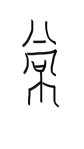
Here we have a compound character. What do you get when you combine cháng (尚), a character that meant to revere:

… with a character that depicts jīn (常), the square head cloth that males wore over their hair buns once they achieved full adult status?

Jīn’s own etymological evolution includes the word diào (吊) which uses a pictogram of a “small bird with a dangling tail” to describe the top knot. This bird and a couple others are sub-components in lots of words, as you’ll see in the future. But in the Western Zhou Bronze Inscription of Lâozî’s time, jīn looked like this:

Lâozî combined these two sub-components into a word, also pronounced cháng, that’s written in modern script like this:

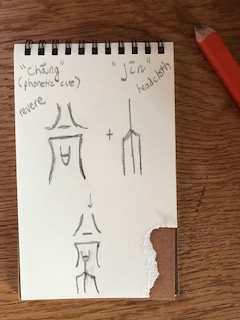
The two sub-characters shown above are in the Western Zhou Bronze Inscription script that I think were most like the script Lâozî would’ve used. But I can’t find an image from those times of the compound character, so… yes, I drew one. That’s what you see at the top of this post!

There are many such cases in the Dào where I can’t find a WZB version of a compound word that Lâozî used. (Of course, you can see how this plays into my theory that our brilliant Lâozî made up all these words a lá Shakespeare!) Hopefully I’ll either find these WZB hybrids somewhere on the internet or figure out how to draw them in a clean digital way at some point soon. Of course I must say that all such efforts are simply my best estimate as to how the two components were combined, based on looking at the modern character. Here’s a peek into my process:

It’s super fun. If you turn your hand to this and come up with something cool, please send it to me.

Meanwhile, what meaning do you imagine when we combine these two sub-characters? The first sub-component here, also called cháng, is considered to be the “phonetic” component that simply gives the compound character its sound. The real meaning—the “semantic” part—is considered to be the bottom component. Modern definitions include: normal,  general, common, constant, and invariable. Indeed, the jīn head cloth was worn by every grown man, so it was a common, constant part of daily life and probably seemed like it had been forever.

Some Dào Dé Jīng translators, like Yi Wu, translate cháng to the simple word constant. But others, including Chen, Feng and English, John C.H. Wu, and Mitchell, think Lâozî meant something even more cosmic. They translate this character in Chapter 1 as eternal. But they also substitute other words in different places, depending on the context: always, constantly, never, abides, forever, and so on. Sometimes they don’t directly include this word but fold it implicitly into how something just “is” or “isn’t” something.

By now, you know I get frustrated when I’m reading a translation and can’t tell if I’m looking at the same word that was used in the paragraph before, the page before, etc. But of course, I understand why it’s done. It’s hard to make just one phrase make sense or even fit grammatically in every context.

And you also know what I’m going to do next: throw in ALL the things! To heck with brevity and certainty! The translation I use everywhere for this character is:

the ever-present square fabric which our grown men wrap around the ‘little bird’ top knots on their heads after receiving their public courtesy-names—or what we know as the timeless, whole-cloth ‘ji’ version of

I like the square shape of the jīn… so pleasing. I love that this word includes fabric which to me relates to the revelation in yesterday’s post that the word xuàn shows us an infinity-loop of black thread! I wonder how else parts of this word will tie into other pictograms and concepts as we move on.

And when I step back and look at this phrase and how it’s normally translated as eternal or constant, I think it gives us a very particular sense that in ancient China, these traditions of becoming, being, and being recognized as an adult man were indeed very timeless, ubiquitous, and solid. And they were revered—which is why I think the “phonetic” component in this word actually contributes a lot to its meaning.

Of course, now when we look back at how cháng‘s used in Chapter 1, it’s even more interesting. But we’ll delve into that more and put it all together after we look at a couple more words in this chapter. Thanks for joining me here once more! I hope you’re settling into the uncertain, floaty feeling of this text and letting it wash over you without having to come to any conclusions. There’s some powerful alchemy at work, I just know it.

TINKERED WITH: 1/15/20, I replaced my paper-drawn composite of the Bronze Inscription components with a digital hand-drawn version.

Categories
#1 Bù 不 Fú 弗 Fēi 非 Wú 無 Wú 勿 Wú 毋

no way—no one dancing with long tails flowing from their wrists—no, never, nothing, nowhere, nohow Not-Being

What does this drawing look like to you? Linguists say it was a pictogram of a person with something long dangling from each hand—maybe long tails or sleeves—dancing. It must be a fancy dance or maybe a shamanic one, judging by those tails/sleeves.

That drawing is the Western Zhou Bronze Inscription character, close to the kind of script I believe Lâozî would have used. Later—maybe toward the end of Lâozî’s era—this character evolved into a Seal Script form in which the horizontal and vertical bits got exaggerated:

From there, maybe we can see how it turned into the modern character:

But here’s the thing: I have a hard time understanding why a beautiful, powerful, evocative drawing of a dancer holding long flowing objects turned into a word that’s now translated as not, without, not having, free from, no, un-, nil, -less, non-, or some other negating concept. How did it go from portraying a person engaging in celebration/ritual to conveying a complete lack/undoing of something? And, more importantly to me, when did it undergo this change? Because, of course, you and I want to know how Lâozî actually experienced this character’s meaning.

Chinese has several “negation particles”—little words placed before or after other words to indicate the opposite or lack of that base word. English does too as evidenced by that list of translations in the previous paragraph. When this character was ‘borrowed” away from its original meaning and turned into a negation particle, a new character was created for the word dancing by modifying the original pictogram with some extra marks near the person’s feet to show they’re taking steps.

This change seem to have happened in or just before the Western Zhou Bronze (WZB) era. We know this because 1) Oracle Bone script didn’t use this negating form of , and 2) this new character for dancing appeared in the WZB era:

Later, by the time it turned into Seal Script, it looked like this:

And now it’s written as 舞. My point here is that some linguistic effort was made to change the original character just to retain its own original meaning because somehow this person dancing with long things flowing from their wrists was turned into… nothing. Literally. Or worse, it was turned into something that undoes or negates every kind of stuff or abstract idea that it’s attached to. Puzzling. Especially because there are others way to “undo” things.

Negation

And now we are going to go down a rabbit hole into nothingness. Literally. It’s an important part of the Dào, so it’s good to go there right up front. Bonus: contemplating it elicits a not-unpleasant sort of spaciousness.

As you remember, Oracle Bone (OB) script was the version of written Chinese immediately preceding Lâozî’s time, though he certainly was familiar with it since he was a court scribe. There were five negation particles found in Oracle Bone script, and our word-of-the-day (無) was not one of them because back then it still meant dancing. We see documentation that this word was indeed used quite often as a negator in Classical Chinese which was the main writing beginning in the 5th century BC—well after Lâozî’s time. But what was happening with this word in between, during Lâozî’s lifetime? This appears 43 times in the first 37 chapters of the Dào Dé Jīng. Why and how did Lâozî use it? Did Lâozî use it with the earlier OB meaning of dancing or with the later Classical meaning of negation… or both/neither? Conventional translators make it out to be a negation particle. I like to read through the text and substitute that dancing being for . It’s kind of wild that way. I am starting to wonder if, like Shakespeare, Lâozî hybridized and made up words and, indeed, changed the language of that time. It’s something to keep in mind as we move through the Dào.

What makes things even more tricky in translating—if you’re trying to use unique translations for each character—is that Lâozî uses other negators as well. The most common negation particle in OB was (不). And appears 113 times in the first 37 chapters of Lâozî’s Dào. It’s the most common negator in the book, so in this way, Lâozî is using a typical Oracle Bone style. The glyph which Lâozî would have used depicts a sepal—those outer, guard petals on a flower. I translate it as the husk of the initial protective bud casing—the sepal—but not really the true inner flower of… [whatever word follows it]. It looks like this:

is what’s called a p-type negative, and is an m-type negative. No one’s sure why there are two parallel series of negative particles. Some linguists hypothesize they represent a very old, possibly prehistoric fusing of two different peoples and dialects—maybe each group of people had a different sound they commonly used to mean “uh uh.”

It’s also not clear how the particles or their uses evolved, and furthermore there are different theories among linguists as to when and why a particular negation particle is used. Some say the the ptypes modified actions beyond the control of living people and the mtypes attached to words describing actions over which people thought they had control. Interesting. Since was most commonly used, I wonder if the people that used the bbbb/fffff sound to mean “nope” were more dominant than those that used the sound? Or did OB-era conversations tend to negate a lot more uncontrollable actions than controllable ones? Did Lâozî?

Now, brace yourself for what lies ahead. Chinese has a lot of homophones—words that are pronounced exactly the same as each other but mean something altogether different or, as in this case, they mean something similar but uniquely flavored and with a different written Chinese character. And it turns out that a separate m-type negation particle, also pronounced , was most commonly used as a negation particle during the Oracle Bone years: 毋. It derived from the character that meant mother. By the time of Western Zhou Bronze inscriptions, this other looked like this:

Lâozî doesn’t use this character at all in the Dào. So in this case Lâozî’s deviating from OB negation style completely. And yet… and yet using a word that sounds like the typical negator but looks like this fancy dancing person. Linguists have noted that in Zhou time, this character “was already phonetically confused with and read like 無.” So again we see these big changes in the negation particles happening during Lâozî’s era. Indeed there were all these different drawings to make this one sound and general meaning, but, I would say, each drawing has a different effect. I doubt scribes like Lâozî were just confused or careless with their spelling.

There’s also a THIRD (!) m-type negative pronounced : 勿. It’s an obsolete character whose pictogram was a bloody knife:

Wow. Hardcore. Lâozî uses this other character four times in Chapter 30, and that’s the only place in the Dào that it appears. I translate it as not—seriously like blood on a blade, just don’t… [Dramatic yet again, I know, but I’m only trying to keep it accurate!]

So far we’ve found that when it comes to the m-type negators, Lâozî prefers our word-of-the-day version of even though that hadn’t been the norm up until then. That being the case, all the m-types are still way out-numbered in the Dào by the p-type negator .

And Lâozî uses one other p-type negation particle: (弗). Its Western Zhou glyph is considered to depict either 1) two arrows leaning against each other and wrapped up to be straightened or 2) a bundle of sticks tied together to start a fire. (In English, the latter was called a faggot which shows really horrible things about our culture and language.) Lâozî uses this twice in Chapter 2 and nowhere else in the Dào.

Finally… there’s one more negator in the Dào, fēi (非). It doesn’t seem to be classified as either one of the older two types of negation particles—it came on the scene after the Oracle Bone years:

Some say this is a pictogram of a pair of broken wings on a baby bird. Others say it’s a combination of with a compound character that shows a heart and a short-tailed bird. I translate it as: is breaking the little wings off

Okay, that also sounds a little dramatic, but, dang. Either one of those possible etymologies is pretty harsh. Happily Lâozî only used this word fēi four times. Of course, two of those are right in the first chapter, which, by the way, is where we are, or were, before this side trip into negation…

Back to

I read somewhere that to write this character you begin with three horizontal lines and add eight kind of slashing or negating marks on top of it—four vertical ones downward through the three-line structure then four short diagonals spraying out from the bottom. It may just be the power of suggestion, but I do experience this repeated-negation sensation when writing out the character. Try it and see how it feels.

Because of the completely annihilating tone of all modern definitions as well as these eight “no no no no” kind of marks and the fact that I want a translation that will work in any setting, I decided to translate this character as noone-noway-no-never-nothing-nowhere-nohow-not-Being. You saw that phrase in the complete Chapter 1 translation I put in yesterday’s post.

Why did I include the word being? It allows me to use this phrase everywhere, including in places where other translators have felt the need for a noun and translated this term as nothing, nothingness, or non-being. Plus at least I’m throwing in a reference to the actual being that appears in the original pictogram.

But writing this post to you today has made me realize that I broke my own rules with this translation. I was so swayed by the singular modern focus on the negating aspect of this character that I completely left out the actual original image and its meaning. And my whole goal is to include those drawings for the reader to experience! So I’m officially changing my translation right here.

Then the question becomes: how can I keep the the extreme “nil” effect, the ability to be a noun as well as a modifier, and our dancer? I don’t think the dancing part can be the first or last thing without throwing off the negation. After many arrangements, I come up with:

no way—no one dancing with long tails flowing from their wrists—no, never, nothing, nowhere, nohow Not-Being.

It gives me goose bumps, and that’s my favorite kind of “yes.”

~

You can see how and why my translations are not short and catchy and why they’ve gone through so many iterations. It’s hard to have it any other way, given my goals and intentions. You can see why some people prefer to find a short-hand translation (like, in this case, Not-Being), and I fully support whatever they—or you—decide works. In fact I myself often silently shorten my own translations in my mind when looking through my book or thinking about a chapter. But for me, these longer historical written versions carry a fullness and a mysterious, evocative sense—even if they don’t look like regular, clear-cut writing. It feels like they constellate into something bigger… eventually.

Meanwhile, I stay open to what occurs. I’ve changed my translation for in the Chapter 1 tab and throughout my whole Dào document, so now I’ll be reading through and see if it works everywhere. And I’ll be getting ready for the next post when we’ll delve into something that may (or may not!) be the opposite of Not-Being: a timeless eternal piece of fabric.

Thank you for joining me on this journey! I hope you’ll use the comment section below or contact form to send me your thoughts and feelings. I’d love to hear them.

Betsy

Categories
#1 Jiâo Miào Xuán

mysterious feminine essence—a few drops of that womanly mist

miào

Welcome back! I’m grateful you’re here. Let me get straight to the point: you probably returned because of the confounding puzzle in yesterday’s post… namely the Dáo Dé Jīng’s first chapter! And more specifically, I bet (or hope!) you were particularly struck by the character that I translated as: mysterious feminine essence–a few drops of that womanly mist.

The name of that character is miào:

Yup — I couldn’t make this stuff up!

This intriguing term appears TWICE in Chapter 1. And it does so in sort of a baffling Russian doll fashion. When you try to follow the logical layout of Chapter 1 (which we’ll do together in a minute), you find it’s as if miào is a small interior doll BUT ALSO somehow comprised of or entered via the complete make-up of a Russian nesting doll itself. It’s like the over-arching structure of how things work is the entryway into this substance that makes up one tiny part of it? Hmmm… sort of like a fractal but not exactly. Let’s see if the pictogram version of this word illuminates things for us.

~

As is always the case when I can’t find a Western Zhou Bronze (WZB) Inscription character for a modern character that’s made up of multiple images, I looked into each of the two components of this word. The left sub-component is a drawing of a woman. The old WZB glyph shows a kneeling person with breasts (that sort of curly-queue around her torso):

The even older Oracle Bone Script glyph—the most ancient version of every Chinese character—is almost identical:

That similarity’s important to me because when I started looking into the right-hand sub-component, I couldn’t find a WZB inscription version. But I did find an Oracle Bone Script glyph of this character, and I figure Lâozî, an accomplished court scribe, and his peers were familiar with it too. This pictogram of four dots means few or little in number:

This sub-component is considered to be the phonetic part of the word—in other words it carries the sound of the word. This character on its own is pronounced shǎo, so presumably when combined with the first sub-component, we see that the new word, in this case, ends with that “ao” sound.

Together, the two components might look like this:

You can see how the modern Chinese character, , incorporates the updated symbol for woman on the left and re-arranges the four dots in the right-hand component.

When the two components were combined into one, that compound character miào came to mean mysterious, subtle; fine, glorious; ingenious; exquisite. What a gorgeous word. And when it comes to interpreting Lâozî’s use of it, things get even more interesting. Stephen Mitchell translates it variously as mystery and all understanding in Chapter 1 ,wisdom in Chapter 15, and the great secret in Chapter 27. Gia-fu Feng and Jane English stuck with mystery both times the character appears in Chapters 1 and 27, but in Chapter 15 they called it unfathomable. Yi Wu used myriad subtleties or essential subtlety. Thomas Cleary follows his lead in some places, but in this first chapter calls it marvels.

So now you can see how I came up with my translation by combining the abstract meanings as well as the actual images. Even though the four little drops are supposedly “only” the phonetic part of this word, that sense of a little bit of something seems crucial to the word’s meaning, so I included them in the one phrase I decided to use everywhere this character appears:

mysterious feminine essence–a few drops of that womanly mist

It’s quite a word. And somehow a keystone in The Way that Lâozî’s describing. As you remember from yesterday, Chapter 1 lays it out like this:

  • Lâozî first describes for us this yoked, matching pair of core concepts (Not-Being and Being) then
  • outlines how each of those core concepts lies at the beginning of an important part of our universe (Not-Being is Sky-Earth’s conception, and Being is the suckling of all the material stuff or what is known in Chinese as “The 10,000 Things”), and then
  • tells us what each of those “holds a basket of” (miào and jiâo, respectively). Miào is associated with Not-Being, and that’s what we’re exploring here today. As for Being’s jiâo (徼), its WZB character shows four sub-components: left, white/acorn/or skull, sword tip, and right.While its modern translations is frontier, border, patrol, or inspect, other Dào translators have called it manifestations, outward, or the surface. I translate it as delineated surface because the sword is said to be drawing a line from left to right.
  • We then find out that these two core concepts actually started out altogether but that when they stepped out into the world, they became known by different titles. When they’re together though… what they’re REALLY called? Well that possesses something that may be my favorite word of all: xuán (玄). It deserves its own post on here for sure! Suffice for now to say that while others translate it as darkness or mystery, I absolutely want you to know that its glyph is a picture of a mysterious infinity-loop of string dyed black: Seriously. It is. I imagine you can see where my physics-happy mind goes!
  • Furthermore it turns out that this mysterious infinity-loop of string dyed black ITSELF also possesses, has, or is somehow made of… yes: mysterious infinity-loop of string dyed black.
  • Mind=boggled.
  • But here’s the grand finale, the last line of Chapter 1 and what seems at this point to be the outermost Russian nesting doll:

The sun shining down like an eye on the people sees all this, sees mysterious feminine essence—a few drops of that womanly mist—has this double-winged gateway.

~

So there you have it. We now know that today’s featured heroine, the mysterious feminine essence—a few drops of that womanly mist—known as miào, is what’s held by Not-Being and that it may be entered via a double-winged gateway that seems to be the entire Not-Being/Being situation outlined above in which Not-Being/Being are really the same thing and, though differently masked/named once they step out into the world where one of them is the origin of heaven-and-earth and the other is the origin of all of its material inhabitants, in fact what they’re really called when they’re together has this mysterious infinity-loop of string dyed black. And this is the mysterious-infinity-loop-of-string dyed black’s own mysterious infinity loop of string dyed black.

I couldn’t love it more.

~

Thank you so much for sticking with me on this big trip. I hope you’re feeling a little disoriented. I am, and I think that’s key. We’re just at the beginning, after all. Tomorrow let’s double-back and look at pictures of Not-Being and Being. I bet that’s not an invitation you get everyday! I can’t wait.

*Updated 1/5/20 to include the specifics of the jiâo and xuán translations.*


Categories
#1 Dào

The Way of the Loose-Haired Chieftain

Dào 

The first character in the first line of the first chapter of the Dào Dé Jīng (AKA Tao Te Ching) is, quite fittingly, Dào itself. I can think of no better way to kick off this new year and new decade than by starting here, at what is perhaps, after all, the end game of its author, Lâozî (AKA Lao Tze or Lao Tzu).

It seems likely that Lâozî actually wrote in something most closely resembling ancient Western Zhou Bronze Inscription script. Its glyph of Dào is shown above. The center part of the drawing shows a person with a long mouth and a pronounced head of hair. On its own, this sub-component means head or chief/leader and was drawn like this:

The marks on the outsides of the glyph mean step, and those at the bottom show a footprint, meaning to halt. In modern Mandarin script, these have been consolidated into one sub-component on the left side:

This character can mean explain; talk about; method or principle; and, more commonly nowadays, way, path, road. It has been translated as head in motion, walkie-talkie, or, more expansively, as traveling through life with one’s attention on non-duality or unity with nature. In Buddhism, it’s commonly called The Way.

So well known is this word that many translations simply stick with the Mandarin Pinyin transcription: Dào. In keeping with my goal of providing a translation that includes every pictorial element as well as the more abstract evolutions of a character, I translate Dào as:

The Way of the loose-haired chieftain—walking a while, stopping a while, seeing and speaking of it all

I have to come love this phrase and the person it describes—that person that I’ve come to think of as the author Lâozî. With each additional image, line, and chapter in this book, I feel we get closer to this wandering, free observer of life.

~

Chapter 1 of the Dào Dé Jīng introduces many key characters that appear over and over in the rest of the book. Each one is filled with the same kinds of subtleties you’ve seen in considering just this first word, so I’ll look into more specific words during the course of this week. But since this first chapter feels like a summary of The Dào and things to come, I present the entire first chapter for you below. As always, I give each character its own line, and each line from the original text is presented here as one paragraph.

~

1.

The Way of the loose-haired chieftain—walking a while, stopping a while, listening, and speaking of it all—

about which you can purse your lips like a piece of cane and puff: ‘Yup, that’s it, definitely

The Way of the loose-haired chieftain—walking a while, stopping a while, listening, and speaking of it all—’


is breaking the little wings off

the ever-present square fabric which our grown men wrap around the ‘little bird’ top knots on their heads after receiving their public courtesy-names—or what we know as the timeless, whole-cloth ‘jin’ version of

The Way of the loose-haired chieftain—walking a while, stopping a while, listening, and speaking of it all.


Its personal, childhood name—what it says to identify itself by moonlight—

about which you can purse your lips like a piece of cane and puff: ‘Yup, that’s it, definitely

its personal, childhood name—what it says to identify itself by moonlight—’


is breaking the little wings off

the ever-present square fabric which our grown men wrap around the ‘little bird’ top knots on their heads after receiving their public courtesy-names—what we know as the timeless, whole-cloth ‘jin’ version of

its personal, childhood name—what it says to identify itself by moonlight.


No-one-noway-no-never-nothing-nowhere-nohow-not-Being…

its personal, childhood name—what it says to identify itself by moonlight…

Sky(that level above the human head)-Earth(this soil vagina)

has this

conception.


Flesh-and-blood meat-holding-Being…

its personal, childhood name—what it says to identify itself by moonlight…

the swarm of Ten-Thousand Things, 

all external matter—like cows—cut off from you

has this

suckling.


Anciently, for ten generations, this therefore lightly hits and leaves a mark of reason:

the ever-present square fabric which our grown men wrap around the ‘little bird’ top knots on their heads after receiving their public courtesy-names—what we know as the timeless, whole-cloth ‘jin’ version of

No-one-noway-no-never-nothing-nowhere-nohow-not-Being…

desiring what’s wanting—what’s been eroded from this ravine…


this means:

keeping watch from the temple tower for

what it holds a basket of…

mysterious feminine essence—a few drops of that womanly mist;


the ever-present square fabric which our grown men wrap around the ‘little bird’ top knots on their heads after receiving their public courtesy-names—what we know as the timeless, whole-cloth ‘jin’ version of

Flesh-and-blood meat-holding-Being…

desiring what’s wanting—what’s been eroded from this ravine…


this means:

keeping watch from the temple tower for

what it holds a basket of…

delineated surface—a patrolled frontier border lightly hit with a sword tip from left to right.


This here—the foot stops a person here on their footprint:

a matched pair, like a harness of ox yokes

—now this is cooking!—

altogether with one another—as together as a commonplace plate with a mouth—

stepping out of their cave,


and yet now, bearded:

differently-masked,

its personal, childhood name—what it says to identify itself by moonlight.


Altogether with one another—as together as a commonplace plate with a mouth:

what that’s really called—from the gut—

has this

mysterious infinity-loop of string dyed black.


Mysterious infinity-loop of string dyed black

has this

again—on the right hand—

mysterious infinity-loop of string dyed black.


The sun shining down like an eye on the people sees all this, sees

mysterious feminine essence–a few drops of that womanly mist–

has this

double-winged gateway.

~

Whaaaat?! I hope that’s your reaction, as it was mine when I built this. Don’t worry though—as we look at different characters and the way this chapter is organized, you’ll come away with some clearer sense of the parts and the whole. It’s still going to feel wild, though. That I can promise.

As we move through this book together, I look forward to your comments on what, I know, is a somewhat radical approach to this beloved classic. Please know that I have only respect for the received translations and for the traditions and lineages that came out of those texts. What follows here and in the rest of this project is my own fun investigation to help me directly experience this invaluable, mysterious document in a personal way. I hope it does the same for you.

Happy New Year and new decade!

Last tinkered with 3/10/20