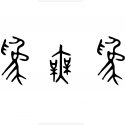
wéi wú wéi
Before I got side-tracked by interjections—oh my!— we were finishing up Chapter 3. We had been looking at: 1. what it means to “breed civilians” in certain ways, 2. how the sage governs, 3. the implications of the traditional version of breeding civilians for Not-Being, and, 4. lastly, we were just at the part where we were learning what that traditional version of breeding does to our old friend, fū, this particular grown man:
breeding—like a gentleman holding a fountain pen making something happen—
that is to say, this particular grown man with a hairpin and public courtesy name…
“firing arrows from the mouth—sure” as the sun, daily…
—now this is cooking!—
the husk of the initial protective bud casing—the sepal—but not really the true inner flower of
daring—lightly hitting ears on both sides of the head—
efforting—like lifting up an elephant…
—yes, that too, vagina!
efforting—like lifting up an elephant…
nothing—no one dancing with long tails flowing from their wrists—nope, never, no way, nowhere, nohow Not-Being
efforting—like lifting up an elephant;
after following this sacrificial blade-and-cauldron-like ritual example, standard, or regulation…
nothing—no one dancing with long tails flowing from their wrists—nope, never, no way, nowhere, nohow Not-Being…
the husk of the initial protective bud casing—the sepal but not really the true inner flower of
“governing—regulating by harnessing the river named Happy or speaking of turning yourself.”
Let’s parse this out.
- We see that the traditional version of breeding civilians is breeding this particular man one way: very sure.
- And this very sure grown man is not really daring “efforting.” He isn’t really being brave enough to get himself to do that grinding approach to things. Is this foreshadowing that our hero isn’t rising to the occasion?
Lâozî has talked to us about this efforting (wéi) approach before. We first examined this character here, at the beginning of Chapter 2. We saw that an “efforting” of any particular kind of quality resulted in “lopping off and defining” a rather opposite quality in something before that thing was even born.
And later in Chapter 2 we looked at it again here because Lâozî used the phrase “Not-Being efforting.” It could simply mean “not efforting.” I also did wonder if “Not-Being efforting” resulted in a lopping off and defining of Being before it was even fully developed and born. Now, considering the weird things we keep seeing about Not-Being and Being, I wonder if this phrase was talking about a person who has an outsider status. Maybe it’s describing someone who was considered a “non-being” and was doing some efforting! Well, bear with me and let’s see what happens here in Chapter 3 when Lâozî brings that Not-Being character back into a discussion of efforting.
- “Efforting… Not-Being efforting.” That is one whole line. Just those three words, all by themselves. Wow—okay I’m taking a breath! What’s this mean?
- Maybe it’s a short list of two opposites, like we saw in the list in Chapter 2. It could be saying: “ok, so we have efforting and we have not-being efforting… now let’s talk about them both.”
- Or maybe this line’s talking about when “hard work isn’t hard work.” Maybe it’s talking about when getting stuff done is somehow magically easy. “Doing not-doing.” That’s the usual interpretation, and it is a beautiful one that I love. But. If this is the correct interpretation, then our shamanic dancing character wú (Not-Being) is simply the negative particle “not.” That’s how most translators in fact translate this word—except in some cases when they don’t!
- Sometimes the word’s just sitting by itself, and so they let it have a life of its own. That throws me and makes me wonder if wú is truly just a particle in other cases like this one. Furthermore, why use bù (“just the husk and not really”) as a negative particle sometimes and wú (the dancing Not-Being) other times? You remember I did delve into that question here. In short, p–type particles like bù originally seemed to modify actions beyond the control of living people, and the m–types like wú seemed to attach to actions over which people thought they had control. In the part of Chapter 3 I translated at the top of this post, would you say “daring” is something over which we have NO control, and “efforting” is something over which we DO have control? That’s hard for me to believe. That’s why I’m going to consider what it would mean if Not-Being were more than just “not.” What if Not-Being has full status as a character of its own..
- Maybe the proper interpretation of this line is: “efforting… to be a Not-Being who is efforting:”
- Or maybe: “an efforting that is… a Not-Being who is efforting:”
In any of these interpretations, the next line is super important because it’s going to modify this one and tell us something important about it. We’ll explore that next time.
Meanwhile… I hope you’ll play a little mind experiment and explore what it would feel like to you to be:
really muscularly trying… nothing—no one dancing with long tails flowing from their wrists—nope never, no way, nowhere, nohow Not-Being really muscularly trying
Please use the contact form to let me know your feedback. I love the comments I get, and if you haven’t sent one yet, now is a good time to start. Thank you for that and for being here.
 The Dào of Lâozî