
shèng
Last time, in the second half of Chapter 2, we met a new character: shèng, 聖.
This character’s sub-component 耳 (êr) is a pictogram of an ear and considered to be what gives the overall character its meaning. This character is also the second part of what’s widely believed to be Lâozî’s own personal childhood name, Lî Êr. Its bronze inscription glyph looks like this:

The other sub-component, 呈 (chéng), is considered to be the phonetic part that gives shèng its sound. Its glyph is in turn also a compound of two pictograms. The first is a mouth (口):

The second may be a carrying pole (壬) or, more likely, the symbol representing king (王, three lines that represent Heaven, Man, and Earth):

When you put those two together as the character chéng it looks like this:
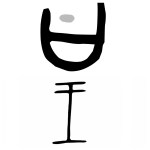
In its modern form, chéng is translated as flat, submit, show, appear, petition, or memorial. Etymologists say this old glyph represents a man standing on the ground, speaking. It’s interesting to me that it’s like a king BUT ALSO listening and speaking. That’s an important distinction. You remember our main character, Dáo, The Way of the Loos-Haired Chieftain is ALSO listening and speaking BUT isn’t standing still. Rather that person is walking awhile and stopping awhile on a path. It feels to me as if the latter is more part of the world and regular life.
When you put all the components together for shèng, we get:

Modern meanings of this word are noble, holy, sacred, saint, sage, Confucius, master, professional, emperor, and king. Translators of the Dào most commonly use master or sage. My translation carries all that (with the exception of Confucius himself who is said to have been born the year Lâozî left the country and disappeared):
the grounded sage—listening and speaking, standing connected to earth as well as the heavens
Many people think this character refers to Lâozî as well as other wise people who follow the Dào, but there are other places where Lâozî actually says “I.” Shèng appears 11 times in the Dào part of the Dào Dé Jīng (i.e., the first 37 chapters). In eight of the appearances it’s preceded by a phrase that carries a lofty, objective perspective (“the sun sees that this means…“). This all combines to make me wonder if the grounded sage is an image of a theoretical, idealized wise person and not Lâozî per se. For these reasons, I treat it as its own character.
~
Lâozî introduces this ideal person in Chapter 2. Directly after giving us the list of paired opposites, Lâozî segues into a description of the sage during certain conditions:
- As we saw last time, the first thing we learn about the grounded sage is that with respect to “staying,” the sage’s personal role has this Not-Being efforting. Here’s the rest of the list…
- When it comes to being out in public moving, the grounded sage’s teaching has this: just the husk of, but not really, speaking.
- When it comes to the Ten Thousand Things, the grounded sage’s getting up and going to work, and yet now, as one bearded, is just the husk of, but not really, falling into some empty-language style of governing.
- When it comes to birthing, the grounded sage, as one bearded, is just the husk of, but not really, Being.
- When it comes to real work completing—that final nail in the weapon on a pole—the grounded sage, as one bearded, is absent as sticks that were tied together in a bundle to start a fire—’fff!’—not abiding.
Very clear… and also puzzling of course. It feels straightforward that the sage teaches without too much speaking and that the sage works with all the many realities of the world without really falling into empty-worded governance. But then, when it gets to “birthing,” we float into that familiar uncertainty that comes with the characters Being and Not-Being. And THEN… then the sage is actually completely absent when it comes to work-completing. Perhaps the sage was “burnt up” in starting some metaphorical fire. What is going on here?
The sage, as well as Being and Not-Being, are prominent characters in the narrative arc of the Dào. For that reason, we’re going to pause here and devote the next post to the “birthing” that links these three characters. Hopefully more will be revealed to us.
~
Until then, what’s my takeaway?
I like to unravel the Dào for a couple reasons. One is to learn about Lâozî, and the other is to learn what ideas this book holds for my own life. Even without solving the whole mystery of the story or even deciding for sure on the meaning of any one character, I still get a lot out of any snippet… whether it be a word, line, or chapter. A big theme for me is allowing myself to rest in not being certain about things. That holds true in every post thus far as well as every aspect of my life. This character of the sage is already posing some useful and pleasant-feeling variations on that theme. Consider the pictures in that character: listening, as well as speaking, feet on the ground even as connected to the loftiness above us. Getting a visual image of that sensation makes me so grateful to Lâozî.
Thank you for being here! If you have any comments for me before next time, please use the contact form (click on the Contact tab). I love getting your notes.
Tinkered with on 2/16/20
 The Dào of Lâozî