shî
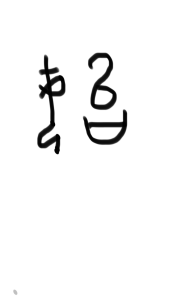
Remember how, during my post about wú, I changed my own translation to include more of the actual picture shown in the script from Lâozî’s own time? I just did it again with today’s character, shî. Writing out my rationale to you is having a big effect on this project and shaping my perspective on translations I’d settled on over a year ago! So thank you for reading along and for your ideas and support. It’s results in a powerful alchemy.
So, back to today’s character. The modern version might look familiar to you:
始
The left hand component is the same kneeling woman (person with breasts) we saw in xuán, the mysterious feminine essence:

The right-hand component (台) is considered the phonetic part of the character, giving us a pronunciation cue—it’s pronounced yí which rhymes with the overall word’s sound. You can see it is itself a compound character. I find two different ways of looking at the top sub-subcharacter. On one hand, 厶 comes from an old pictogram that looks like this:

This character is from the Warring States (WS) era bronze inscription, so more than likely this came from just after Lâozî, but it’s the closest I can get for now. It’s considered to be a picture of revolving around oneself or self-circling and meant private.
Even though I would have tended to think that was the origin of this sub-sub-component, more sources say it’s the character 㠯, and that this is the phonetic clue for yí. Not much else besides the pronunciation seems very certain. The pictogram and meaning are mysterious. The Western Zhou Bronze Inscription character from Lâozî’s time looked like this:

Some say that’s a plough; others say its a turned version of the pictogram for a snake or a fetus. In modern times, its use is mainly in a different word also pronounced yî, 以, where it’s morphed into being written in the form of the left-hand component you see there. It’s meaning is by, according to, or by means of.
The lower sub-sub-component (口) is another one that’s familiar to you. It’s a mouth, which sometimes means mouth, sometimes indicates someone is “saying” the thing in whatever other picture it’s drawn next to, and sometimes refers to a hole in something (entrance, exit, mouth of a cave, etc.) :

Together, these two added up to a compound character 台 that was the original character meaning happy. In the 4th-3rd centuries BC it came to mean I or me. I can’t find an old image of this word, so I drew how it might have looked when Lâozî drew them together:
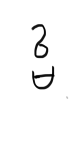
And when we put that with the kneeling woman in the left sub-component, it would look like this:
That’s the complete old glyph style drawing of today’s word, shî, usually translated as begin, start, beginning, starting, or initial. But… after I saw the etymology described as “beginning in and by a woman,” I decided to re-think those ordinary translations.
In fact, fittingly, this is the very first, the beginning etymological reference I noticed on Hilmar Alquiros’ website. It’s what started this project of mine. I was quite taken with its beauty and amount and quality of interesting information. To keep the original feel, I decided conception was a better translation, and you saw me use that in my initial translation of Chapter 1 in my very first post.
The thing is, typing all this to you, I remember that when I decided on that word, I was still trying very hard to come up with simple, preferably one-word translations to make it easier to read and in keeping with the one-word nature of each character in the Tao Te Ching. Heck they are all one syllable!! But in the last year and a half, I’ve evolved more and more to believing it’s valuable to include as much information as I can to give the reader—be it me or you—regarding the experience of the old glyph as LâoZî may have drawn it.
For that reason, I’m now going with the translation I first saw:
beginning in and by a woman
One thing immediately reinforced my belief that this way of interpreting the characters is valuable: the recurrence throughout Chapter 1 of this kneeling person with breasts.
~
Remember the context of this character in Chapter 1: it’s when Lâozî’s telling us that “Not-Being, its name is Sky-Earth’s beginning in and by a woman.” I’m going to get into how in the world we can interpret this phrasing, probably the day after tomorrow. But meanwhile, just note that in the very next pair of lines, we learn that “Being, its name is The TenThousand Things’ suckling.” Of course suckling was the term I decided to use back in my one-word translation days. Let’s look at it again.
The actual word, mû (母), looked like this:

Yup, the kneeling person’s breasts now have distinct nipples a lá a nursing woman, female, older woman relative, or mother. Most translators use that last word. I want to keep the word “woman” so we can “see” it shares a sub-component with shî, so I’m modifying my original translation to this:
suckling from a woman
And then a few lines later, and in the very last line also, we see our kneeling woman in the form of xuán, the mysterious feminine essence—a few drops of that womanly essence:

All these female-specific words do notably contrast with that male-specific image in the word cháng, the ever-present square fabric which our grown men wrap around the ‘little bird’ top knots on their heads after receiving their public courtesy-names—or what we know as the timeless, whole-cloth ‘ji’ version of… things and, for that matter, in the word ér, and yet—now bearded. It remains to be seen what we can make of these gender-specific terms. Other characters (the dancer in wú, the loose-haired chieftain in dào, the person being named in míng) have no specific gender, nor do most terms and pronouns in Chinese.
I had considered wrapping up Chapter 1 today, but I felt negligent not talking to you about these other concepts and so instead dove into these words, and thank goodness since it led me to some worthwhile tinkering. I best not move on without delving into a few more. Tomorrow I think we’ll get into Heaven… or at least the sky and its heavenly implications. I’ll see you then. Thanks for visiting here again and following this translation’s evolution. I look forward to your comments!
Tinkered with 3/10/20
 The Dào of Lâozî